Vietnam's top leader To Lam returns home after China visit
China, Vietnam issue joint statement on deepening cooperation on new energy, supply chain and maritime devt
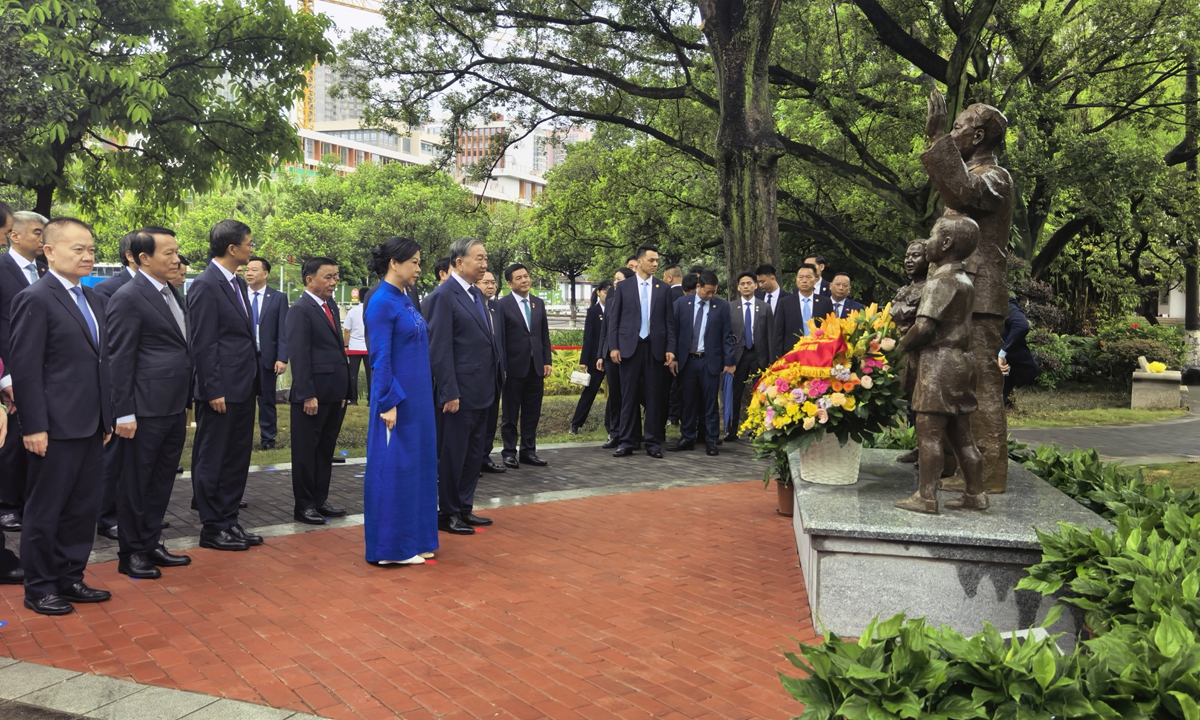
General Secretary of the Communist Party of Vietnam (CPV) Central Committee and Vietnamese President To Lam pays tribute to a statue of late President Ho Chi Minh on April 18, 2026, during his visit to Guangxi University. Photo: cnsphoto
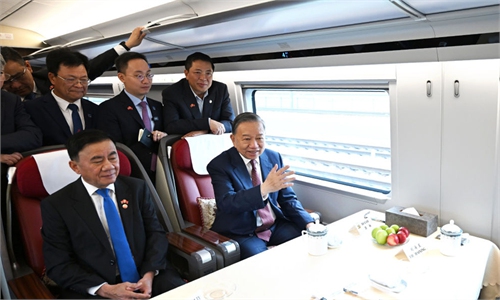
On Friday, General Secretary of the Communist Party of Vietnam (CPV) Central Committee and Vietnamese President To Lam boarded a special train in Nanning, South China's Guangxi Zhuang Autonomous Region, for his return home, concluding a four-day visit to China, showed a video released by Chinanews.com on Friday.The relatively uncommon way of departure also underscored the close ties between the two neighboring countries, as Vietnam can be reached directly by rail from Guangxi, which borders the Southeast Asian nation, Chinese observers said.
Singaporean newspaper Lianhe Zaobao noted in a Friday's report on his China visit, saying that the Vietnam's top leader took China's high-speed rail twice. It described that such long-distance high-speed rail travel by a visiting foreign leader across thousands of kilometers from northern to southern China as highly unusual, with the combined journey time of around 12 hours setting a record among visiting foreign leaders to China.
Upon his arrival in Beijing on Tuesday, Lam took a high-speed train to visit Xiong'an New Area. He departed Beijing by high-speed train for Guangxi on Thursday morning and arrived in the autonomous region after around 10 hours of travel.
On Friday, Lam visited the China-ASEAN Countries Artificial Intelligence Application Cooperation Center and tried AI real-time translation glasses in Guangxi on Friday, the Xinhua News Agency reported.
According to chinanews.com, Lam also visited Guangxi University, where he toured the former site of Nanning Yucai School, formerly known as the Central School Area of Vietnam, and paid tribute to a statue of late President Ho Chi Minh.
Nanning Yucai School, which was established in the 1950s, served as a key cradle for officials and talent for the early days of Vietnam's national construction. It has witnessed the development of relations between the two nations, standing as a precious asset worth highlighting in the history of China-Vietnam exchanges, Ge Hongliang, vice dean of the ASEAN College at Guangxi Minzu University, told the Global Times.
As young Vietnamese people continue to visit China for "Red Study Tours," the school has become a key platform for preserving the revolutionary legacy of China-Vietnam cooperation. Lam's visit also reflected the core focus of high-level China-Vietnam party exchanges on governance and political security, while highlighting efforts to pass the traditional friendship between the two parties to the next generation, said Ge.
Launched in May 2025, the Red Study Tours initiative seeks to facilitate exchanges between young people in China and Vietnam. From May 2025 to March 2026, a total of eight themed camps across 10 provincial-level regions in China were organized under the initiative, providing more than 1,000 Vietnamese youths with the opportunity to experience China firsthand, according to the Xinhua News Agency.
On Friday, China and Vietnam issued a joint statement on further deepening building of a China-Vietnam community with a shared future, stating that China and Vietnam, sharing common aspirations and development paths, view the bilateral relationship as a strategic, overarching and historic significance, representing a shared strategic choice of both countries, Xinhua reported.
They agreed to continue maintaining high-level exchanges through forms such as mutual visits, the dispatch of special envoys, hotlines, letters, annual meetings, and meetings on the sidelines of multilateral forums. These will help promptly exchange views on major issues in bilateral ties as well as regional and international situations, thereby steering the China-Vietnam Comprehensive Strategic Cooperative Partnership in the new era toward sound, stable development from a strategic and long-term vision.
In addition, the two sides also voiced readiness to enhance coordination and alignment in such key areas as new energy, production and supply chain, trade and investment, and science and technology innovation.
Both sides also emphasized the need to better manage and actively resolve disagreements at sea to safeguard peace and stability in the South China Sea. They also agreed to promote consultations on joint maritime development cooperation and the delimitation of the waters outside the mouth of the Beibu Gulf, and strive to make substantive progress at an early date.
The visit "was a great success, positively contributing to strengthening the traditional friendship and accelerating the building of the Vietnam-China community with a shared future that carries strategic significance, thus promoting peace, stability, development, and prosperity in the region and the world," VietnamPlus reported on Friday.
RELATED ARTICLES