Vietnam’s To Lam to visit China days after being elected head of state
First overseas visit after assuming presidency underscores emphasis on ties: Chinese experts
By Li Yawei and Published: Apr 10, 2026 12:29 AM

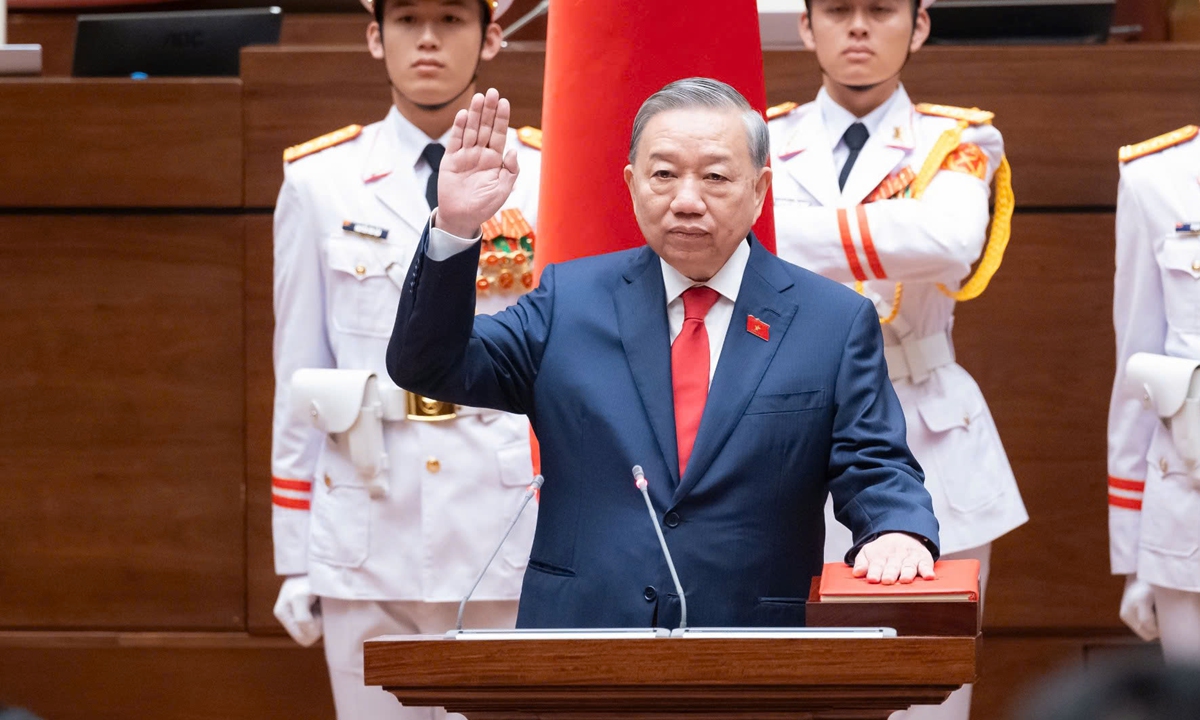
General Secretary of the Communist Party of Vietnam To Lam takes his oath as the country's President during a National Assembly session in Hanoi, Vietnam, on April 7, 2026. Photo: VCG
At the invitation of General Secretary of the Communist Party of China (CPC) Central Committee and Chinese President Xi Jinping, General Secretary of the Communist Party of Vietnam Central Committee and Vietnamese President To Lam will pay a state visit to China from April 14 to 17, the Xinhua News Agency reported on Thursday.
The announcement was made by Hu Zhaoming, spokesperson for the International Department of the CPC Central Committee.
Vietnamese local media outlet VietNamNet highlighted on Thursday that this marks the first overseas trip by To Lam in his capacity as head of state since being elected President at the first session of the 16th National Assembly, Vietnam's top legislature, on Tuesday.
Chinese observers noted that the official announcement of the visit, which comes shortly after To Lam assumed the office of president, underscores the strong emphasis both sides place on bilateral ties.
This visit not only consolidates the building of a China-Vietnam community with a shared future, but also facilitates cooperation and exchanges across various fields, advancing alignment between the two sides in their respective modernization drives, observers added.
Deeply valued
Nhan Dan Newspaper of Vietnam reported on Thursday that To Lam's wife and a high-level Vietnamese delegation will accompany him on the visit to China.
A Reuters report described To Lam's visit as taking place "as ties between the two nations continue to warm."
Gu Xiaosong, dean of the ASEAN Research Institute at Hainan Tropical Ocean University, told the Global Times on Thursday that the visit underscored the distinctive strategic standing between China and Vietnam as socialist neighbors - with China being regarded as the primary partner in ensuring a stable external environment and advancing Vietnam's own development.
Echoing Gu, Ding Duo, a deputy director of the Institute of Maritime Law and Policy at China's National Institute for South China Sea Studies, also said that amid the current global geopolitical tensions, this upcoming visit sends a signal that Vietnam's new leadership is unwilling to be swayed by external interference and remains resolutely committed to safeguarding the high-level bilateral relations.
Since the beginning of this year, the two countries have maintained close exchanges across various fields.
From January 29 to 30, Liu Haixing, special envoy of General Secretary of the CPC Central Committee Xi Jinping, visited Vietnam, Xinhua reported. Several days later, Chinese Foreign Minister Wang Yi met with Le Hoai Trung, special envoy of General Secretary of the CPV Central Committee To Lam, in Beijing on February 3, per Xinhua.
On March 16, the first ministerial meeting of the China-Vietnam "3+3" strategic dialogue on diplomacy, defense and public security was held in the Vietnamese capital of Hanoi on March 16. Chinese Foreign Minister Wang Yi, Minister of Public Security Wang Xiaohong and Minister of National Defense Dong Jun chaired the meeting, together with Vietnamese Foreign Minister Le Hoai Trung, Defense Minister Phan Van Giang and Minister of Public Security Luong Tam Quang.
Both sides agreed the successful conclusion of the event signifies that China-Vietnam strategic communication and coordination have established a new platform, advanced to a new stage, and been elevated to a new level, according to a release from Chinese Foreign Ministry on March 17.
Ding said To Lam's upcoming visit also clearly conveys the continuity of Vietnam's policy toward China, prioritizing ties with China in the country's diplomacy.
Analysts say a steady stream of exchanges over the past four months, capped by the upcoming visit, underscores both sides' resolve to deepen a China-Vietnam community with a shared future. They expect the high-level trip to unlock further tangible gains in bilateral cooperation.
Practical outcomes expected
Given the substantial similarities in the political systems of the two countries, the visit is expected not only to consolidate bilateral relations but also to enable Vietnam to draw on China's experience in economic development, energy, infrastructure construction and other sectors, Chinese observers noted.
This visit is expected to yield a series of practical outcomes, potentially cooperation in fields such as railways, energy, economy and trade, as well as Science and technology, they said.
Vietnam Deputy Minister of Industry and Trade Nguyen Sinh Nhat Tan noted that the ongoing conflict in the Middle East has significantly disrupted global oil and gas supply chains, with impacts surpassing previous oil shocks in scale and intensity, VNExpress news reported on April 4.
Ding said as a major country in terms of technology and resources, China could provide power grid interconnection, investment in clean energy projects, as well as technical support for LNG and renewable energy. This can help Vietnam ease supply pressures, stabilize regional supply chains, and prevent disruptions to global manufacturing caused by energy shortages, he added.
BBC reported that a test to To Lam will be whether he can meet the ambitious growth targets he has set his government, at a time when the global economic outlook is so unsettled.
Chinese Ambassador to Vietnam He Wei said that in 2025, the bilateral trade volume between China and Vietnam historically surpassed the $290 billion mark, with China continuing to be Vietnam's largest export market for agricultural and aquatic products, chinanews.com reported on February 12.
Vietnamese fruits and vegetables earned $5.5 billion in foreign exchange from exports to China, greatly contributing to local farmers' income growth and prosperity, He added.
In the first two months of 2026, China was Vietnam's largest trading partner, with bilateral trade turnover reaching $66.7 billion, an increase of 30.2 percent, according to information released on the official website of the Government of Vietnam on Thursday.
Vietnam's exports amounted to $17.4 billion, up 32.5 percent, while its imports reached $49.3 billion, up 29.4 percent, according to the government.
Vietnam's economic development is currently constrained by inadequate infrastructure, an area where China is well positioned to offer substantial support, Gu noted.
Vietnam and China have signed a technical cooperation agreement on planning two standard-gauge railways - Hanoi-Dong Dang and Hai Phong-Ha Long-Mong Cai - marking progress in bilateral railway connectivity, VietNamNet reported on March 25.
Ding said the alignment of railway systems via standard gauge can enhance cross-border logistics efficiency, and when coupled with cooperation on infrastructure such as 5G, it can drive the integration of digital economies, collectively transforming the "hard connectivity" between the two countries into a growth pole for shared development.
Chinese analysts said the two parties, CPC and CPV, are also expected to deepen exchanges on governance through party-to-party channels, sharing experience on reform and development, and anti-corruption efforts. At the same time, broader ties—in areas such as youth engagement, local cooperation, tourism, and cultural exchange—are set to expand, reinforcing the foundation of the bilateral relationship.
Against this backdrop, analysts said closer coordination between China and Vietnam as neighboring socialist countries could help inject greater certainty and stability into regional industrial and supply chains. Such cooperation is also expected to bolster opposition to unilateral pressure and lend momentum to multilateral approaches.
RELATED ARTICLES