14-year-old Chinese student makes progress handcrafting an aircraft engine after self-teaching calculus
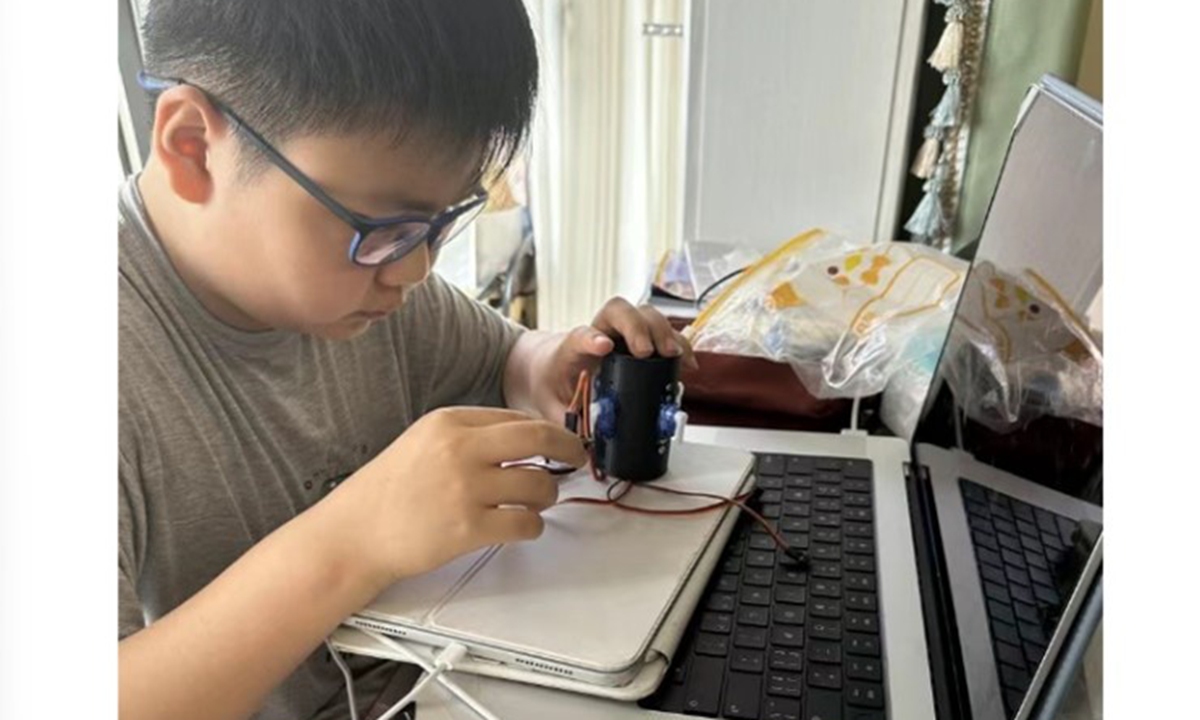
Che spends his spare time fabricating components by hand. Photo: Screenshot from media reports
Would you believe that the core of an aircraft's power—a turbojet engine—could be made by hand from scratch? And would you believe that this feat was accomplished by a 14-year-old middle school student who taught himself calculus?
The 14-year-old, Che Jingang, has harbored a dream of spaceflight since he was very young. On April 12, he said in a video that he had completed a second round of assembly of his turbojet engine and was about to conduct a new round of testing, chinanews.com reported.
During his kindergarten years, he was captivated by the magic that a flatly thrown paper ball would only trace a parabola and plummet to the ground, whereas a paper airplane, ingeniously folded, could elegantly hover, fly level, and glide, the report said.
Eager to figure out how to make airplanes fly farther, more steadily, and stay aloft longer, Che turned every corner of his home into a test flight ground, chinanews.com reported.
By the third grade, he was already teaching himself calculus, aerodynamics, printed circuit board circuitry, SolidWorks, and Computer-Aided Design (CAD), the report said.
Che once devoted three to four hours each day to reading popular science and science fiction books also intensified the impulse within him to "create something tangible."
He thus turned to Chinese social media platform Douyin for tutorials. "Tutorial videos are scarce on other platforms, but they are more detailed and intuitive on Douyin," said Che. Whenever a new idea struck him, he would search for tutorials on the platform, dissect real-world cases, summarize methods, and then experiment on his own, per chinanews.com.
Later, while scrolling through Douyin, Che came across a video of a "DIY creator" who had started as a water pump repairman and gone on to build 13 versions of a turbojet engine. In the video, the Mach diamonds that burst from the tiny turbojet at ignition immediately caught Che's attention. "At that moment, I thought, this was just too cool," he was quoted by chinanews.com as saying.
"Some people publish blueprints online, but if I just copied them directly, I felt it would be meaningless," Che said, adding that "I wouldn't learn anything, and it would be a waste of time."
He began designing entirely from scratch: drafting 2D engineering drawings in CAD, building 3D models in SolidWorks, calculating airflow, temperature, and pressure using simulation software, and refining his design based on the data—a process that took six months, chinanews.com reported.
During his research, Che received kindness from numerous strangers. Unfamiliar netizens who watched his videos messaged him to offer help in machining the parts he needed; many fellow enthusiasts shared advice in the comment section; and countless online viewers cheered him on.
The work is not yet fully completed, and Che is still in the process of continuous experimentation and revision, chinanews.com reported. Regarding the setbacks encountered along the way, Che said that he would not be discouraged. "Nothing can be successfully accomplished on the first try. Even if I didn't succeed, I learned something, and that gives me the motivation to build it a second time," Che added.
RELATED ARTICLES