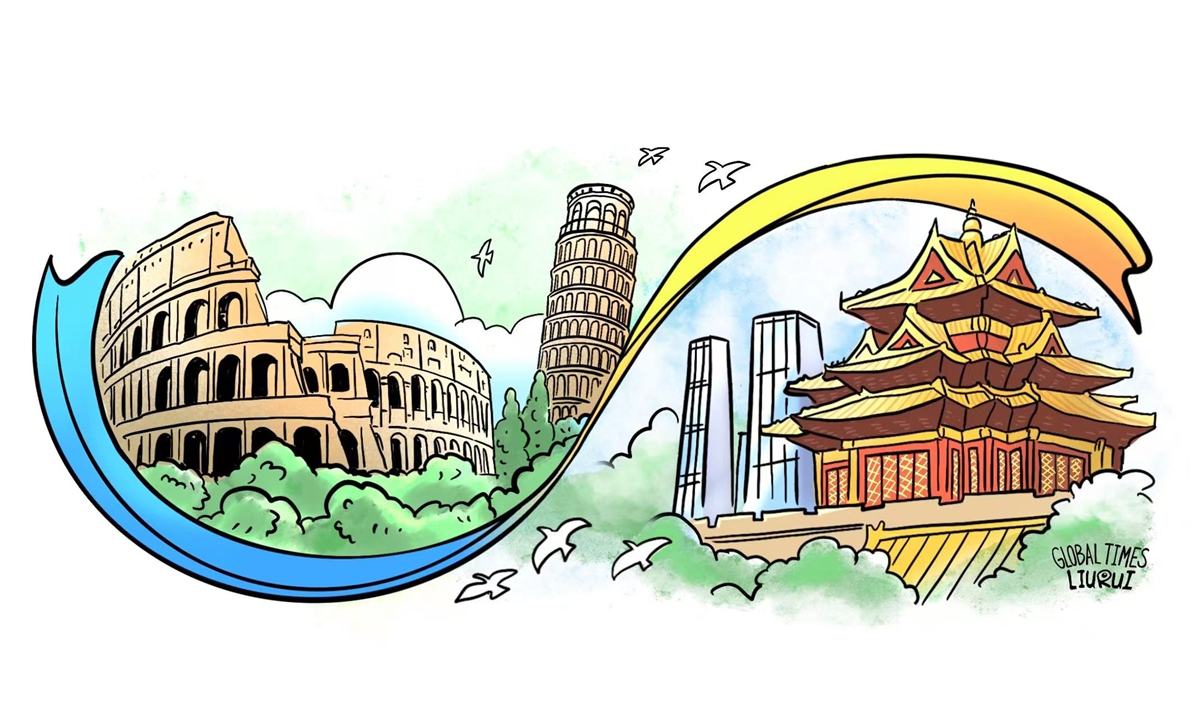
Illustration: Liu Rui/GT
Italian Deputy Prime Minister and Minister of Foreign Affairs and International Cooperation Antonio Tajani is visiting China this week, continuing the wave of foreign dignitaries arriving in Beijing for talks at this critical historical moment, a phenomenon that reflects a broader global tendency to look eastward amid turbulence.
Since the latest Middle East crisis started and US-Iran tensions escalated, and as the future of the Strait of Hormuz remains relatively uncertain despite reports of progress toward full reopening, several major European countries have taken positions that differ from Washington's.
Italy, though a longstanding US ally, has reportedly declined to provide support for American military actions. And Tajani's visit at this crucial juncture, with an agenda including bilateral cultural, trade cooperation and collaboration on international issues, reflects Italy's pragmatic recalibration of its China policy.
China is not only Italy's largest trading partner in Asia, but also its second-largest trading partner outside the EU. Bilateral trade approached 75 billion euros (about $81 billion) in 2025, up 11.2 percent year-on-year.
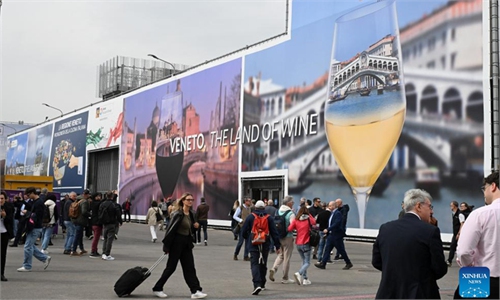
At the same time, Rome hopes to expand the presence of its competitive products, including agri-food goods, pharmaceuticals, high-end machinery, fashion and luxury items, in the Chinese market.
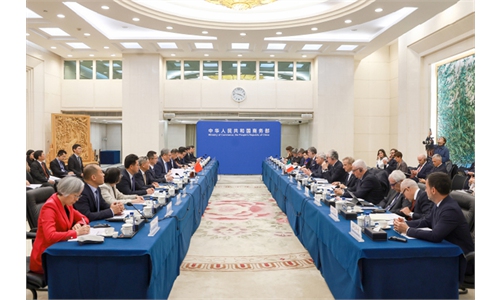
After meeting the Chinese Minister of Commerce, Wang Wentao, on Thursday, Tajani attended the 16th Session of the China-Italy Joint Commission for Economic and Trade Cooperation. In 2024, Italy and China signed the Italy-China 2024-2027 action plan that promised to experiment with new forms of cooperation. Encouraging new qualified Chinese investments in Italy and further improving access to the Chinese market for Italian companies were also part of the discussions.
In cultural terms, Italy has long excelled at projecting its national image through culture, art, design and lifestyle. Such activities not only enrich people-to-people exchanges, but also help create a more favorable atmosphere for the promotion of "Made in Italy" in the Chinese market. In this sense, cultural diplomacy is becoming an important stabilizer in China-Italy ties. Over 50 Chinese universities teach Italian, while Italian universities have more than 15,000 Chinese students, described by Tajani as "a strategic long-term investment" as "these young people act as a bridge between our societies and contribute to strengthening mutual understanding with lasting effects."
In addition, "given the complexity and volatility of the current international situation, Italy highly recognizes China's important influence in international affairs and multilateral platforms such as the United Nations," Tajani said during a meeting with Chinese Foreign Minister Wang Yi. In the meeting, Wang said that China stands ready to enhance communication and coordination with Italy in international and multilateral affairs, demonstrating the contemporary significance of the China-Italy comprehensive strategic partnership.
Under the current international circumstances, Italy-China dialogue is no longer confined to bilateral trade but increasingly linked to global security governance. For a country like Italy, which depends heavily on external energy supplies and international trade, any deterioration in the Gulf situation could affect not only oil prices, but also shipping security, production costs and supply chain stability. Rome is seeking closer communication with Beijing and hopes the latter can play a constructive role in easing tensions and promoting peace talks.
At a time when US policy in the Middle East remains uncertain and Europe is under mounting pressure from the spillover effects of regional instability, Italy's outreach to China reflects both practical interests and a desire to preserve diplomatic room for maneuver.
Finally, after withdrawing from the Belt and Road Initiative in 2024, Italy emphasized that it still wants to advance bilateral ties under the framework of the China-Italy comprehensive strategic partnership. Italy is trying to move its China policy away from a largely political framing toward a more pragmatic, institutional and project-based approach. Rome is seeking to rebuild a more balanced and workable framework for cooperation with China.
Overall, Tajani's visit to China, while not signaling a fundamental shift in Italy's China policy, reflects a realistic adjustment shaped by domestic economic pressures and external security risks. The essence of the visit is not about choosing sides, but about securing greater economic benefits and diplomatic flexibility for Italy.
Looking ahead, China-Italy relations are likely to be characterized by pragmatic cooperation pursued with caution, and Tajani's trip sends an important signal of that emerging trend.
The author is an associate professor at the School of International Studies and director of the Italian Communication Research Center at the Academy of International and Regional Communication Studies, Communication University of China. opinion@globaltimes.com.cn
RELATED ARTICLES