When a British gentleman hears the Chinese ‘Orchid Grass’ melody from a London street sweeper
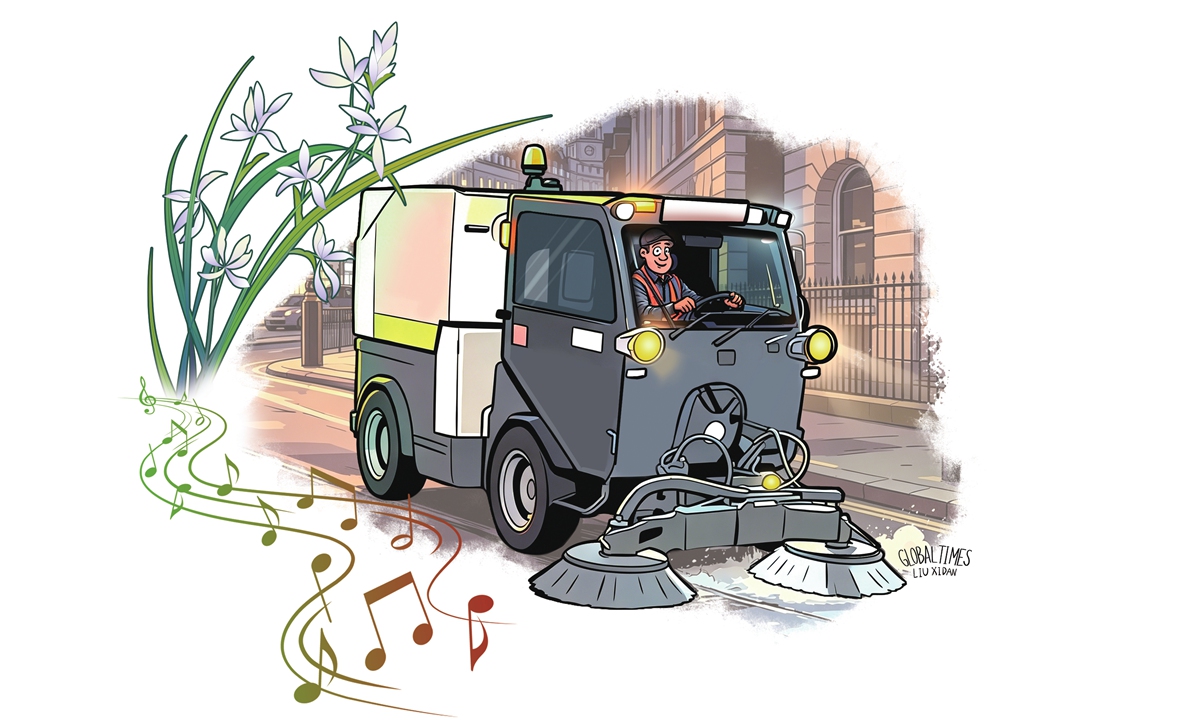
Illustration: Liu Xiangya/GT
A short film of a Chinese-made street sweeper in London has gone viral on China's social media - not for its engineering, but for its soundtrack.Picture the scene: an autonomous cleaning vehicle glides silently through the streets in the early hours, its rooftop sensors sweeping the tarmac without fanfare while a melody unmistakably Eastern in character drifts from its chassis.
The song is Orchid Grass - a beloved Chinese folk tune familiar to virtually every urban Chinese citizen as the acoustic calling card of the neighborhood sweeper.
In China, when you hear that jingle, you know the cleaning vehicle is coming. And you know, without a shadow of a doubt, that it is Made in China.
That moment, unremarkable in its origins yet quietly extraordinary in its implications, captures something essential about the nature of contemporary globalization - not the grand proclamations of trade summits or the abstractions of economic doctrine, but the unscripted, unplanned cultural encounters that take place at street level, in the margins of the night shift.
China has become a major exporter of new energy sanitation vehicles. The supply chain stretches like an invisible web, embedding the physical presence of Chinese manufacturing into the daily fabric of cities that may never have given it a second thought.
The manufacturers themselves harbor no particular ambitions as cultural ambassadors; they want their products to be safer, cheaper, and easier to maintain. London's municipal procurement officers, for their part, were focused on cost-effectiveness and mechanical reliability, not musicology.
And yet, when the electronic strains of Orchid Grass drift along the embankment, something unrehearsed is born - belonging neither to a pristine idea of China nor to any conventional notion of Britain, but to the collision of three forces: Chinese manufacture, global circulation, and local encounter.
There is a pleasing historical symmetry here. In the early years of China's reform and opening-up, ice cream vans modeled on their American counterparts rolled into Chinese cities, bringing not only frozen confections but also that iconic, faintly comical jingle. Chinese children chased those vans through summer streets, blissfully ignorant of the American folk traditions encoded in the tune, yet forming an indelible association between the sound and the taste of something sweet.
The roles have now been reversed. A Chinese-made sweeper, carrying its Eastern melody, has entered a Western city - and the English gentleman need not understand a single syllable of the lyrics to find, after a handful of chance encounters, that the tune has lodged itself in his mind as the sound of a clean street.
This symmetry is not merely charming, it is instructive. Cultural exchange has never operated as a simple pipeline of export and absorption. It is generated, almost incidentally, by the friction of functional necessity - and the hybrid scenes it produces are among the most honest expressions of how the world actually works.
One can imagine the conversation over a Sunday lunch. "You know," says one Londoner to another, "that Chinese sweeper near my place plays the most curious Eastern tune."
They will not discuss who wrote the original verses or the Republican-era intellectual traditions from which the song emerged. That doesn't matter. The melody has already become part of their city's texture. It's globalization's most candid, most grounded witness.
This, perhaps, is what genuine cultural exchange looks like in practice. Not the carefully curated exhibition, not the theoretical jousting of academic conferences, but a Chinese-designed machine and a London pedestrian briefly sharing the same pavement, brought into fleeting, recurring accord by a few electronic notes. The goodwill between nations grows, quietly and reliably, in precisely such ordinary moments - moments that pierce the information bubble and offer the world a Made in China that is rather more human, and rather more neighborly, than the one that tends to make the headlines.
RELATED ARTICLES