IN-DEPTH / IN-DEPTH
From imagined China to lived China: how firsthand encounters, everyday exchanges are reshaping outdated assumptions about China


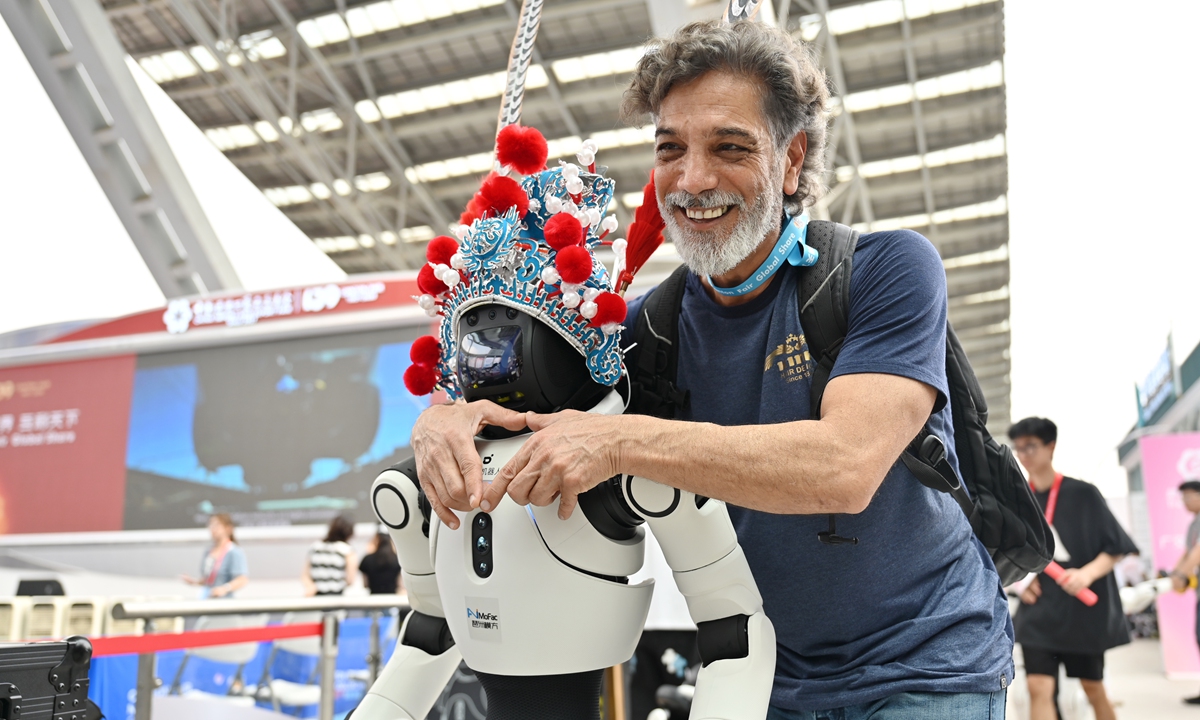
A foreign buyer poses for a photo with a humanoid robot performing a local Yingge folk dance at the 139th edition of the China Import and Export Fair (Canton Fair), which opened in Guangzhou, South China's Guangdong Province on April 15, 2026 (see commentary on Page 12). Photos: VCG
"China is not what I expected," "I was shocked by China…" Two years ago, as "China travel" took off on YouTube, such phrases became a familiar formula in videos by early foreign creators, capturing the gap between long-held second-hand impressions and fresh firsthand experiences.
A recent interview with Beijing Guoan's Portugal-born player Fábio Abreu, published by Tencent News, has sparked similar discussion online. Reflecting on his move to China in 2023, Abreu said he had hesitated before coming, influenced by what he heard in Europe.
"In Europe, China is classified as not a clean country… I come out of the airport, everything is clean. How is it possible?" he said. "You guys speak about a country that you don't know… and put an image on people's heads."
He also pointed to differences in daily life. "It feels safe here… I can go out, leave the car switch on with the keys inside the car, nobody's gonna touch," he said, contrasting it with his experience in Europe.
In interviews with the Global Times, foreigners living in or visiting China described similar experiences, noting that assumptions about cleanliness, safety and daily life often changed after direct exposure.
Meanwhile, firsthand snapshots of everyday life shared by Chinese users on platforms such as Xiaohongshu (RedNote) and TikTok are gaining popularity. These posts are also challenging outdated assumptions among foreign audiences and presenting a more multifaceted image of China.
Li Haidong, a professor at China Foreign Affairs University, told the Global Times that such changes in perception are rooted first in China's own development. As the country's overall strength has grown and social governance, infrastructure and public services have continued to improve, what foreign visitors encounter in daily life is increasingly concrete and visible.
As more people encounter China through direct everyday experience - whether in person or online - rather than through secondhand descriptions, such firsthand accounts are increasingly shaping how China is understood abroad.
From distant to real
Sonia still remembers the sense of ease she felt taking the subway in China with her three young children late at night.
For the Italian mother, who has visited China several times in recent years, that sense of ease stayed with her. Before coming, she had heard familiar descriptions of China as "crowded, polluted and not especially safe." What stayed with her instead was the ordinariness of feeling secure.
"The cities I visited were extremely well-organized, clean and safe," she told the Global Times.
She recalled moving through crowds without worrying about her belongings and began to realize that the China she was experiencing did not match the one she had heard about.
Beatrice, an 18-year-old Italian student who has visited China multiple times, described a similar shift from a younger generation's perspective.
What stood out to her in Shanghai was not only that the city felt clean and safe, but that it felt welcoming. "People there are extremely welcoming and friendly," she said. "I felt absolutely safe while walking down the streets and the city was meticulously clean." The place she had expected to feel distant instead felt livable, even familiar.
That widening of perception can also be seen in football player Abreu's remarks, as he commented on another dimension of change: everyday convenience.
In his Tencent News interview, he spoke not only about ride-hailing, but also about how quickly he had grown used to daily life in China. He recalled that when he went back to Europe for a holiday, he would sometimes forget he was no longer in Beijing - leaving his phone on the table in a café before suddenly remembering that he needed to be more careful.
For many visitors, the change in perception extends beyond cleanliness and safety to the ease of daily life.
Kym Bergmann, an Australian journalist, described another side of that reassessment. During a recent visit, he told the Global Times, what struck him was not only China's development, but the feel of city life, including how "quiet traffic in Beijing" seemed compared with cities in Australia.
In these accounts, the shift often begins with ordinary life: safety, cleanliness, convenience and the feel of the city.
What many foreigners appear to be revising, then, is not just an image of China in the abstract, but their sense of what life in China actually feels like. Those changing impressions of individual travelers are increasingly being shared, reposted and discussed online.
Seen and shared
For Sara, a TikToker who posts as "Sara in China," demonstrating changing perceptions about China does not begin with an argument. It begins with showing ordinary life.
During the interview with the Global Times, she said one of the most common assumptions she encounters is that China may look modern in major cities, but ordinary places - especially small towns and villages - could be poor, dirty or underdeveloped.
That is why she deliberately posts videos not only from Shanghai, but also from smaller cities and rural areas in her hometown, trying to present China "from an ordinary person's perspective."
One of her videos on TikTok, filmed in a small village in East China's Zhejiang Province, received about 250,000 views, with many comments expressing surprise that the countryside looked so clean, calm and livable.
What made the video resonate was precisely its ordinariness. There was no spectacular scenery or eye-catching architecture - just an average Chinese rural village.
Yet, after being exposed to Shanghai's dazzling skyline or Chongqing's dramatic landscape, overseas viewers were now entering places many of them had rarely associated with China at all: village roads, community streets, local markets and quiet daily routines, which, she said, were not very different from the kind of life many ordinary people around the world would want for themselves.

Foreign students pose for photos among blooming flower fields in Jurong, East China's Jiangsu Province on April 10, 2026.
That matters because it broadens the kind of China being seen.
The point is no longer simply that China looks different from what they expected. It is that life there can be observed at closer range, in more ordinary settings, and over a longer stretch of time.
CNN reported, citing experts, that the trend of "becoming Chinese" reflects deeper undercurrents, including dissatisfaction among many Americans with life at home - from political turmoil, gun violence, immigration crackdowns and persistent racial tensions. The report added that what many of them are now seeing is increasingly redefining their image of what is "cool."
Wu Han, a Chinese student majoring in education in Finland, told the Global Times that he has noticed another side of that process. Many videos that gain traction overseas, he said, are reposted from Chinese platforms, while AI translation is making them easier for foreign audiences to understand.
In his view, this has made it easier for people who have never been to China to see everyday life there more directly, rather than relying only on older assumptions or mediated accounts.
Zhu Wei, a professor at the Communication University of China, said the appeal of such content goes beyond curiosity. In his view, some aspects of Chinese daily life, precisely because they are ordinary, low-threshold and easy to adopt, have become relatable to overseas audiences in ways that broader cultural narratives often do not.
Shift in context
To understand why these changes in perception are becoming more visible, they need to be seen in a broader context shaped by geopolitical shifts, long-standing media narratives and China's own development, Li said.
Estelle, a Chinese woman based in Australia, said many people had long had little direct exposure to China. At the same time, media coverage and online searches related to the country often skewed negative.
That is also why, she said, visa-free policies and the growing volume of firsthand social-media content have become so important. They give people a chance to "go and see for themselves," rather than relying entirely on what they have been told.
That shift is also reflected in broader opinion data. A Global Times Institute survey released in December 2025, based on 51,689 valid respondents across 46 countries, found that 69 percent of foreign respondents held a favorable impression of China, up 6 percentage points from 2024. The survey also showed that three-quarters were willing to visit China in the future under the visa-free transit policy.
Bergmann pointed to a deeper historical background. He said the gap between reality and impressions of China in Australia is due in large part to "the conservative media." He noted that "the anti-China attitude of much of the media - supported by conservative politicians, commentators and analysts - goes back to at least 1949."
"Several generations have grown up against this background," he said.
Li told the Global Times that the shift is rooted first in China's own development. As changes in the country's daily life have become more visible and tangible, older impressions formed from afar are becoming harder to sustain.
Once people arrive, they are no longer dealing with an abstract image of China, but with something they can judge through daily experience: transport, neighborhoods, safety, convenience and the general functioning of society, Li said.
Li noted that expanding people-to-people exchanges, together with the rise of short-video platforms and social media, have accelerated that process by allowing more people to compare old narratives with what they can actually see and experience for themselves.
Bergmann said perceptions of China are improving, though not in a straightforward way. Older impressions of China may not disappear overnight, but they are increasingly being challenged by direct contact, visible reality and a growing body of firsthand accounts.
RELATED ARTICLES