81% of German auto firms say China's R&D boosts speed, market seen as key testing ground: Chamber report
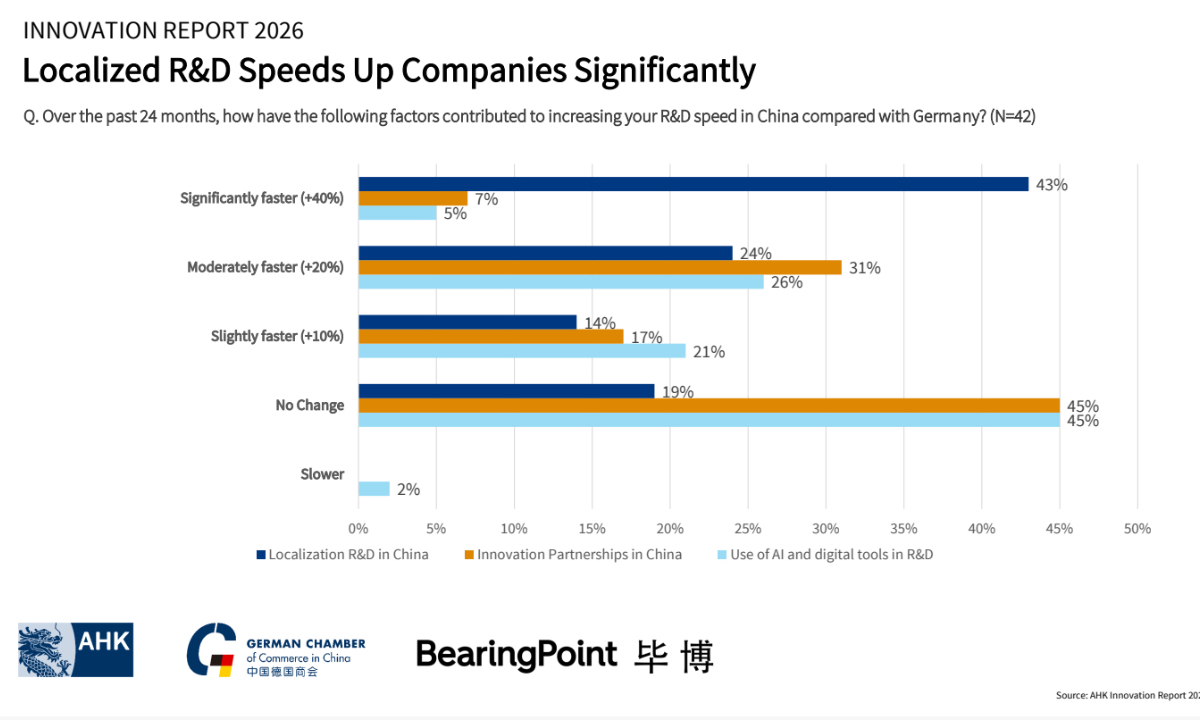
Screenshot of the Innovation Report 2026 Photo: Courtesy of German Chamber of Commerce in China
German automotive companies are rapidly expanding research and development (R&D) operations in China, with a growing share targeting both local and global markets, as intensifying competition and innovation pressure reshape corporate strategies, according to a latest innovation report by the German Chamber of Commerce in China.
Localized R&D in China has significantly accelerated development for German automakers. Eighty one percent of companies from the automotive industry say that localizing their R&D in China has accelerated their development speed over the past two years compared with Germany. Notable, 43 percent say their innovation speed increased substantially - by more than 40 percent, according to the report that the chamber sent to the Global Times on Tuesday.
Over the past two years, the proportion of German carmakers in China conducting R&D for both domestic and global markets has nearly tripled from 12 percent to 33 percent. Meanwhile, the overall share of German automotive firms with R&D and innovation activities in China rose to 73 percent, up 4 percentage points, the report showed.
Jan Roennfeld, executive director and board member of the German Chamber of Commerce in China - South and Southwest China, said the Chinese market is increasingly seen as a "testing ground" for innovation.
"As competitive pressure and the need to innovate intensify, the Chinese market is becoming an important testing ground. Innovations that succeed in China are often well positioned for global success," he noted.
To succeed and grow in China and globally, German companies must keep pace with their Chinese competitors, Roennfeld said, adding that localized R&D has become "a central pillar" of strategy for German automotive firms. He noted that companies are making long-term strategic adjustments in response to an increasingly challenging market environment.
Cost advantages are another key driver. According to the report, 79 percent of companies said localized R&D in China has reduced their R&D costs compared with Germany, while 70 percent credited innovation partnerships in China for further cost savings.
"In a market with intense price pressure, every cost reduction directly strengthens competitiveness," Roennfeld said.
The findings underscore how China's innovation ecosystem — characterized by strong supply chains, rapid iteration cycles and a large application market — is reshaping the global strategies of foreign firms, particularly in the automotive sector, where electrification and intelligent transformation are accelerating.
The Innovation Report, jointly produced by the German Chamber and consulting firm BearingPoint, surveyed 257 member companies between March 16 and April 10, including 42 from the automotive sector. First launched in 2022, the report aims to provide insights into China's evolving innovation landscape and the opportunities and challenges facing German businesses operating in the country.
The deepening R&D linkages reflect a broader shift toward two-way industrial integration. German automakers such as Volkswagen, BMW and Mercedes-Benz are strengthening partnerships in China in software and intelligent technologies, while Chinese firms are expanding their R&D footprint in Germany to build up engineering capabilities, according to the Xinhua News Agency.
This evolving pattern highlights the complementary positioning of the two sides across the automotive innovation chain. Data from the German Economic Institute showed that German investment in China rose significantly in 2025, with new investment reaching around 7 billion euros, well above the roughly 4.5 billion euros recorded annually in the previous two years. The data provides further evidence of growing two-way engagement between Chinese and German businesses.
Meanwhile, a 2026 global passenger car market outlook released by Germany's Center Automotive Research Institute in Bochum noted that the future of the automotive industry lies in cooperation with China, Xinhua reported.
"As competitive pressure and the need to innovate intensify, the Chinese market is becoming an important testing ground. Innovations that succeed in China are often well positioned for global success," he noted.
To succeed and grow in China and globally, German companies must keep pace with their Chinese competitors, Roennfeld said, adding that localized R&D has become "a central pillar" of strategy for German automotive firms. He noted that companies are making long-term strategic adjustments in response to an increasingly challenging market environment.
Cost advantages are another key driver. According to the report, 79 percent of companies said localized R&D in China has reduced their R&D costs compared with Germany, while 70 percent credited innovation partnerships in China for further cost savings.
"In a market with intense price pressure, every cost reduction directly strengthens competitiveness," Roennfeld said.
The findings underscore how China's innovation ecosystem — characterized by strong supply chains, rapid iteration cycles and a large application market — is reshaping the global strategies of foreign firms, particularly in the automotive sector, where electrification and intelligent transformation are accelerating.
The Innovation Report, jointly produced by the German Chamber and consulting firm BearingPoint, surveyed 257 member companies between March 16 and April 10, including 42 from the automotive sector. First launched in 2022, the report aims to provide insights into China's evolving innovation landscape and the opportunities and challenges facing German businesses operating in the country.
The deepening R&D linkages reflect a broader shift toward two-way industrial integration. German automakers such as Volkswagen, BMW and Mercedes-Benz are strengthening partnerships in China in software and intelligent technologies, while Chinese firms are expanding their R&D footprint in Germany to build up engineering capabilities, according to the Xinhua News Agency.
This evolving pattern highlights the complementary positioning of the two sides across the automotive innovation chain. Data from the German Economic Institute showed that German investment in China rose significantly in 2025, with new investment reaching around 7 billion euros, well above the roughly 4.5 billion euros recorded annually in the previous two years. The data provides further evidence of growing two-way engagement between Chinese and German businesses.
Meanwhile, a 2026 global passenger car market outlook released by Germany's Center Automotive Research Institute in Bochum noted that the future of the automotive industry lies in cooperation with China, Xinhua reported.
RELATED ARTICLES