Czech PM rejects govt plane for Senate chief's trip to Taiwan region; move reflects internal divergence of Czech Republic over Taiwan question: Chinese expert
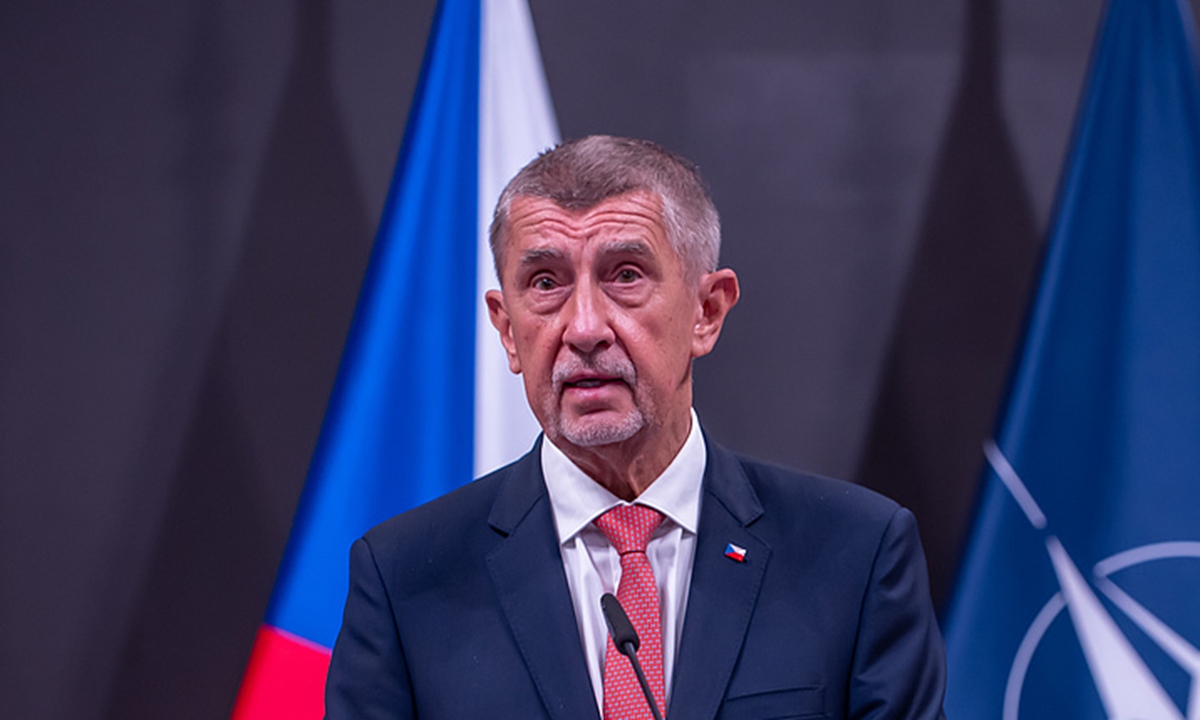
Czech Prime Minister Andrej Babis speaks to the media during a press conference on April 16, 2026. Photo: VCG
The Czech government will not make a government plane available for the Senate chief's planned trip to Taiwan region and wants a more pragmatic foreign policy that does not damage business ties with China, Prime Minister Andrej Babis said, Reuters reported on Monday. A Chinese expert noted that this reflects the existing two divergent stances in the Czech Republic regarding its policy on Taiwan question.
Babis said on social media that Senate chief Milos Vystrcil, a member of the Civic Democrat party that led the previous government, would lead a business delegation to Taiwan in May but would have to travel by commercial airline, the report said.
The prime minister also criticized past trips by Vystrcil and the previous lower house speaker to Taiwan region that he said had "destroyed business," per the report.
Czech media outlet Expats.cz quoted Czech media as saying that the decision reflects the cabinet's current foreign policy position toward Beijing, and the ongoing divide in Czech politics over how strongly to support Taiwan island.
According to Reuters, Babis' ANO party took power in a coalition government in December and has pulled back on some policy goals of the previous centre-right cabinet.
Jiang Feng, a researcher at Shanghai International Studies University and president of the Shanghai Regional Studies Association, told the Global Times on Tuesday that there exist two divergent stances in the Czech Republic regarding its policy on Taiwan question. One side holds long-standing leanings toward Taiwan island and has continuously pushed for closer and upgraded exchanges with China's Taiwan region. The other seeks to maintain sound and stable ties with the Chinese mainland, concerned that overly close interactions with the island would harm its relations with the mainland.
Jiang said that the two different parties leading the prime minister's office and the Senate are using the Taiwan question as a tool for partisan struggle, while Babis and the ANO party have adopted a more pragmatic approach toward China, and the Civic Democratic Party emphasizes strengthening relations with Taiwan region. He pointed out that such divergent stances may be a dual-track policy on the Taiwan question, reflecting some Czech politicians' attempt to have its cake and eat it too.
The expert noted that exchanges with China's Taiwan region involving high-level national officials or official institutional participation go far beyond ordinary economic and trade cooperation. Such moves amount to a substantive upgrade of interactions with Taiwan region, which also sends a signal of support for separatist "Taiwan independence" forces.
"Actions of this kind send wrong signals that embolden separatist tendencies, run directly against China's core and vital national interests," Jiang told the Global Times.
According to POLITICO, a visit by the Czech senate speaker to Taiwan in 2020 was a "boyish provocation," then country's President Miloš Zeman said. Babis also criticized at the time that Vystrcil for violating the one-China principle and mixing politics with business, per Xinhua.
The Chinese Foreign Ministry said at the time that China appreciates President Zeman's consistent commitment to advancing China-Czech friendship and cooperation, as well as his adherence to a correct position on major and sensitive China-related issues. The sound development of China-Czech relations serves the shared interests of both countries and their peoples. China hopes to work with the Czech side to remove disruptive factors on the basis of mutual respect and equality, and push bilateral relations for steady progress.
On March 6, Feng Biao, Chinese Ambassador to the Czech Republic, published a signed article in Czech media including Naše Pravda, Poslanecké listy and Iportal 24, elaborating on the historical context and legal facts proving Taiwan is an inalienable part of China, reaffirms the unshakable one-China principle, and refutes the fallacies and acts of individual politicians who distort and challenge UN General Assembly Resolution 2758, according to the Chinese embassy in the Czech Republic.
Any attempt to challenge Resolution 2758 is an affront to China's sovereignty and territorial integrity, the authority of the United Nations, and the international order established after World War II. Such moves are utterly absurd and dangerous, the Chinese Ambassador wrote.
RELATED ARTICLES