Illustration: Xia Qing/GT
Editor's Note:
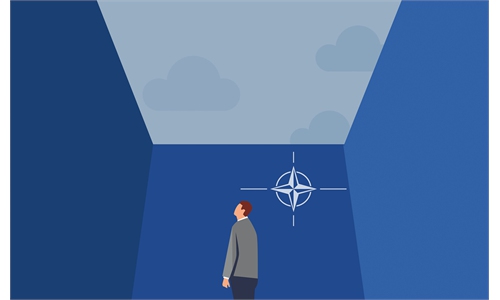
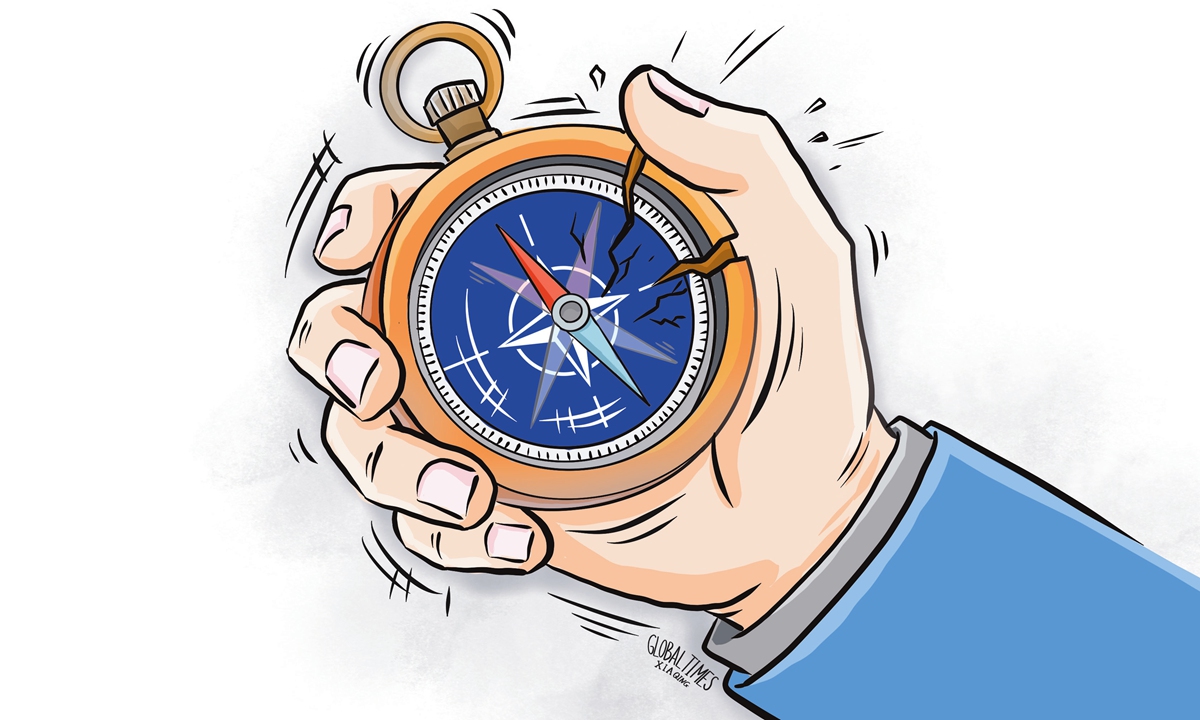
From the war in Ukraine to the US-Israel-Iran conflict, from trade wars to the Greenland issue, NATO's internal cohesion is coming under increasing scrutiny and doubt from within the alliance itself. Is the transatlantic alliance now at a critical turning point? Is NATO's "Asia-Pacificization" a cure for its survival? The Global Times invites three scholars to share their analysis on these questions.
Einar Tangen, an American scholar and a senior fellow of the Center for International Governance Innovation, a Canadian think tank
NATO and the EU are approaching an inflection point, not only because of the Ukraine war, but also because of the internal contradictions the Iran war has finally exposed. It is supposed to be a partnership of equals, yet it functions largely as an instrument of US policy. The war in Iran has forced Europeans to confront what many preferred to ignore. Washington expects loyalty, but doesn't return it, and [Washington] preaches values but doesn't practice them.
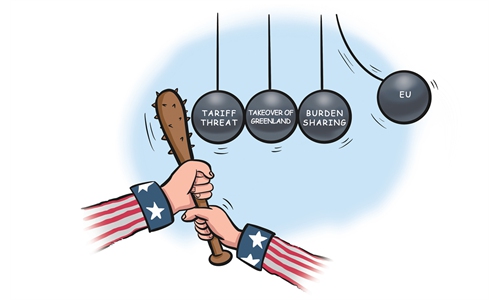
The contradiction was visible before Iran. When the White House openly threatened to take Greenland, NATO Secretary General Mark Rutte's response was "daddy diplomacy." While European capitals grumbled, NATO, as an institution, did nothing.
The turning point came only when Washington demanded NATO and the EU support the US by securing the Strait of Hormuz. Now, it was Europe's economic ox that was being gored. Several European countries have explicitly refused to participate in a war they were not advised of, that makes no sense and will push their countries into an economic recession, if not a depression.
This time the costs have landed directly on Europe. Before the Iran war shock, the IMF expected the eurozone to grow around 1.4 percent in 2026. It has now been downgraded to 1.1 percent, with inflation rising as energy prices surge. The eurozone remains highly vulnerable because of its dependence on imported energy and stable maritime trade routes - an economic energy shock following on the impact of the Ukraine war.
NATO now faces two possible futures. Either Europe builds its own defense regime inside or alongside NATO - with or without the US - focused on regional security, industrial policy and diplomatic independence. Or NATO and the EU remain subordinate to Washington, meaning higher military spending on US bases, weapons, proxy wars, all to support American primacy, while abandoning European necessities.
The uncomfortable truth is that NATO outlived the Cold War and never fully redefined its purpose. Instead of becoming a cooperative security framework after the Soviet collapse, it expanded, militarized and continuously sought new threats to justify itself.
The Iran crisis may be remembered as the moment NATO and Europe finally realized that their dependence on a lopsided alliance is not workable.
If NATO and Europe continue to be subject to a hierarchy dominated by US goals, rather than a partnership, it will gradually fragment. Not with a bang but with a whimper.
Raffaele Marchetti, director of the Center for International and Strategic Studies at Luiss University, Italy
The crisis in the Persian Gulf is putting the NATO alliance under stress. While the US invited the European countries to join the hostilities, all European allies refused to take part in the war.
The Europeans made clear: First, they were not previously consulted. Second, NATO activation can only be legitimate under Article 5 [of North Atlantic Treaty], which requires a defensive war. However, the US-Israel attack is an offensive war.
As a response, Washington continued to demand the participation of European allies, and later on started to harshly criticize the old continent, promising retaliation for the future.
This tension with Europeans adds up to the previous ruptures on Greenland, on the allegedly decadent European polity and the defense spending in the continent.
We are still far from a breaking up of NATO, but for sure all this repeated stress is provoking a great anxiety with NATO and causing some countries to consider countermeasures. France, for instance, decided to stop using US software in its public administration. Most likely Europeans will decide for some sort of engagement, perhaps a post-conflict de-mining in the Strait of Hormuz, for their own self-interest, but also in the interest of sending a reassuring message to the US.
This will not reunite the two sides of the Atlantic, but it will buy time for the Europeans to set up a plan for their strategic autonomy.
Lü Chao, dean of the Institute of American and East Asian Studies at Liaoning University
NATO is a product of the Cold War. With the dissolution of the Warsaw Pact and the disintergration of the Soviet Union in the early 1990s, which marked the end of the Cold War structure, NATO had already lost its purpose. NATO's foundation lies in the military alliance between the US and European countries.
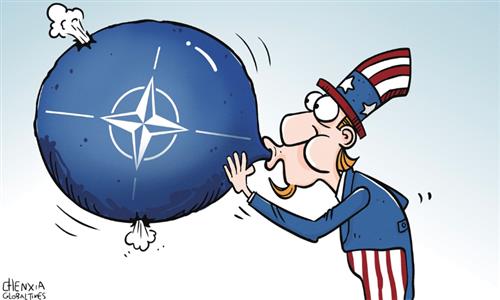
The recent US-Israeli military actions against Iran have intensified the rift between the US and NATO to a level unseen since the Cold War, which prompted the alliance to push for "Asia-Pacificization," seeking to align with Washington's new "Indo-Pacific Strategy" in an attempt to ease transatlantic frictions and prolong its own relevance. But, in reality, it is unlikely to work.
First, NATO is by design a defensive military alliance of countries from Europe and North America. Reducing NATO into a tool for US global dominance runs counter to European interests, undermines the postwar international order centered on the UN, and violates universally recognized moral and legal principles.
Second, this move will not alter Washington's longstanding objective of leveraging NATO to maintain control over Europe; rather, it is likely to deepen US dominance over NATO's military command structure, further entrenching the alliance as an instrument of American hegemony.
Furthermore, NATO's attempt to "shift tensions eastward" by exporting instability to the Asia-Pacific in exchange for relative calm in Europe is also unlikely to succeed.
The Asia-Pacific is a vital engine of global economic growth and is closely intertwined with European economies, and thus instability in the region would disrupt supply chains for industrial raw materials and undermine key markets. Relying on Japan and South Korea as strategic footholds is far from assured.
Most countries in Asia-Pacific prioritize stability and development, and such a move would likely heighten their vigilance and could even provoke countermeasures. NATO's Asia-Pacific turn will do nothing to reduce US unilateral influence over Europe. In fact, it may give Washington further leverage to pressure its allies to shoulder the costs of potential conflicts in Asia-Pacific.
Last but not least, NATO's Asia-Pacific push to embolden Japan and uphold the status quo is akin to making a pact with a tiger for its skin. For European countries that once suffered under fascist aggression, repeating the mistakes of history would be unwise amid Japan's growing calls to revise its pacifist constitution and expand its military.
In conclusion, Asia-Pacificization is not a cure for NATO's decline, and the alliance should be dissolved. Even if it refuses to disband, it should confine itself to European affairs and has no justification for meddling in the Asia-Pacific.
RELATED ARTICLES