IN-DEPTH / IN-DEPTH
CPC takes important measures in grass-roots governance and providing services to the people: Middle East think tank delegate
From Shikumen to skyscraper
By in Shanghai Published: Apr 21, 2026 10:48 PM

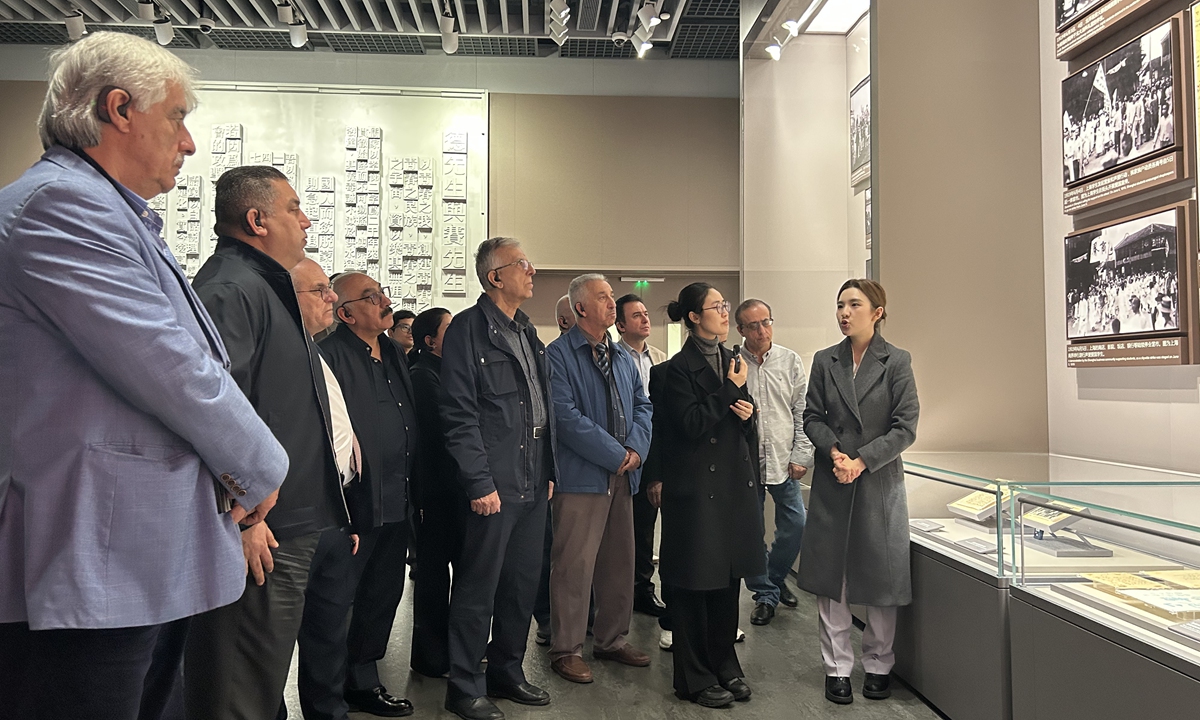
The delegation from think tank Global Civilization Initiative Research Center visits the Memorial Hall of the First National Congress of the CPC in Shanghai on April 12, 2026. Photo: Huang Lanlan/GT
Editor's Note:Chinese President Xi Jinping has pointed out, "to understand China today, one must learn to understand the Communist Party of China (CPC)." With the rapid development of China's economy and society, and the steady advancement of the Chinese path to modernization, the notable achievements of the CPC have drawn extensive international attention and scholarly interest. Against this backdrop, the Global Times has launched the "CPC in Global Eyes" column, focusing on the feelings, perspectives and insights of international friends from various fields regarding the CPC's historical path and achievements.
They include those who have toured China, who deeply study the CPC in academic fields, who work, live, study, seek employment or do business in various fields in China, and who, though having not visited China in person, pay close attention to the CPC's policies and trends. Through their vivid personal experiences, we aim to present a multifaceted overseas view of the CPC.
In the eleventh installment of this series, a Global Times reporter accompanied a group of members from political parties and think tanks from the Middle East on their recent trip to Shanghai. There, they visited the birthplace of the CPC, explored the Party's founding mission, attended an engaging lecture on the CPC, and experienced firsthand how China's development and grass-roots social governance, under the Party's leadership, have delivered tangible benefits to the people.
Shanghai breathes with the vitality of spring in April. A minibus pulls to a stop. The door opens, and Kawa Mahmoud steps out, lifting his gaze to a typical Shikumen-style building - a traditional architectural style of Shanghai - by the roadside. This is the Memorial Hall of the First National Congress of the Communist Party of China (CPC), the birthplace of the Party.
In mid-April, a delegation from think tank Global Civilization Initiative Research Center - an organization made up of members of some political parties and think tanks from several Middle Eastern countries - visited Shanghai. Their first stop during the three-day trip was this historic landmark steeped in revolutionary and development memory of the CPC.
As head of both the delegation and the research center, Mahmoud, who is also former secretary of the Central Committee of the Kurdistan Communist Party of Iraq, had been yearning to visit Shanghai. It is a city whose story, he believed, was inseparable from the Party's own.
"Shanghai reflects the great achievements the CPC has made on its long march, especially as a model in the field of high-quality development," Mahmoud told the Global Times through an Arabic interpreter during the trip.
A major turning point in history
In one of the memorial's screening rooms, the lights dimmed. On the screen, a story began to unfold.
In July 1921, a group of young people, with an average age of just 28, quietly gathered in a Shikumen-style house to prepare for the First National Congress of the CPC. From the founding of the Party, to leading the Chinese people in overthrowing oppression and fighting for national independence, and then to largely contributing in the country's development and opening up, the relentless efforts and sacrifices of generation after generation of the CPC members moved everyone in the audience.
When the film ended and the lights came back on, the room erupted in warm applause. The Global Times reporter saw the members of the delegation, touched by the history they had just witnessed, rise to applaud spontaneously in tribute.
The memorial's exhibitions offered a detailed account of the CPC's founding and development. The delegation members examined the displays, listened closely to the docents' explanations, and frequently raised questions.
"This place is more than just an historical building; it is a major turning point in history," delegation member Nabaz Abdullah told the Global Times in English at the memorial. "In 1921, a political force was born, and [it went on to] change the world. The history [of the CPC] shows that, real success comes from staying loyal to your initial goals, and never losing touch with the people," said Abdullah, executive director of the research center, and director of foreign relations and consular affairs of Kurdistan Communist Party of Iraq.
From a small group a century ago, to the world's largest governing party with more than 100 million members today, the CPC's growth has drawn global attention and filled its members with pride. At an oath-taking area in the memorial, Mahmoud happened upon a group of young Party members facing the Party flag and renewing their vows of membership. "I could feel their pride," he said.
After the visit, Mahmoud left a heartfelt message in a guestbook at the memorial. "This memorial tells the CPC's history of struggle. We learned about the CPC members' relentless efforts in the past to secure a better life for the people, and their continued efforts today to advance steadily toward Chinese modernization," he wrote in Arabic. "Long live the Communist Party of China! Long live the Chinese people!"
Putting people first
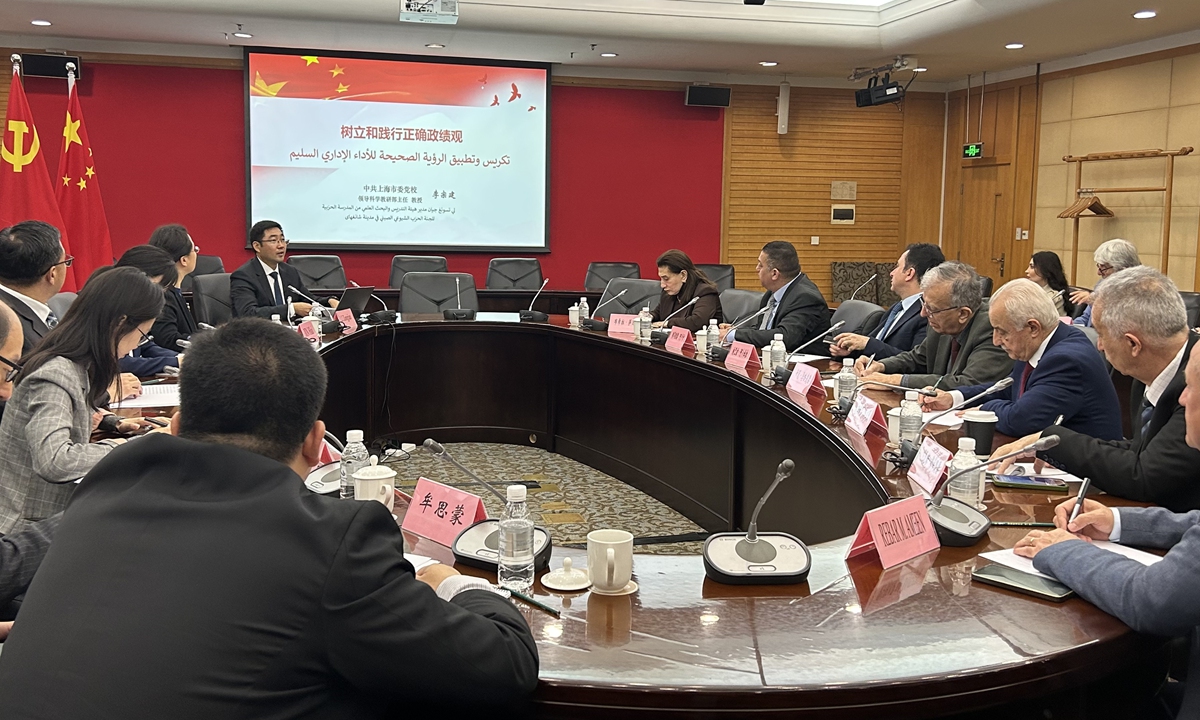
The delegation from think tank Global Civilization Initiative Research Center attends a lecture at the Party School of Shanghai Municipal Committee of CPC on April 14, 2026. Photo: Huang Lanlan/GT
The memorial offered the delegation a glimpse into the CPC's original aspiration. And the Party School of Shanghai Municipal Committee of CPC, which the delegation visited on its third day, showed how that aspiration continues to shape the Party's governance today.The school welcomed the delegation into a bright classroom, where a professor gave a detailed lecture on why and how the Party establishes and practices a correct view on governance performance. When the professor explained that, bringing benefit to the people is the fundamental principle of governance, the members of the delegation nodded in agreement as they took notes.
The lecture gave Abdullah a more systematic understanding of the CPC's people-centered development philosophy. "Putting the people first means placing high-quality development and common prosperity above the mere pursuit of GDP growth," he told the Global Times.
He added that, unlike systems driven by short-term election cycles, "the CPC evaluation requires a 'correct view on governance performance,' holding the Party members and officials accountable for long-term social well-being and environmental protection rather than 'image projects' or special interests."
Abdullah took part in the Kurdish translation of the first three volumes of Xi Jinping: The Governance of China. He was particularly impressed by the book series' emphasis on the principle of "putting people first."
"Putting people first, means that people are at the top and the beneficiaries in any plan, and everything [the CPC does] is for the people to be happy in many [aspects]," Abdullah said.
Mahmoud, who also worked on the translation of the book series, offered a broader assessment. "This is a set of books with a comprehensive and integrated body of theoretical thought," he told the Global Times. "It's hard to say that any single aspect is the most impressive - I would say that every part of the book series left a deep impression on me."
In Mahmoud's view, what changes in the book series are the reform and innovation measures that keep pace with the times, while what remains unchanged is the commitment to development for the people and the conviction of achieving the great cause of national rejuvenation, the Xinhua News Agency quoted him as saying in a December 2025 article.
Vivid expressions at the grassroots
The Party school lecture on the CPC's development philosophy of "putting people first" has vivid expressions in practice. After the lecture, the delegation visited a CPC grass-roots service station in Shanghai that afternoon, where members saw firsthand how this principle reaches into the city's capillaries - placing people's needs at the center of grass-roots governance and public services.
At Lujiazui, Shanghai's and even China's most iconic financial hub, the Financial City CPC construction service center is located on the 22nd floor of the Shanghai Tower, the country's tallest building at 632 meters.
That afternoon, the delegation entered the service center and, guided by staff, toured its community canteen, clinic and medicine dispensing room, activity room, public security service point, and a room for Party-building activities, among other facilities. In the community canteen, when staff said that anyone could "eat their fill for 20 yuan ($4.4), and eat very well for 30 yuan," the visitors responded with approving smiles.
Standing in front of an electronic display screen introducing the service center's work, a staff member shared a telling example. The Lujiazui Financial City area is home to many young working parents, and every summer the same question arises: "Where do the children go?" In response, local Party branches took the lead in pooling ideas from local residents and workers, and then launched a public-interest summer childcare program. The program provides childcare and features a rich array of activities for children.
"Parents drop their children off in the morning, then go to work, and pick them up again after work," the staff member said. Hearing that, several delegation members gave an unprompted thumbs-up. Behind this heartwarming case lies the nuanced, people-centered touch of a political party branch operating at the grass-roots level of governance.
At the end of the visit, the delegation ascended to an observation deck on the 22nd floor of Shanghai Tower. Through the vast floor-to-ceiling windows, Shanghai's iconic Huangpu River wound below them, while across the water the Bund's famed cluster of historic buildings stood in striking contrast to the forest of skyscrapers at their feet.
Standing by the window, Mahmoud said with emotion that, in this very heart of the financial center where every inch of land is precious, it is remarkable to find a grass-roots service center of the CPC that allows ordinary workers and lower-income employees to access a wide range of services, including medical care, dining, childcare and cultural activities.
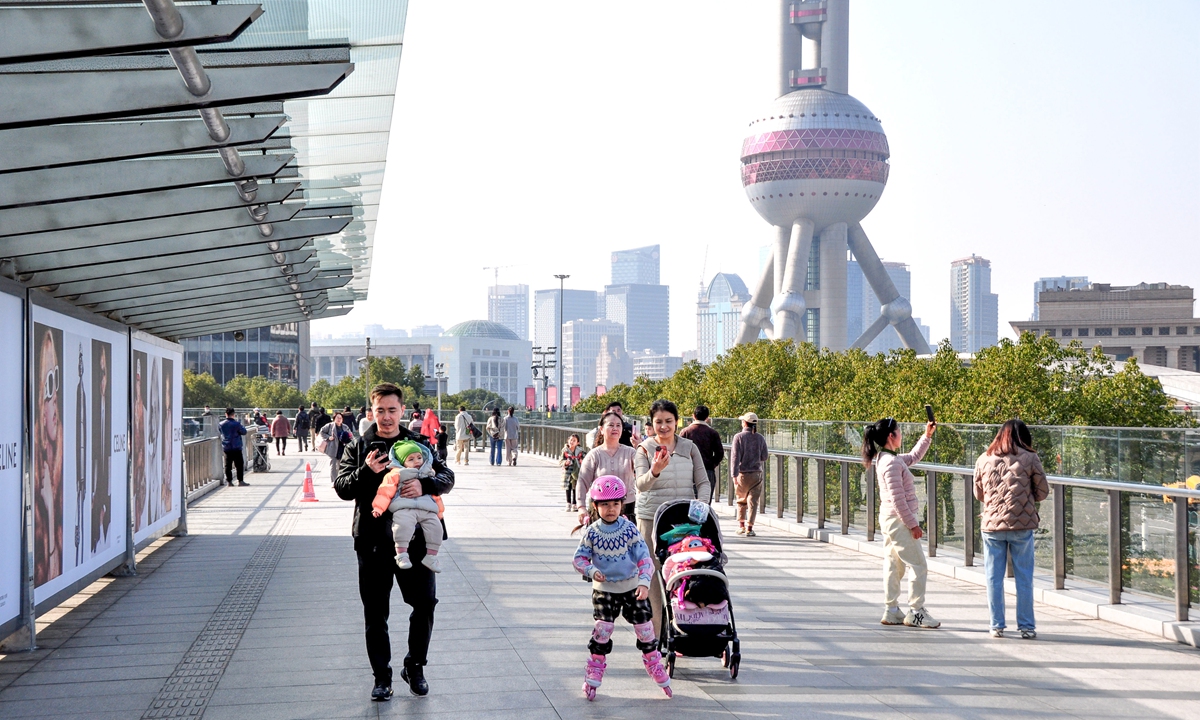
A view of the Lujiazui Financial City area in Shanghai Photo: VCG
"The CPC has taken a series of important measures in grass-roots governance and providing services to the people," at the observation deck, Mahmoud told the Global Times. "The CPC truly serves the people, listens to their needs and addresses their difficulties."Nizam Mohammad, a member of the board of directors of Global Civilization Initiative Research Center, also spoke highly of this grass-roots service center of the CPC. "I think this is a very good achievement for the history and for the practices of China. I think this is a model for others to follow up with," he told the Global Times in English.
At this observation deck with sweeping views over the city, there is also a display of the Party admission oath. Sunlight streamed through the glass and fell upon the large golden CPC emblem, making it shine brilliantly. Many members of the delegation posed for photos with the emblem, taking it as a memento of the final stop on their Shanghai visit.
"We've seen... the economic, social, cultural aspects [of the city], and how the CPC deals with her people. [It] brings very good life [to] the citizens," Mohammad, who was visiting Shanghai for the first time, told the Global Times. "That gives me reason to say that China is moving in the right way."
RELATED ARTICLES