iQIYI issues clarifications on controversial ‘AI celebrity database’ after multiple actors deny involvement amid viral discussion on how far AI should go
By Sun Langchen and Published: Apr 21, 2026 11:50 PM
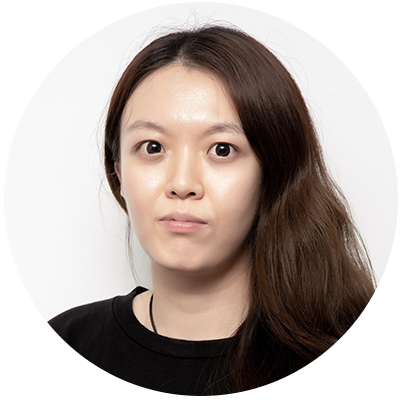
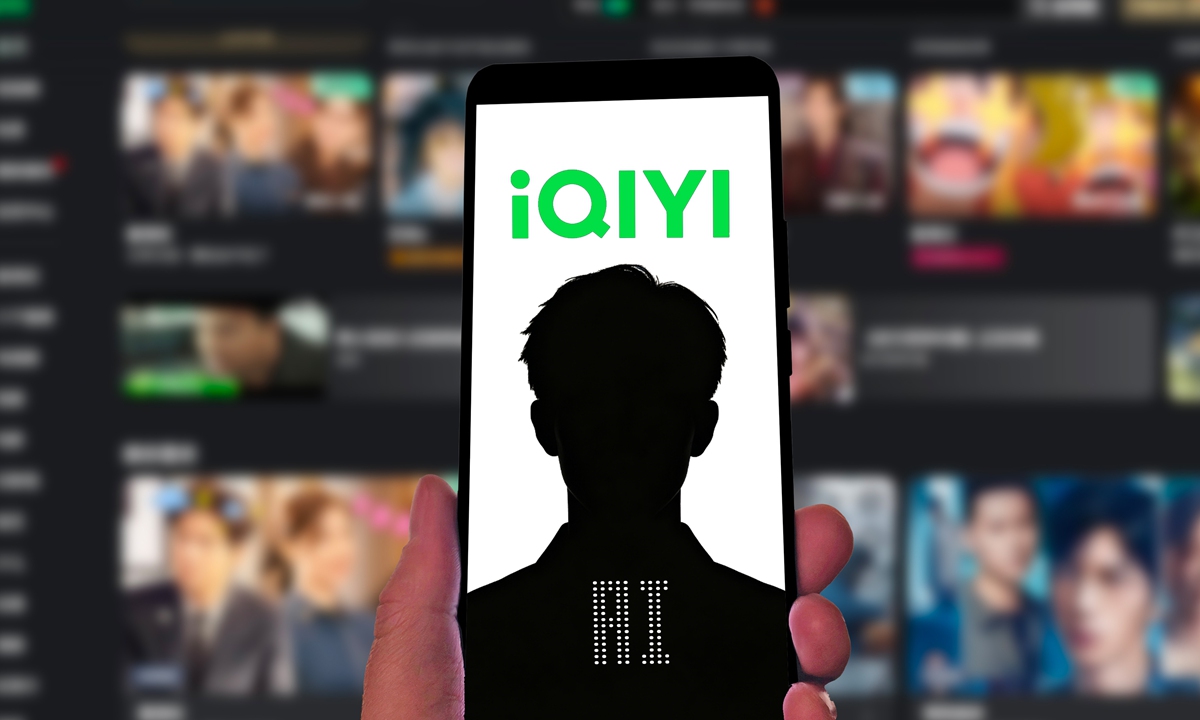
China's major online streaming platform iQIYI announces on April 20 on a conference that it has established an "AI Celebrity Database," claiming that more than 100 Chinese entertainers had agreed to allow their likenesses, voices and other biometric data to be used in AI-generated film and television production, while some actors deny the claim. Photo:VCG
Chinese video platform iQIYI announced at a conference on Monday that it has established an "AI Celebrity Database," which has sparked widespread controversy among netizens, promoted clarifications from several actors that they had "never signed any AI-related authorization," and further discussions on how far AI should go.The platform later issued clarifications on Monday and Tuesday, with one on Tuesday stating that the database is designed to provide a standardized platform for efficient communication between AIGC creators and celebrities. Joining the database only means that the celebrity is open to discussing possible cooperation on AI film and TV projects. Whether they participate, and in what form, will be decided individually according to each specific project, following the same process as for traditional live-action projects. "There is no situation where an entertainer is included in the database without their consent," the statement said.
As the hashtag of "iQIYI is crazy" trended on Weibo, many netizens posted their disapproval of the "AI Celebrity Database," saying they could not accept AI celebrities or AI TV dramas. Some people say there is already an abundance of AI-generated videos, and they do not want to see AI stepping in to perform for them.
Industry insiders pointed out that public debate reflects a growing public unease at the prospect of even actors—real people who convey emotion—being replaced by AI.
"Audience had already noticed in some AI-generated short dramas a pronounced sense of the "uncanny," with characters appearing eerily artificial. To audiences, no matter how realistic AI-generated performances may seem, they still struggle to replicate the spontaneity and emotional resonance of human expression," Ding Daoshi, a veteran analyst in the internet sector, told the Global Times on Tuesday.
"In an industry built on emotional exchange, the expectation is not only to consume a story, but to connect with a human presence behind it. When that presence becomes algorithmic — or indistinguishable from it — the emotional contract between creator and viewer begins to blur," Ding said.
Gong Yu, the CEO of the company, explained on Tuesday on his personal Weibo account that "technology should be people-centered—it exists to serve, not replace, humans. In the film and television industry, AI is meant to better serve audiences with more and higher-quality content, support creators including actors, expand the industry, and reduce workloads so creators can focus more on creativity and live better lives."
"With audiences' attention increasingly fragmented across a wide range of entertainment formats, film and streaming platforms are searching for new ways to cut costs and seek breakthroughs. In that process, many have turned to AI tools — but this approach, in many ways, amounts to a hasty, ill-considered fix. At its core, audiences are unlikely to accept a shift in which the human performances that once conveyed emotion are replaced by AI-generated imagery delivered through cold technological systems," Ding said.
However, industry experts reached the Global Times also noted that this doesn't means that film industry cannot use AI.
Shi Wenxue, a film industry expert and a veteran culture critic, expects that, in the near future, AI-generated footage could become indistinguishable from live-action material to the average viewer.
"Such progress is already reshaping production practices. Take this as example: seven individual creators in the Jimeng AI director programs have already released seven AI generated film last November, and they are all not traditional film producers. The democratization of creation, as some see it, could vastly increase the number of stories told, allowing voices previously excluded from the industry to participate," Shi told the Global Times.
"The application of artificial intelligence across industries is an inevitable and unstoppable trend, but the issue is that AI should be applied to areas that do not rely on creativity or the delivery of human emotion — for example, in animation production," Shi said.
While giving a speech on "AI in film production" at a "Spring Reading" event held by the Global Times on Monday, screenwriter and director Yu Baimei said that AI is not a replacement for human creativity, but an amplifier of possibility.
In his view, AI dramatically expands the "seek" phase of creation — generating ideas, images and narrative options at an unprecedented scale, which though at an extremely low probability, could write out any scripts human wrote, but humans remain uniquely responsible for "select" what matters. That act of selection, shaped by lived experience and emotional judgment, cannot be replicated by algorithms.
RELATED ARTICLES