China, Mozambique upgrade ties as Xi, Chapo hold talks; China to work with Africa to address spillover effects of Middle East conflict, says Chinese leader
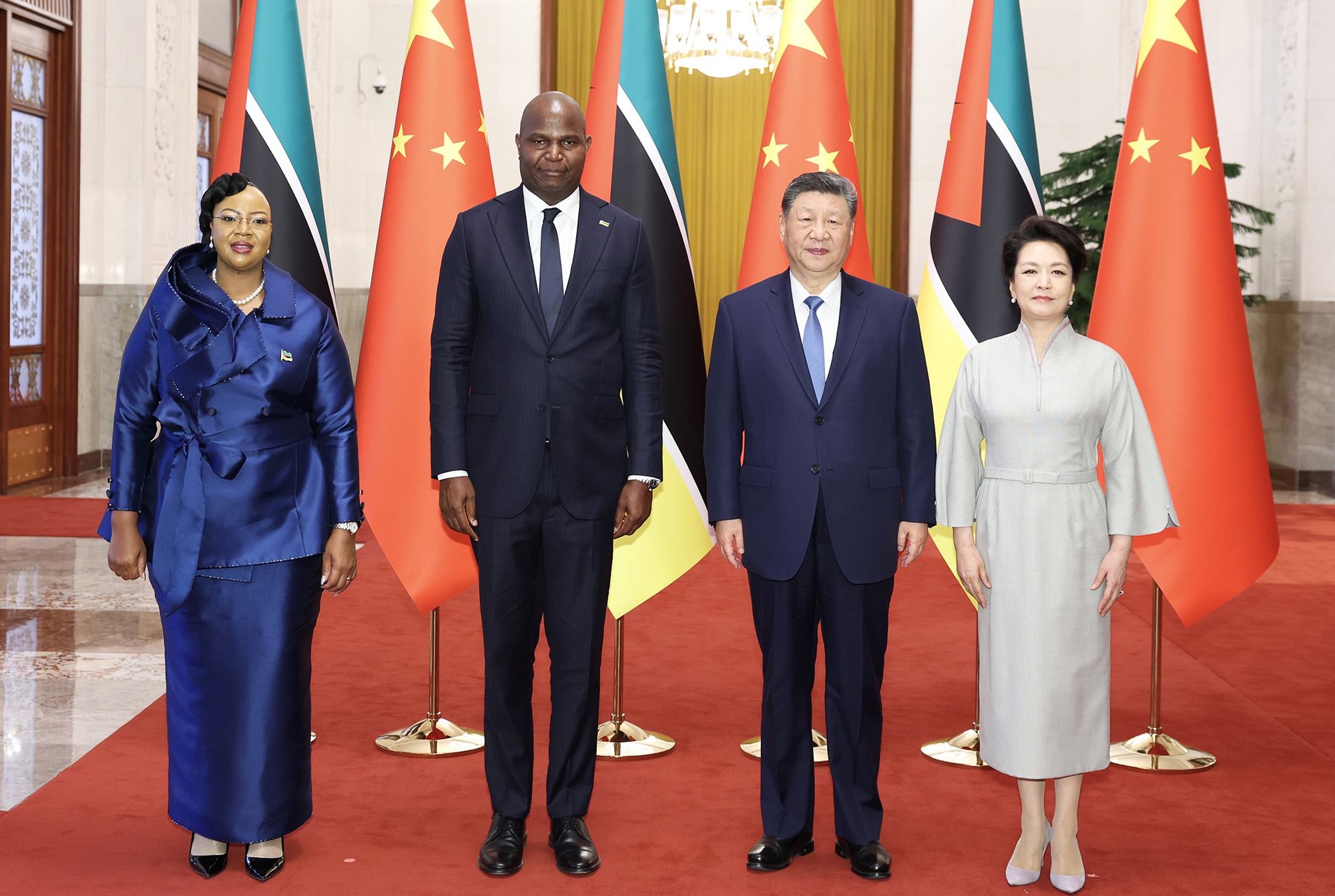
Chinese President Xi Jinping and his wife Peng Liyuan pose for a group photo with President of the Republic of Mozambique Daniel Francisco Chapo and his wife Gueta Chapo ahead of the talks between Xi and Chapo at the Great Hall of the People in Beijing, April 21, 2026. Photo: Xinhua
Chinese President Xi Jinping and Mozambican President Daniel Francisco Chapo held talks in Beijing on Tuesday, and the two heads of state agreed to upgrade bilateral ties to a China-Mozambique community with a shared future in the new era, according to the Xinhua News Agency.President Xi stressed that friendship and mutual trust are the defining features and political strengths of China-Mozambique relations. The two sides should carry forward the fine traditions, continuously extend firm mutual support on issues bearing on each other's core interests and major concerns, strengthen interactions at various levels and across various sectors between governments, political parties, legislative bodies, and sub-national authorities, and enhance experience sharing in party and state governance, per Chinese foreign ministry website.
The strong economic complementarity between the two countries opens up broad prospects for cooperation. This year marks the beginning of China's 15th Five-Year Plan period. China is ready to work with Mozambique to strengthen alignment of development strategies, create new cooperation models, explore new pathways for the integrated development of infrastructure, energy and mining, and actively cultivate new growth drivers in areas including agriculture, new energy, digital economy and AI to promote the high-quality and sustainable development of practical cooperation between the two countries, said the Chinese leader.
Facing the changing and turbulent international landscape, the two sides should continue to strengthen coordination, solidarity and collaboration in the UN and other institutions, and jointly advocate an equal and orderly multipolar world and a universally beneficial and inclusive economic globalization, and safeguard international fairness and justice, President Xi noted.
President Chapo noted that it is a great pleasure to be the first leader of an African country to pay a state visit to China this year, which testifies to the friendly and brotherly bond between the two countries, and carries great significance to the people of Mozambique. Mozambique attaches great importance to its relations with China, unconditionally abides by the one-China principle, and supports China in achieving national reunification, Chapo noted.
The two sides issued the Joint Statement Between the People's Republic of China and the Republic of Mozambique on Building the China-Mozambique Community with a Shared Future in the New Era.
Chinese analysts stated that China-Mozambique ties have advanced to a new level on the basis of equality and mutual respect. Building on historical friendship, the two sides will set a benchmark for the Global South, enhance solidarity and unlock more development opportunities.
Friendship with mutual trust
This meeting has in effect upgraded China-Mozambique relations, which embodies the core foundation for China to develop its ties with Mozambique featuring equality and mutual respect, Song Wei, a professor at the School of International Relations and Diplomacy at Beijing Foreign Studies University, told the Global Times on Tuesday.
The exchange through the meeting also demonstrates China's great emphasis on developing bilateral relations with Mozambique, and showcases China's commitment to supporting Mozambique's development, deepening solidarity and mutual assistance between the two countries and promoting high-quality Belt and Road cooperation, Song added.
The visit by Chapo, from April 16 to 22, is the first state visit to China by a head of state from Mozambique in 10 years, and it is also President Chapo's first visit to China since taking office. Kicking off his China trip in Central China's Hunan Province, the president subsequently visited Northwest China's Qinghai Province before arriving in Beijing on Monday.
Viewed from a historical perspective, Yang Baorong, director of African Studies of the Institute of West Asian and African Studies at the Chinese Academy of Social Sciences, told the Global Times that Mozambique have forged enduring bonds of friendship with China.
The expert cited Mozambican president's visit to the Shaoshan Mao Zedong Memorial Museum in Hunan, observing that the exploration of historical legacy serves to retrace mutual bonds, and further demonstrates that African countries including Mozambique could draw lessons from China's national governance experience accumulated over its development journey.
Following the talks, the two heads of state witnessed the signing of over 20 cooperation documents covering the Belt and Road Initiative, implementation of the Global Security Initiative, economy and trade, cultural and people-to-people exchanges, medical and health services, as well as press and media cooperation.
According to the joint statement, the two sides stand ready to leverage their respective strengths to strengthen mutually beneficial cooperation in the energy and mineral sectors, conduct exchanges on governance policies and practical experience, and jointly explore new pathways for integrated development and coordinated growth in energy and mineral resources as well as infrastructure construction.
The two sides will also further expand agricultural cooperation, deepen industrial chain cooperation covering agricultural product production, processing, logistics and warehousing, and help Mozambique enhance the added value of its agricultural products.
Highlighting "South-South cooperation at the core," a report by Africa News on Monday stated that the visit is expected to pave the way for increased Chinese investment in the southeastern African nation.
Effective from December 1, 2024, China has granted zero-tariff treatment on 100 percent of products to all least-developed countries with which it has diplomatic relations, including Mozambique, making Mozambican products more competitive in the Chinese market. According to Chinese customs statistics, two-way trade reached $5.4 billion in 2025.
Song said that bilateral cooperation holds vast potential to advance Mozambique's livelihood improvement and poverty alleviation, and consolidate its industrial foundation. Strengthening industrial synergy is also crucial in the fields including mineral resources, manufacturing, and agricultural modernization.
Amid rising global protectionism and growing unilateralism, Mozambique can learn from China's governance model through its visit to China. Given the limited resources Mozambique can access on the international market, China plays an important role in supporting its development, Song said.
Model of cooperation
President Xi noted that in the past 70 years of China-Africa diplomatic relations, no matter how the international landscape evolved, the two sides have always forged ahead shoulder to shoulder, through thick and thin. China and Africa, together with other Global South countries, represent a just force in this turbulent and transforming world.
As the impact of the Middle East conflict spills over to African countries, China stands ready to work hand in hand with Africa to address these challenges, jointly promote peace and work together to advance development, Xi said on Tuesday.
As the spillover from the Middle East conflict leads to spiking prices in parts of Asia and Africa, the World Food Program (WFP) said that keeping humanitarian supply chains open is essential to prevent millions more from tipping into food insecurity.
According to Mahmoud Ali Youssouf, chairman of the African Union Commission, continued escalation of the conflict worsens global instability, with serious implications for energy markets, food security and economic resilience, particularly in Africa where economic pressures remain acute.
Although Africa is not a major battlefield of conflicts in the Middle East, its vulnerability has been exacerbated by global economic interdependence as well as the division of labor within global value chains and industrial supply chains. This vulnerability manifests in food security, economic development and other aspects, leading to growing development risks for the continent, Song Wei said.
Against this backdrop, China could potentially provide assistance in the agricultural sector, including enhancing its agricultural production capacity and agri-processing capacity, she added.
Mozambique, a key African country that has served as a non‑permanent member of the UN Security Council and played an active role in upholding multilateralism and promoting African-led solutions to conflicts, also faces the tasks of opposing external interference in regional affairs, said He Wenping, senior research fellow at Institute of West Asian and African Studies of Chinese Academy of Social Sciences.
Song told the Global Times that China-Africa cooperation has set an exemplary model for South-South cooperation, boosting collective solidarity and creating more opportunities for Global South countries' development and revitalization.
Yang said that South-South cooperation concerns the pathways and prospects for Global South countries to pursue independent modernization, and is characterized by diversified cooperation rather than exclusivity.
"China's governance experience of self-reliance and coordinated national modernization offers valuable reference for other developing nations, and the ongoing presidential visit also further propels the advancement of South-South cooperation," he said.
Amid mounting geopolitical tensions that have aggravated the global trust deficit, Song added that China and Africa will carry forward their time-honored friendship to conduct sincere cooperation, set an example for the Global South, strengthen collective solidarity and foster greater opportunities for its development and revitalization.
RELATED ARTICLES