Horgos rail port sees China-Europe, Central Asia freight trains exceed 3,000 this year
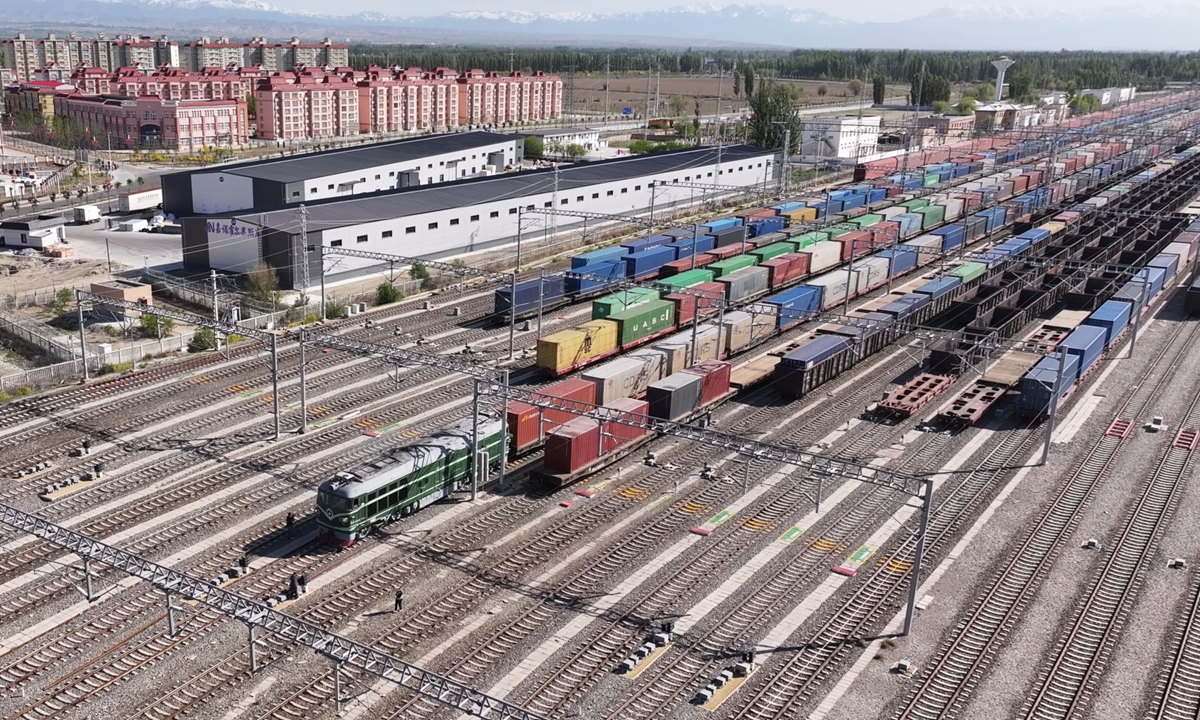
A China-Europe freight train, marking the 3,000th passage through the Horgos rail port this year, departs from the standard-gauge yard on April 21, 2026. Photo: Courtesy of China Railway Urumqi Group
A China-Europe freight train loaded with new-energy vehicle parts and smart home appliances departed from Horgos on Tuesday, bound for Duisburg, Germany. As of the same day, more than 3,000 China-Europe and China-Central Asia freight trains had passed through the Horgos rail port this year, injecting fresh momentum into high-quality Belt and Road cooperation, according to a statement China Railway Urumqi Group sent to the Global Times on Wednesday.
According to Urumqi Customs, the foreign trade of Northwest China's Xinjiang Uygur Autonomous Region reached 71.22 billion yuan ($9.89 billion) in the first two months of the year, up 36 percent year-on-year, while freight train volumes through its two rail ports rose steadily, according to the statement.
Horgos station has streamlined operations amid rising bulk imports such as iron ore, introducing a "residual-to-container" model to handle leftover cargo caused by differing China-Kazakhstan railcar types. By transferring remaining goods into open-top containers and standardizing procedures across transshipment, unloading and dispatch, the station has reduced stockpiling and improved efficiency, maintaining more than two trains per day and supporting bulk imports at the port, according to the statement.
Han Xing, business manager at Horgos Hong'an International Freight Forwarding Co, said in a statement that the company prefers rail transport for its lower costs, efficient customs clearance and high efficiency.
"The main exports we handle include photovoltaic components and new-energy vehicles, while imports are mainly quality inputs such as feed-grade wheat flour. We maintain close trade ties with partners in Russia and Belarus, where demand for Chinese products is steadily rising. So far this year, we have handled more than 700 trains, totaling about 820,000 tons of cargo," Han said.
Horgos station has continuously optimized transport organization by focusing on key procedures such as customs declaration and transshipment, conducting rolling reviews every two hours to track train clearance and cargo flow, and coordinating outbound traffic to improve efficiency, according to a statement by Ma Xiaogang, a dispatcher at the station's safety and production command center.
Through more precise scheduling, the station has enhanced clearance efficiency and throughput capacity, providing solid transport support for high-quality Belt and Road cooperation. Daily train volumes at Horgos station now remain stable at more than 27, Ma said.
Bian Yongzu, an executive deputy editor-in-chief of Modernization of Management magazine, told the Global Times that the Horgos rail port reached the 3,000-train mark earlier than last year, indicating a steady increase in throughput despite a complex and volatile geopolitical environment. Maintaining such growth under these conditions reflects the resilience of China-Europe freight services, he said.
He attributed the trend to rising reliance on China-Europe freight trains, whose advantages—such as speed and reliability for higher-value goods—are becoming more evident as routes expand, cargo categories diversify and services become more regular. This has created growing commercial opportunities along the route and strengthened trade links across the Eurasian continent.
Bian added that improving coordination, standardization and technological upgrades among participating countries have enhanced operational efficiency and reduced costs. Coupled with the complementary nature of the Chinese and European economies, these factors are reinforcing the strategic importance of China-Europe freight trains, with Horgos expected to play an even greater role in future trade.
So far, more than 55,000 China-Europe and China-Central Asia freight trains have passed through the Horgos rail port.
The port now operates 91 routes, reaching 46 cities and regions across 18 countries, with more than 200 categories of goods transported.
In recent years, Xinjiang's railway authorities have improved port transport operations and advanced smart port development, with annual train volumes exceeding 10,000 on average for six consecutive years.
In 2025, cargo throughput reached 32.1 million tons, up 12.1 percent year-on-year, while 18,000 China-Europe and China-Central Asia freight trains were handled, an increase of 7.4 percent, supporting higher-quality, more efficient and safer development of the rail service.
RELATED ARTICLES