What a canal in Laos tells us about the China model
By Published: Apr 22, 2026 09:42 PM
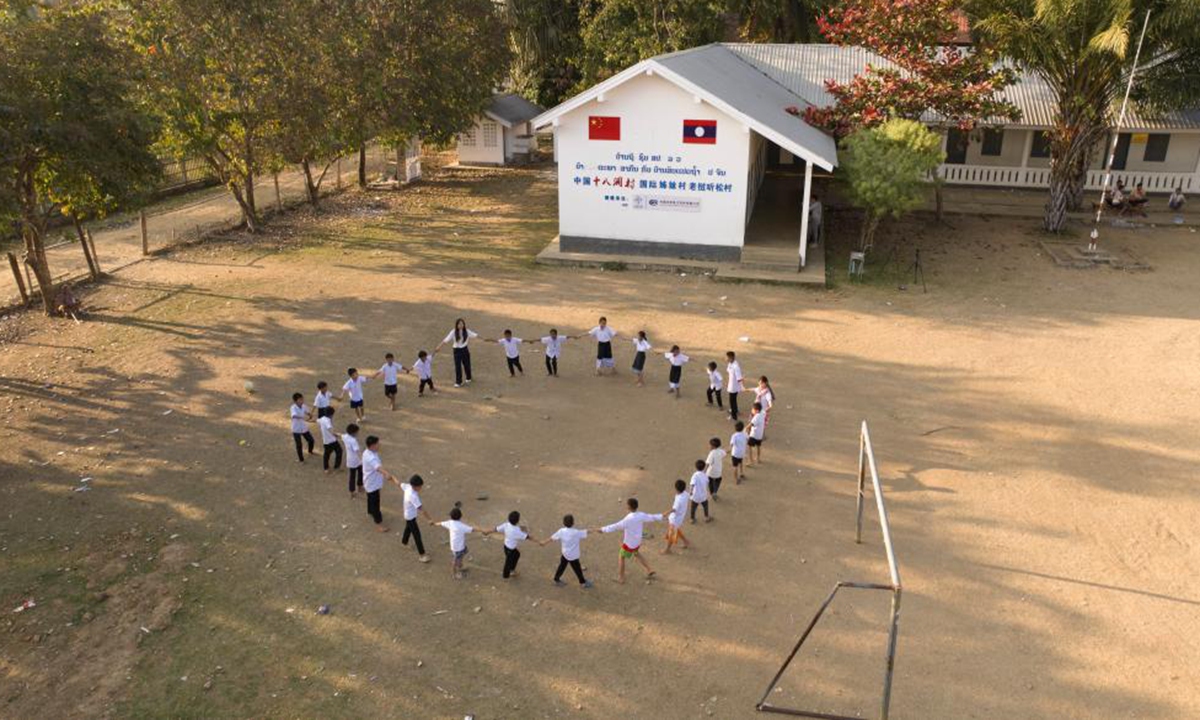
Students play on the playground at a kindergarten in Tingsong Village in Laos. Photo: Xinhua
This year marks the 65th anniversary of diplomatic ties between China and Laos. If you read Western media or consult Washington's think tanks, you will almost exclusively view this relationship through the cold, rigid prism of grand strategy.
The Western strategic community is deeply anxious about economic integration between China and Southeast Asian nations. Commentaries in publications like Foreign Affairs routinely rely on buzzwords like "squeezing" and "debt traps" to characterize China's footprint in the region.
In its spring issue this year, the Washington Quarterly published a paper on the "enduring constraints" on China's influence, arguing that, despite China's geographic and economic gravity, Southeast Asian nations' preference for non-alignment imposes a structural ceiling on Beijing's reach.
Reading between the lines, one senses a desperate Western hope that these nations will keep China at arm's length.
But place these sweeping macro-analyses next to the reality on the ground - specifically, the story of China's Shibadong Village and its "international sister village," Tingsong Village in Laos - you will experience a severe case of narrative whiplash.
During the dry season in Tingsong Village, farmers used to trek for miles just to carry water on their backs to irrigate their fields. That backbreaking routine ended when a simple, 8.6-kilometer irrigation canal opened.
It was built with Chinese assistance, born from a partnership with Shibadong, a Miao ethnic minority hamlet deep in the mountains of China's Hunan Province.
Shibadong is where President Xi Jinping first introduced the concept of "targeted poverty alleviation" in 2013. Back then, the village's per capita income was less than 2,000 yuan (about $280). By 2025, it had soared to over 30,000 yuan. In the prevailing Western discourse, China's developmental success is inherently untransferable because it is tethered to an "authoritarian" political system. The Atlantic Council, in its think tank reports, routinely dismisses authoritarian development as a "false promise," arguing that any early economic gains are fleeting and fail to yield broader social progress.
But one must ask: What exactly is "authoritarian" about an irrigation canal?
Shifting focus from ideology reveals Shibadong's success: adapting solutions to local needs. Develop cultural products if Miao embroidery sells, tourism where scenery thrives and specialty agriculture on fertile land. No universal template exists; strategy targets individual household needs.
This isn't high theory; it's common sense. Poverty takes many forms, so the paths out of it must be equally diverse.
What people in Tingsong Village borrowed from China wasn't a political manifesto. They learned how to build a canal, construct a kindergarten and get kids reading. Today, nearly 40 left-behind children in Tingsong have a place to receive early education. Next to the kindergarten sits a newly built "Lancang-Mekong library," where local children are opening picture books for the very first time.
Is this the "export of authoritarianism"? The problem isn't that Western critics lack intelligence; it's that they start with a predetermined conclusion and retrofit the evidence to match it.
China lifted some 800 million people out of poverty - accounting for more than 75 percent of the global total.
China's success proves that a nation can drastically improve its people's lives without following the Western path. For the guardians of the Western model, this represents a fundamental, existential shock to their claim of absolute universalism.
Since 1945, the West has monopolized the international development aid system. Yet, while the West continues to define a nation's capacity for development strictly by the "superiority" of its political institutions, the people living in the Global South have already been troubled by the development model exported by the West.
The essence of development is the expansion of human capabilities - the ability to eat, to read, to access healthcare. These are the very substance of freedom, not mere accessories to a ballot box.
The 8.6-kilometer canal in Laos was not created through a Western-style democratic process. However, farmers no longer have to carry water on their backs, making this canal an essential solution for them. And that is the way for them to go forward.
The author is a senior editor with the People's Daily and currently a senior fellow with the Chongyang Institute for Financial Studies at Renmin University of China. dinggang@globaltimes.com.cn. Follow him on X @dinggangchina
RELATED ARTICLES