Illustration: Chen Xia/GT
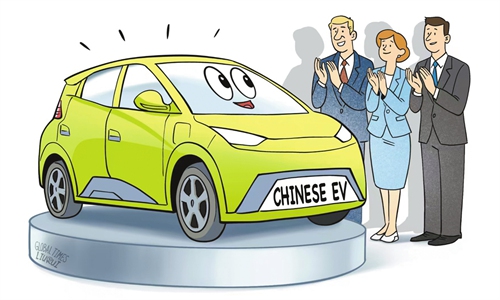
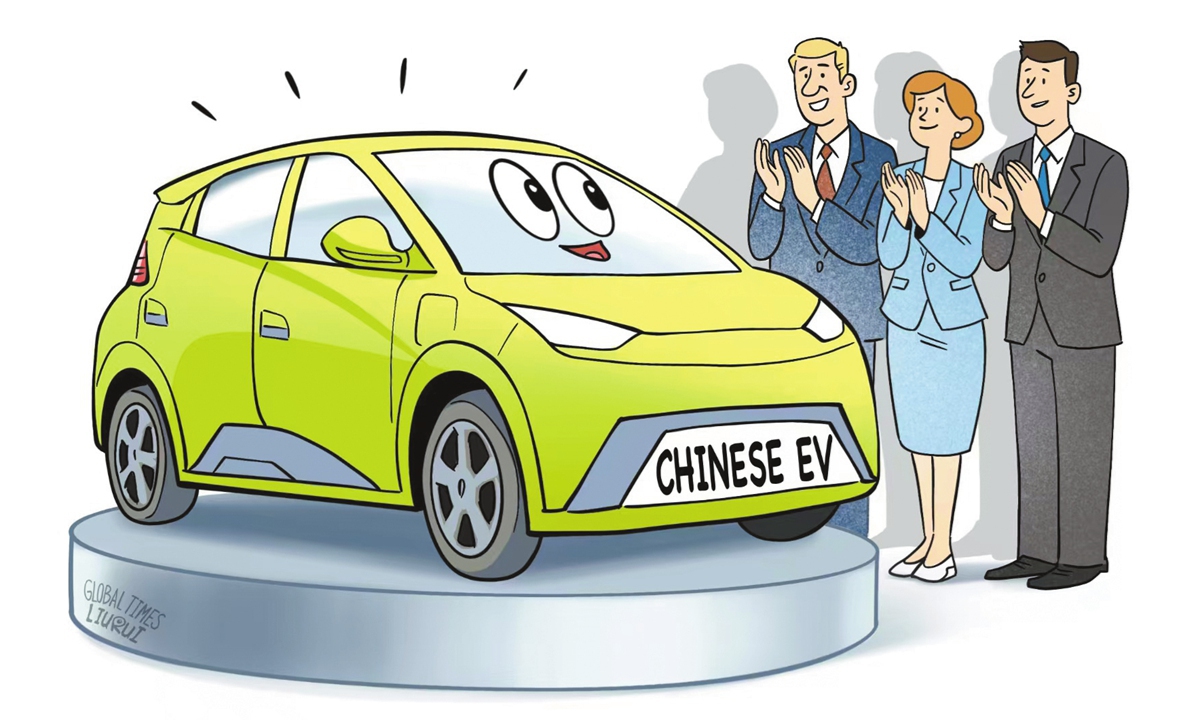
Chinese electric vehicle (EV) brands are winning over US consumers on social media, undermining US efforts to keep them out, Bloomberg reported on Tuesday, noting that while Chinese EVs are "virtually nonexistent on US roads" due to high tariffs, national security rules and automotive rules, "that hasn't kept them from breaking through online."The online enthusiasm for vehicles that are essentially unavailable in the US is a signal worth heeding. It sends a clear message: although trade barriers may limit the market access of Chinese EVs, they cannot stop consumers from seeking out desirable green products, as protectionism cannot block the appeal of truly competitive products.
For some American drivers, their attitude toward Chinese EVs has moved beyond mere curiosity to genuine purchase intentions. In an annual survey of US buyers of new vehicles this year, one-third said that they'd consider purchasing a vehicle built in China, according to Alexander Edwards, president of research firm Strategic Vision, according to the Bloomberg report.
A Cox survey, which polled 802 US consumers who expect to buy a car in the next two years, showed that 49 percent of respondents rated Chinese cars as having very good or excellent value, and 40 percent said that they support the idea of Chinese auto brands in the US market, Reuters reported in March.
These survey results all point to the same fact: consumers' choices will ultimately return to the products themselves. In the automotive field, cost performance, cutting-edge technology, and user experience are the real deciding factors, and these are precisely the advantages that Chinese EVs have already demonstrated in global markets.
Even if American consumers cannot buy these vehicles, they are still willing to follow, understand, and even express interest online. When they view these videos, they are not seeing political slogans; they are seeing products that directly address their needs and desires as car buyers. That is why curiosity matures into genuine interest.
This online enthusiasm comes at a time when US auto lobby groups are stepping up pressure on the US government to maintain policies that keep Chinese automakers out, according to media reports. In the short term, restrictions on Chinese EVs may buy some breathing room for US carmakers. But in the long run, they can neither reverse the direction of industry trends nor truly help foster innovation or efficiency in the local industry. The ones who ultimately pay the price are American consumers themselves - they lose the opportunity to obtain more advanced products at more affordable prices, and are forced to compromise on a limited range of local options at a time when the average price of a new car in the US reportedly continues to rise.
Moreover, the attention American consumers pay to Chinese EVs is essentially the reasonable pursuit of high-quality, economical, and green products, and a recognition of the global trend in new energy development. At a time of geopolitical tension, the importance of the energy transition becomes all the more evident. Chinese EVs stand out not only for their exceptional cost performance but also for their clear environmental advantages. The green transition should be an opportunity for global cooperation, not a field for obstruction. With their high cost-effectiveness, Chinese EVs have significant potential to contribute to the world's green transformation.
Chinese automakers' popularity on social media reflects genuine market recognition. It demonstrates that Chinese EVs, through their accumulated product strength and environmental advantages, have earned broad trust in international markets. More importantly, it shows that product quality, technological innovation, and green value are the true drivers of success in the global marketplace.
Ultimately, trade protectionism may create temporary barriers, but it cannot prevent consumers from choosing high-value, high-tech, and environmentally friendly products. The enthusiasm Chinese EVs have generated on social media is a vivid testament to the power of market forces.
RELATED ARTICLES