IN-DEPTH / IN-DEPTH
Sharing extreme condition facilities with researchers from 11 countries, China's large research infrastructure opens wide and fosters trust with world
Explore unknown together
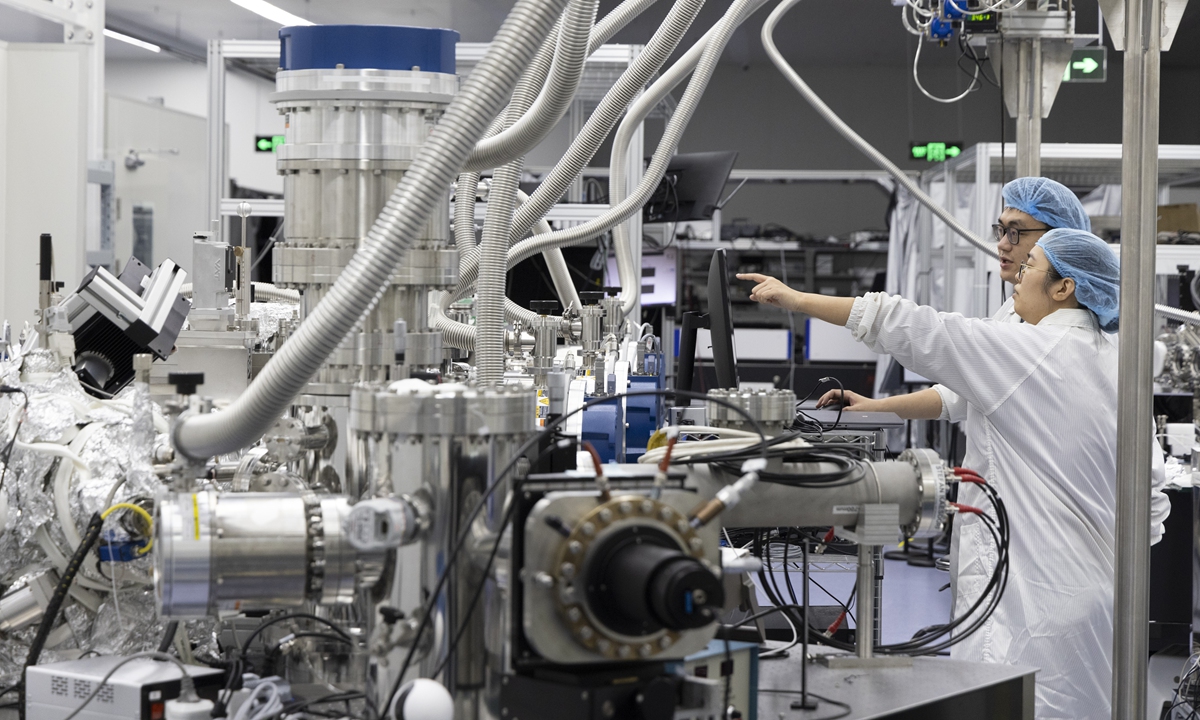
Dong Shuo (female), an associate professor at the SECUF, and her colleague check instrument during work. Photo: Courtesy of Dong
Editor's Note:As global challenges grow increasingly interconnected, technological solutions are rarely confined to a single country. Through research collaboration, open sharing of expertise and partnerships with international institutions, Chinese scientists, engineers and enterprises are engaging more deeply with the world, contributing tools and experience to problems that demand collective answers.
The Global Times launches a series of "Tech Seeds, Global Bloom," spotlighting China's achievements in advancing technology for good both domestically and internationally. By following these trajectories, the series invites readers to consider a different measure of progress: Not how advanced technology becomes, but whom it ultimately serves, and how widely its benefits can spread.
This article is the second installment. It examines how Beijing's extreme-condition research facility opens to global scientists, fostering trust-based collaboration and driving mutual scientific advancement through shared infrastructure and complementary expertise.
More than 60 kilometers from the urban area of Beijing, surrounded by mountains beside the Yanqi Lake, the Synergetic Extreme Condition User Facility (SECUF) operates quietly in the Huairou Science City. Zhou Rui, a professor at the Institute of Physics (IOP), Chinese Academy of Sciences, and head of the nuclear magnetic resonance measurement station at SECUF, focuses on the changing measurement values on his computer screen, checking instruments and communicating with colleagues from time to time.
The SECUF is a major national scientific facility in the field of condensed matter physics in China. Constructed, operated and managed by the IOP, it is the world's first extreme condition facility that features synergetic integration of ultra-low temperature, ultra-high pressure, strong magnetic field and ultrafast optical field, the Global Times learned from the IOP.
It is also one of the 10 major national research infrastructures that China had announced to open to global researchers during the 2026 Zhongguancun Forum (ZGC Forum) Annual Conference held in Beijing in March, according the Xinhua News Agency.
Opening up and sharing large research infrastructure is an international common practice, Cheng Jinguang, professor and deputy director of the IOP, told the Global Times. He noted that SECUF has adopted a global open-access orientation since its very beginning of construction.
According to Cheng, operating under international standards, SECUF opens global user applications twice a year. Proposals are reviewed and selected by a user committee, and researchers with approved proposals are granted free access to conduct experiments.
Since its trial operation in 2022, 16 international institutions from 11 countries, including Germany, France, and the UK, have conducted experiments at the SECUF. Among them are world-renowned academic and research organizations. For example, in 2024, IOP and Germany's Max Planck Institute for Chemical Physics of Solids established the Joint Research Center for Quantum Materials and Physics under Extreme Conditions using SECUF's capabilities. Collaborative results have since been published in academic journals, Cheng said.
He noted that, so far, SECUF has opened 500,000 hours of user time and 3-4 percent of these hours are used by international researchers. This proportion will hopefully increase to 20 percent by 2030. "We will steadily expand the SECUF's global influence by hosting international conferences, building joint research centers and inviting overseas teams to conduct in-residence research, gradually transforming the facility into a broader global scientific stage," Cheng said.
Trust is the cornerstone
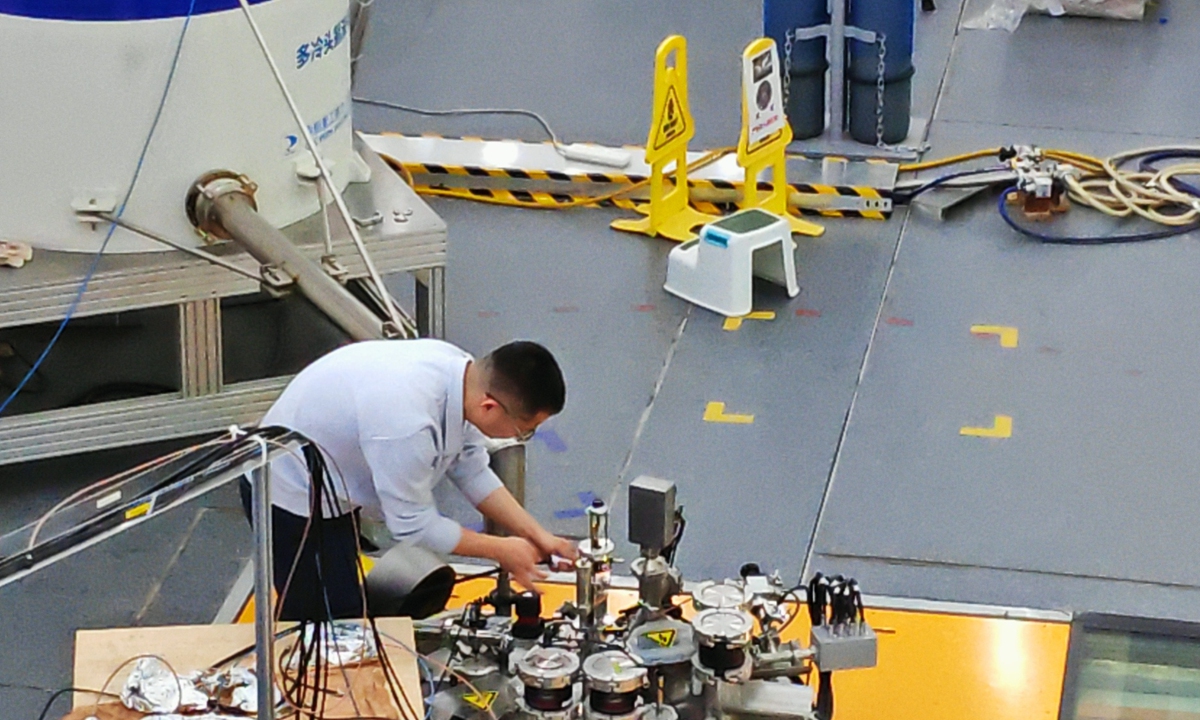
A researcher works at the ultra-low temperature high magnetic field quantum oscillation experimental station in Huairou Science City, Beijing, on April 20, 2026. Photo: Liang Rui/GT
For Zhou Rui, trust is the cornerstone for international cooperation. "Overseas teams travel thousands of miles to come here, and they usually only have two to three weeks to conduct experiments. They must be assured that our facility is reliable, our team is professional and that we share the same values as them," Zhou told the Global Times.That trust, Zhou said, is often built in moments of uncertainty and breakthrough. He recalled a recent visit by a Japanese graduate student, who arrived under intense pressure. Japan, he explained, lacks a platform integrating such comprehensive extreme conditions, and the student was unsure whether the predicted signals could be observed within the limited experimental window.
Zhou's team worked around the clock to ensure stable liquid helium supply, optimize the low-temperature system and fine-tune every parameter. By the end of the experiment, not only had the student observed the expected results, but he also identified previously unseen features. "He was extremely excited," Zhou said.
In another case, a collaboration with a French team encountered an unexpected setback just days before the experiment: a microcrack in a pipeline allowed air into the low-temperature system, causing a blockage. Chinese and French researchers worked side by side to troubleshoot and repair the system, eventually salvaging the experiment within a tight schedule, Zhou said.
Such experiences, Zhou suggested, gradually reshape perceptions. "Some researchers are skeptical about our facility when they first arrive. But after a period of joint work, they realize we offer conditions that are difficult to replicate elsewhere," he said.
Zhou said that in the early stage of the construction of SECUF, there were voices that doubted whether putting four kinds of extreme conditions in one facility would work.
"Facts speak louder than words. Now, SECUF can provide temperatures approaching absolute zero, magnetic fields reach a record 35.6 tesla, combined with ultra-high pressure and ultrafast optical fields, all integrated into a single facility," Zhou said with confidence.
"More international researchers have come to China to use our facilities because we have developed unique strengths and are now at the forefront globally," he said.
Mutual gains, shared progress
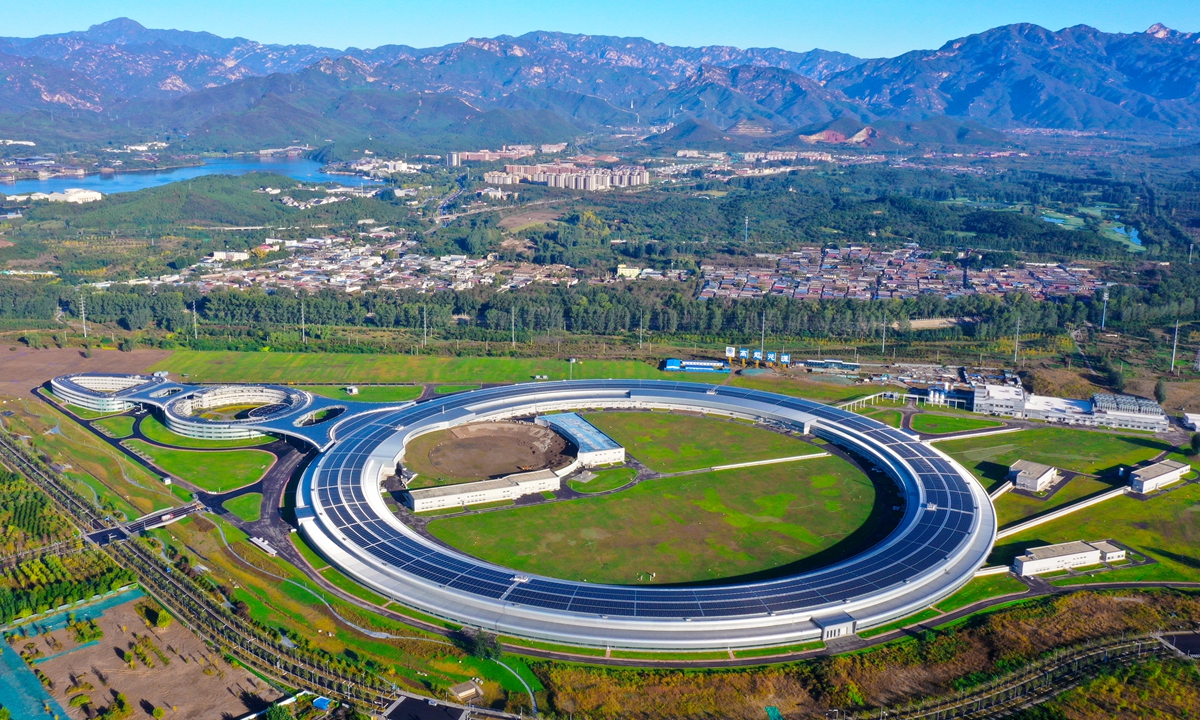
An aerial picture of the Huairou Science City featuring the High Energy Photon Source (HEPS) in the city Photo: VCG
International cooperation has been playing an important role in the development of SECUF since its construction.Ye Peng, associate professor, pointed to long-term cooperation with an Italian professor who has decades of experience in attosecond pulse transmission. The professor participated in the construction of a key beamline and has since become a frequent visitor, staying for weeks at a time to co-develop experimental capabilities. His expertise, Ye noted, has been instrumental in refining the facility's optical transmission systems.
Now, the international cooperation is more like a mutual reinforcing process. Dong Shuo, associate professor, described how some collaboration unexpectedly begins with existing academic networks and evolves into deeper joint projects. Her long-term French collaborators, for instance, sent a student to Beijing for a three-month stay, shortly after SECUF became operational.
"At that stage, we had just completed system integration, so it was mainly a normal technical exchange and joint testing," Dong said. "Our light source is very similar to theirs, so neither of our teams expected to discover any new things in the test."
However, surprises often occur. By introducing a new optical pump beamline, Dong's team discovered an untouched perspective of the French team's sample. This prompted the French group to upgrade their own system. "It became a complementary process: they advanced their setup, and we expanded our functional modules," Dong explained.
As these win-win collaborations deepen, international researchers are increasingly vocal about SECUF's role in advancing frontier science.
"SECUF's hardware is outstanding and fully capable of supporting frontier research. What impressed me most was the team's execution efficiency from agreement signing to project implementation. This reflects exceptional scientific management professionalism," Sergey Medvedev, a senior researcher at the Max Planck Institute for Chemical Physics of Solids was quoted by the Xinhua as saying.
Open to international cooperation
The construction of SECUF and the expansion of its international cooperation serves as a vivid microcosm of the leapfrog development of China's major science and technology infrastructure. In recent years, China has entered a stage of rapid development of domestic major scientific and technological infrastructure. A number of large-scale scientific facilities have been completed and put into operation.
At an altitude of 4,410 meters on the Haizi Mountain in Southwest China's Sichuan, the Large High Altitude Air Shower Observatory, the world's highest-altitude, largest and most sensitive ultra-high-energy gamma-ray observatory, is tirelessly searching for invisible cosmic rays. Among the karst mountains in Guizhou, the Five-hundred-meter Aperture Spherical radio Telescope, known as China's Sky Eye, stares into the cosmos, extending humanity's observational horizon to tens of billions of light-years away. Some 700 meters underground in South China's Guangdong, the Jiangmen Underground Neutrino Observatory (JUNO) hosts a liquid scintillator detector with the world-leading volume and energy resolution to precisely capture neutrinos, known as "ghost particles of the universe."
China has made remarkable achievements in the construction of large-scale scientific facilities after decades of development. If all projects planned in the 14th Five-Year Plan (2021-25) are completed, China will have approximately 70 large scientific facilities, Wang Yifang, former director of the Institute of High Energy Physics (IHEP) of Chinese Academy of Sciences (CAS), who is also a deputy to the 14th National People's Congress, told the Global Times in a previous interview.
In an article published in the Qiushi Journal in May 2025, Wang called for enhanced international cooperation. He noted that, committed to openness and cooperation, China continues to expand the scope, forms and channels of collaboration, inviting greater international participation in project selection, evaluation, design, construction and operation.
As a young Chinese scientist, Zhou, 38, is full of confidence in the internationalization of China's large scientific facilities.
For a long time, Chinese scientific research largely followed the footsteps of others: we built whatever facilities they had already built, and pursued whatever fields they focused on. Today, that picture is gradually transforming with top laboratories and leading institutions in the world actively seeking cooperation with us, he said.
Zhou said that what excites him most about his work is discovering the unknown and exploring new frontiers with colleagues around the world. "What we uphold is simple: eliminate all interference, verify the authenticity of signals and work with global peers to uncover the physical laws that govern the world," he said.
RELATED ARTICLES