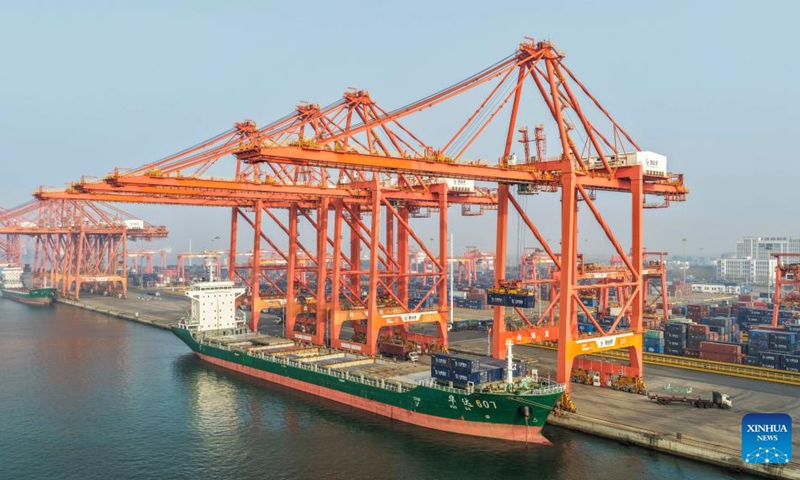
A drone photo taken on April 17, 2026 shows a vessel docking at the Jingtang area of Tangshan Port to load and unload containers in Tangshan, north China's Hebei Province. Photo: Xinhua
China's economy expanded by 5 percent year-on-year in the first quarter of the 15th Five-Year Plan (2026-30) period, which beat many analysts' expectations despite rising geopolitical tensions in the world. The strong momentum of its high-tech industries is creating broad opportunities for the world economy.
During the first quarter, China's development of new quality productive forces gained pace, including the rapid progress of cutting-edge technologies such as artificial intelligence. The value added of high-tech manufacturing sector rose 12.5 percent year-on-year, 6.4 percentage points faster than that of industrial enterprises above the designated size.

Raquel Isamara León de la Rosa Photo: Raquel Isamara León de la Rosa
Looking at the first-quarter data, one can see that it is important to highlight the central role of technological innovations in lifting all industrial lines in the country. And, the data demonstrates the value-added nature of technology as a competitive edge both within and outside of China.
During the two sessions held in March in Beijing, China set a yearly GDP growth target of 4.5-5 percent while striving for a better result in 2026. The goal reflects the government's policy approach of pursuing effective improvement in quality and reasonable expansion in quantity. Also, China has accumulated rich experiences in development planning, building a relatively systemic policy toolkit and an efficient risk-response mechanism in economic governance that can help maintain GDP growth stability and economic resilience.
Given China's remarkable tech innovations, which have caught global attention in recent years, the impact of technological innovation in emerging industries will be a determining factor in improving the sustainability of the China's elevated economic growth.
China's development model is getting increasingly popular nowadays, which is a significant contribution to Marxism, both in theory and practice, as the vision of the Chinese people's improving well-being has been the key to China's rapid GDP growth seen in the past two decades. In the medium- and long-term, this growth will be a decisive factor in accelerating the build-up of a moderately prosperous society, in a sharp contrast to the increase in poverty in many parts of the world.
China's role in the global economy has evolved rapidly. At the beginning of this century, its prominence in international trade marked a milestone in the global economy. Subsequently, the internationalization of Chinese capital in the Global South helps foster a new phase of greater economic interdependence.
And, maintaining a solid supply chain at home and expanding infrastructure investment cooperation with other economies has generated fruitful results, helping many countries to embrace the path of green and sustainable development.
China has been the country that has taken decarbonization of its industrial lines seriously. While maintaining the pace of high-quality manufacturing and innovation would require a greater energy supply, China has diversified its energy mix, becoming the world's largest generator of solar and wind energy.
To put it into perspective, China's rapid economic development has been firmly anchored to the pursuit of the people's well-being and accelerating national rejuvenation, and at the same time, through embracing the principles of extensive consultation, joint contribution and shared benefits, the social consensus forged in China is being translated into global public goods.
China's importance based on its economic prominence has allowed it to be a proactive actor in shaping global governance over the past decade. We must recognize how socialism with Chinese characteristics for the new era gives rise to the community with a shared future for all humanity.
China has highlighted the need for global governance in which the Global South countries will play a leading role. One of the novel proposals of this vision of global governance is the future relational vision of the various actors in the international system, an argument that redefines the idea of global security from a collective perspective and within the framework of a harmonized rule of law.
Through implementing more global initiatives, China is placing good governance high on the international agenda, while help introduce new themes to reorient global governance toward a more equitable vision.
As the global economic landscape now undergoes profound adjustments due to technology-induced structural changes, China's commitment to high-level opening-up and shared development will continue to create vast opportunities for the world through its sizzling economic growth.
The author is an expert on China at the Meritorious Autonomous University of Puebla, Mexico. bizopinion@globaltimes.com.cn
RELATED ARTICLES