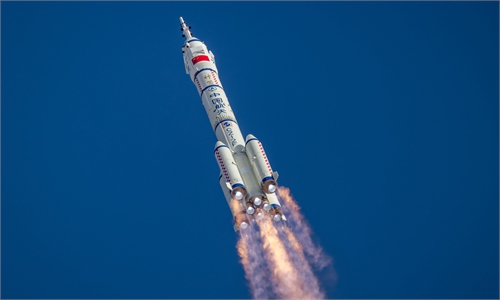
China Space Day shines light on string of remarkable new achievements
Aerospace advances highlight China’s progress, openness: expert
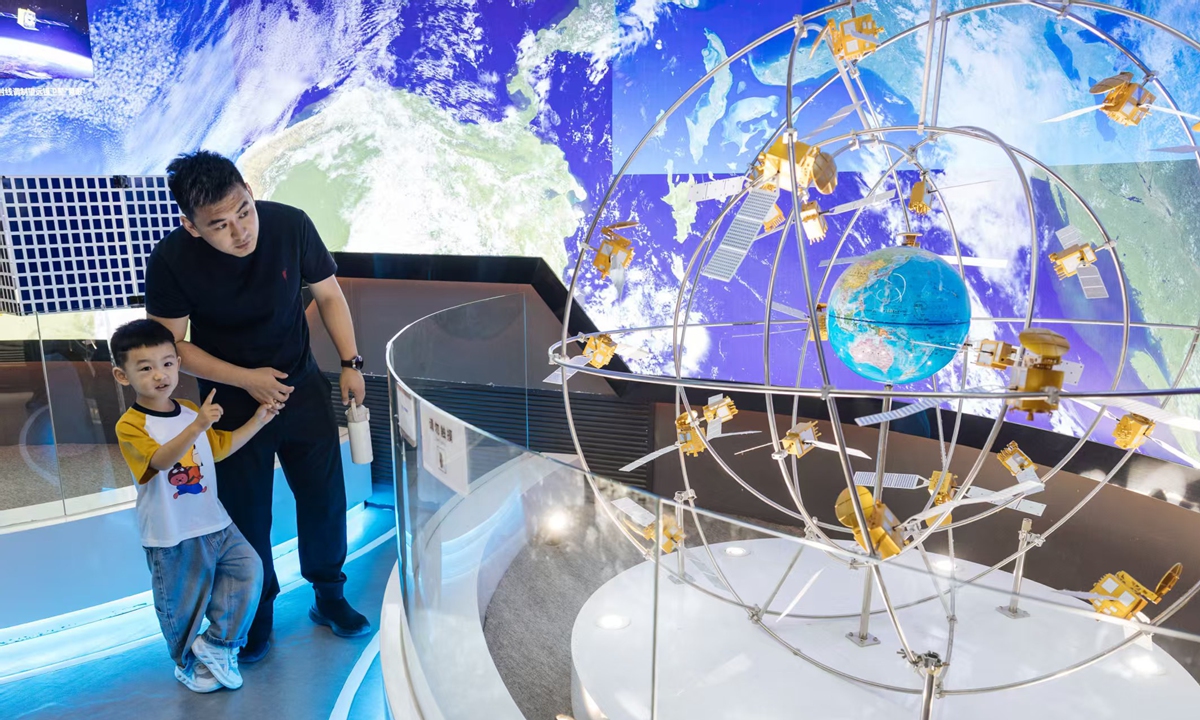
A man and a child observe a model of satellite constellations on display, featuring orbiting spacecraft encircling a miniature Earth, at the China Space Museum in Beijing, China, on April 24, as the day marks the 11th China Space Day, which this year coincides with the 70th anniversary of China's space program. Photo: Li Hao/GT
Friday marks China's 11th Space Day, shining a light on a string of remarkable new achievements in the country's aerospace sector, including new findings from Chang'e-5 lunar samples, the launch schedule for the Tianwen-3 planetary exploration mission, and international cooperation on the Xihe-2 solar observation mission. A Chinese expert said that China's space industry is advancing at an impressive pace, and through inclusive, equal cooperation, China embraces openness to share space achievements to benefit more countries across the globe.One of the major achievements announced at the opening ceremony of the 11th China Space Day was that Chinese scientists have identified two previously unknown lunar minerals from the 1,731 grams of moon samples returned by the Chang'e-5 mission, marking another breakthrough in deep-space research. The two newly discovered minerals have been officially approved and classified by the International Mineralogical Association. They have been named magnesiochangesite-(Y) and changesite-(Ce).
This marks the second and third lunar minerals discovered by Chinese scientists, following the first discovery of changesite-(Y) in 2022. Globally, they are the seventh and eighth new lunar minerals identified in returned lunar samples.
Moreover, the China National Space Administration (CNSA) announced at the Friday event that China's Tianwen-3 planetary exploration mission is scheduled to launch in around 2028 and bring samples from Mars back to Earth around 2031, with five international and Hong Kong and Macao cooperation projects selected to join the mission, according to the Xinhua News Agency.
CNSA also officially announced the selected cooperation projects for the Tianwen-3 mission. The orbiter will carry three cooperative payloads: the Mars PEX spectrometer, led by the exploration working group of the Committee on Space Research, to search for traces of life on Mars and detect the mineral composition of the Martian surface; the Mars molecular ion composition analyzer, led by the Macau University of Science and Technology, to study the escape process of the Martian atmosphere; and the laser heterodyne spectrometer, led by the Chinese University of Hong Kong, to detect the profile distribution of water isotopes in the Martian atmosphere and Martian wind fields.
The 11th China Space Day also saw China release its first commercial space standard system, aiming to leverage the guiding role of standardization in the development of the space industry and promote high-quality development of commercial space activities, per Xinhua.
Wang Yanan, editor-in-chief of Beijing-based Aerospace Knowledge magazine, told the Global Times on Friday that China's aerospace industry is advancing at an unprecedented speed, and has reached the world's advanced level in some key fields and yielded fruitful achievements in space exploration.
By exploring the unknown through aerospace programs, China is striving to seize new opportunities for the long-term development of the country and the nation, which serves as a grand goal, Wang said, citing China's long-term scientific research initiatives including lunar exploration and Mars sample-return missions, as well as steady progress in lunar soil research, fully demonstrating China's firm resolve to advance its aerospace industry on a long-term basis.
China's achievements in aerospace development are not limited to self-progress, but are also being shared with the international community through specific cooperation. At the 11th China Space Day, CNSA announced opportunities for international cooperation on the Xihe-2 solar observation mission, inviting global partners to jointly advance solar science and research aimed at deepening humanity's understanding of the Sun, according to Xinhua.
On the same day, two Pakistani astronauts arrived in China and were admitted to the Astronaut Center of China in Beijing, after the China Manned Space Agency announced on Wednesday afternoon that Muhammad Zeeshan Ali and Khurram Daud were selected as the first foreign astronauts for China's space mission training. After completing all training and evaluations, one of them will participate in a space mission as a payload specialist, becoming the first foreign astronaut onboard the Tiangong space station.
At the regular press conference on Friday, when asked to comment on will China foster more inclusive space cooperation and will the country be more open to cooperation with international partners in the aerospace sector as the focus of space competition has evolved from technology into rule-making and alliances, Chinese Foreign Ministry spokesperson Guo Jiakun said that Space is not an arena for major country contest. China will continue to work with various countries for open space cooperation and advance the common endeavor of humanity in exploring outer space.
Guo emphasized that China always upholds the principle of equality, mutual benefits, peaceful use and inclusive development in outer space cooperation with other countries.
China has signed space cooperation agreements with many African countries, and there are 10 paintings by African youth in Tiangong space station; China-Brazil Earth Resource Satellite helps protect South American rainforests; Pakistani astronauts are ready to head to China's space station with Chinese astronauts, Guo said.
A distinct highlight of China's openness in aerospace cooperation is that through extensive collaboration with all parties, it has lowered the threshold for Global South countries to access aerospace technologies and offered them opportunities to participate in space scientific research, Wang said, noting that this stands in sharp contrast to the past cooperation model of some developed nations, which only partnered with select counterparts with outstanding resources, advanced technology and overall capabilities.
"Guided by the principle of equal-footed cooperation, China's aerospace endeavor is set to benefit more countries, a concept that will gain growing global recognition," the expert said.
RELATED ARTICLES