China’s automotive development path provides footnote to ‘people-centered’ approach: Global Times editorial
Listen
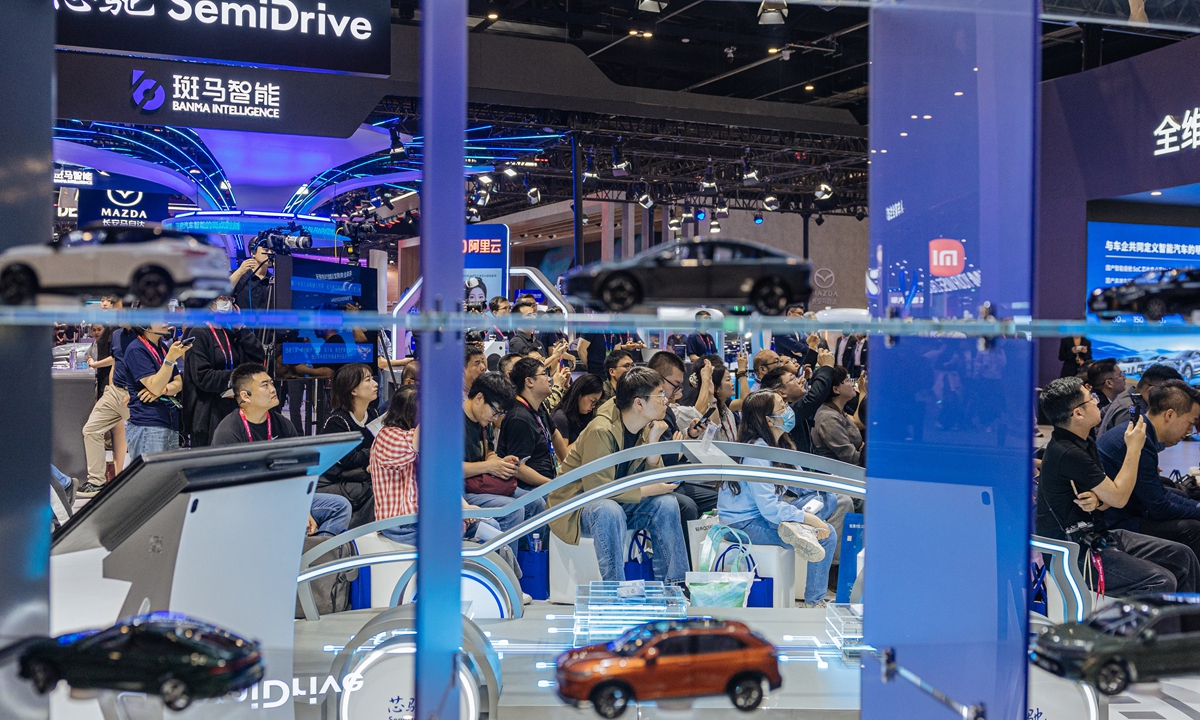
A corner of the 2026 Beijing Auto Show on April 24, 2026 Photo: Li Hao/GT
The 2026 Beijing International Automotive Exhibition boasts an unprecedented scale and remarkable popularity. Since its opening on April 24, nearly 4,000 overseas media personnel have flocked to the venue, with the "Beijing Auto Show" continuously trending on international social media. Within the massive 380,000 square-meter exhibition, 1,451 vehicles from 21 countries and regions are on display, including 181 globally premiering models and 71 concept cars, all competing for attention. Both the "density of new models" and the "concentration of cutting-edge technology" have reached record highs. What the world sees in Beijing is not merely an automotive carnival, but an illustration of China's high-quality development.
The international popularity surrounding the Beijing Auto Show signals the strong international recognition of China's automotive industry. Foreign journalists, moving between exhibition halls, have showered praises on Chinese automakers' latest technological achievements and future driving scenarios, using phrases such as "highly striking design," "the craziest, coolest models," and "amazing" to describe their experiences at the exhibition. For a long time, the world's five major auto shows were dominated by Europe, the US, and Japan. The automotive industry, as a core yardstick of a nation's modern industrial capability, has now extended from "Western-centered stage" to "Eastern exhibition showcase," reflecting the achievements of China's high-quality development.
From the Beijing Auto Show, people clearly see that innovation has become one of the primary engines driving the high-quality development of China's economy. Today, China's automotive industry is no longer merely "following" or "running alongside" global leaders - it is increasingly taking the lead amid the waves of electrification, intelligence, and connectivity. Meanwhile, several core suppliers made their first large-scale entry into prime booths in the main exhibition hall, demonstrating the advantages of China's upstream and downstream coordination and complete industrial chain. The rapid rise of China's auto industry should be attributed to a powerful synergy formed across policy guidance, talent cultivation, technological R&D, industrial support, and infrastructure development. This is a reflection of how different elements of China's high-quality development are interconnected.
Another "code" to China's high-quality development revealed by the Beijing Auto Show lies in its prioritization of the people's aspirations for a better life. Whether it is the introduction of intelligent driver-assistive technology into affordable vehicles priced at 100,000 yuan ($14,600), or "generational leap" in ultra-fast charging technology that eases "range anxiety," all innovations by Chinese automakers remain closely tied to real social needs.
Similarly, China's automotive industry brings together the strength of the entire industrial chain, breaking traditional boundaries and achieving deep collaboration. From AI transforming cars from "transportation tools" into "intelligent companions" to the internet ecosystems enabling "vehicle-road-cloud integration," all of these root economic growth and industrial upgrading in a "people-centered" value pursuit, thereby driving continuous refinement and improvement.
The demand for green and intelligent mobility among Chinese people is also a shared global need. Following the pace of economic globalization, Chinese automakers are also promoting their "people-centered" production philosophy overseas. Just as the Beijing Auto Show opened, China's SAIC Motor's MG unit reportedly plans to set up a European factory in Spain. Many exhibitors have launched new models designed specifically for overseas markets or announced growth targets in Europe and Latin America. An increasing number of Chinese enterprises are building factories, R&D centers, supply chains, and service networks in Southeast Asia, Europe, Latin America, and the Middle East - bringing not just automotive products, but also jobs, technology, management expertise, and green transition solutions. This "going global" does not aim to "squeeze others out," but to grow together with local industries, optimize resource allocation globally, and enable more consumers to enjoy intelligent and green mobility at reasonable costs.
On the path of turning sustainable development into shared global benefits, China is attracting more like-minded partners. A decade ago, multinational automakers often showcased "old technologies" in China; today, they use the Beijing Auto Show as a platform for launching their latest innovations and future strategies. Some foreign media have also noted that at this year's auto show, multinational automakers such as BMW and Hyundai are no longer confined to an "in China, for China" strategy, but are further shifting to a new model of "in China, for the world." They are deepening cooperation with local partners and leveraging China's supply chain to optimize global production and sales costs. The fact that Chinese and foreign companies are learning from each other and co-evolving in the Chinese market demonstrates that openness is not a one-way concession, but a two-way empowerment; competition is not a zero-sum game, but a vital force driving industrial progress.
The ever-evolving Beijing Auto Show has become a microcosm of the harmonious coexistence between the Chinese modernization and global development. Standing in the exhibition halls of the 2026 Beijing Auto Show, what people see is not only thousands of new vehicles, but also a new voyage of high-quality development undertaken by this Eastern powerhouse - with innovation, openness and green development as its wings.
The journey from "participant" to "leader" in the global automotive industry bears witness to how China's "strength" simultaneously becomes the world's "blessing."
The Chinese modernization does not pursue a win-lose outcome, but rather drives shared progress through its own development. This kind of modernization has speed, depth, and warmth. The image of China's automotive industry showcased at the Beijing Auto Show provides a concrete and compelling footnote of such modernization.
RELATED ARTICLES