Blue Momentum: From seawater to green hydrogen, and beyond, Qingdao charts a new growth path
By , Tao Mingyang and Zhang Yashu in Qingdao Published: Apr 27, 2026 09:13 PM

Editor's Note:
China has stressed that advancing Chinese modernization requires promoting the marine economy's high-quality development and forging a Chinese path of leveraging marine resources to achieve strength. With a mainland coastline stretching 18,000 kilometers and a sea area under its jurisdiction of around 3 million square kilometers, China is a major maritime nation with vast potential for developing its marine economy. To document the high-quality development of China's marine economy, the Global Times is launching the "Blue Momentum" series of in-depth articles from local marine economic powerhouses. The second installment focuses on Qingdao, East China's Shandong Province.
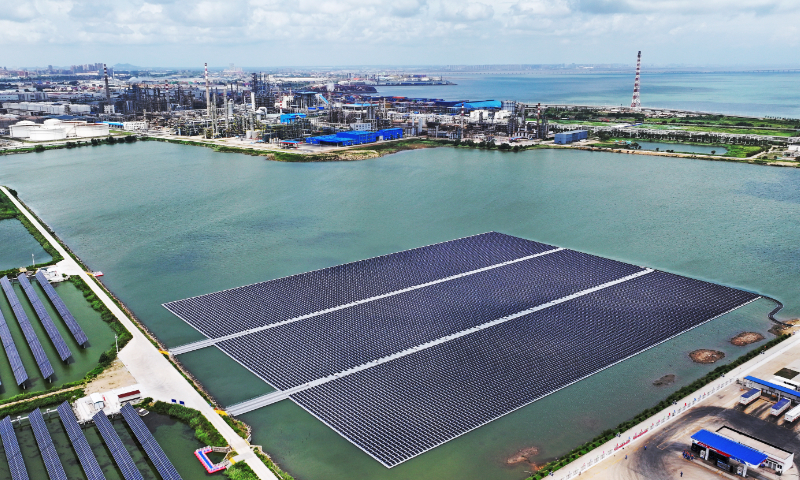
Photo taken on July 23, 2025 shows the 7.5-megawatt fully seawater-based floating photovoltaic project of Sinopec Qingdao Refining and Chemical Co in Qingdao, East China's Shandong Province. Photo: VCG
On a clear day at the sprawling coastal industrial park of Sinopec Qingdao Refining & Chemical Co, a major oil refiner in the country, a modest but groundbreaking facility hums quietly by the shore.
Against the backdrop of a massive industrial complex that stretches for several kilometers stands a shipping-container-sized assembly of pipes and meters arranged in a maze-like structure - the heart of China's first 100-kilowatt factory-scale seawater-to-hydrogen direct electrolysis project, which is turning seawater and sunshine into green fuel.
"After more than a year of research and development, the project has completed over 1,000 hours of cumulative operation and is ready to scale up from research to mass production of green hydrogen," Qin Weilong, a process expert at Sinopec Qingdao Refining & Chemical and technical director of the "Oriental Hydrogen Island" project, told the Global Times.
Unlike conventional industrial hydrogen production, which often relies on purified freshwater or fossil fuels, this project uses pre‑treated seawater directly, powered entirely by renewable electricity generated from offshore solar photovoltaic panels at a nearby solar farm.
In 2025, China's total marine economy output reached nearly 11.02 trillion yuan ($1.62 trillion), with a year-on-year growth of 5.5 percent, and accounting for 7.9 percent of the country's GDP. Utilizing its inherent resources and technological innovation, Qingdao is a prime example of China's efforts to promote the high-quality development of the marine economy.
Green energy from the blue ocean
The "Oriental Hydrogen Island" produces 20 cubic meters of green hydrogen per hour. The electricity comes from 13 megawatts of installed offshore solar capacity - enough that one hour of sunlight can generate roughly 2,600 standard cubic meters of green hydrogen. By consuming renewable power on site, the project dramatically cuts electricity costs for hydrogen production.
Pointing to a container-sized device covered with pipes and meters, Qin said, "This is our photovoltaic green power plus seawater hydrogen production unit."
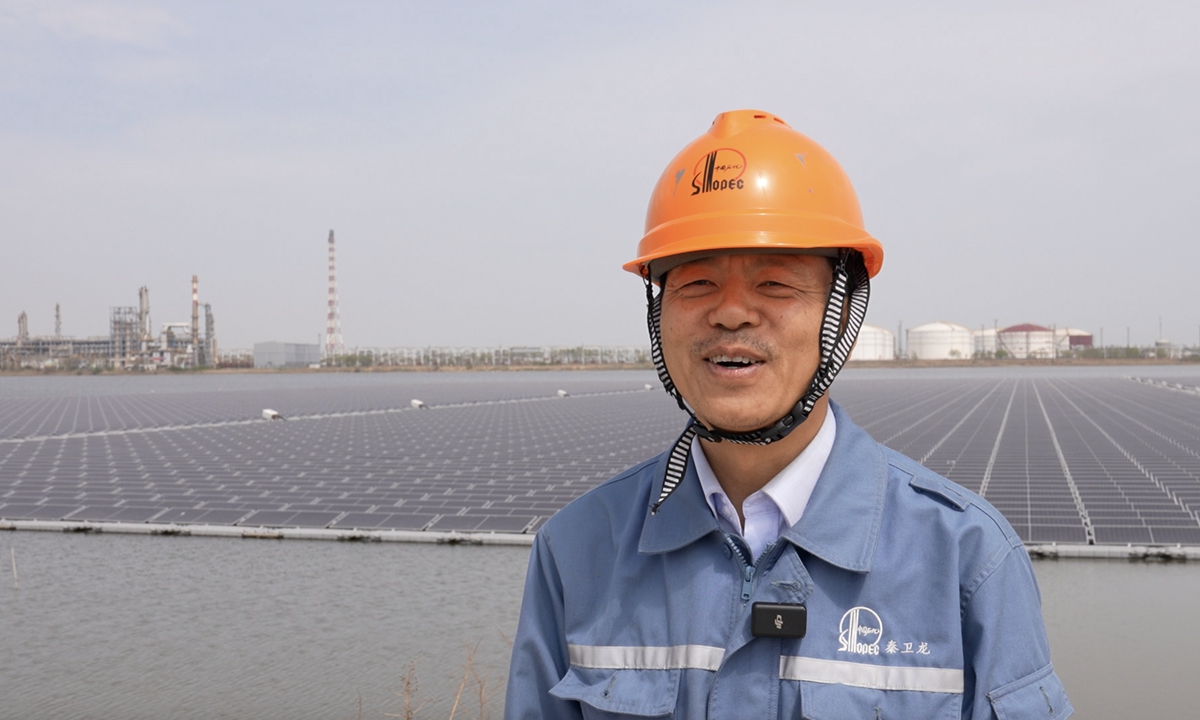
Qin Weilong, a process expert at Sinopec Qingdao Refining & Chemical and technical director of the "Oriental Hydrogen Island" project Photo: Chu Daye/GT
The term "green hydrogen" refers to hydrogen produced with near-zero carbon emissions, typically via electrolysis of water using renewable energy. This distinguishes it from "gray hydrogen" that comes from fossil fuels and "blue hydrogen" that is extracted from industrial byproducts, making it dependent on petrochemical processes. The Oriental Hydrogen Island project represents a clean break: all its input energy comes from solar.
"These solar panels produce enough green electricity in one hour to make about 2,600 standard cubic meters of green hydrogen," Qin said, pointing to the offshore array. "Direct seawater electrolysis saves both freshwater and the high cost of desalination. It's a game-changer."
This project has fully demonstrated the technical feasibility of using intermittent renewable power for green hydrogen production, opening a new path for large-scale consumption of renewable electricity in the future, Qin said.
Yet Qin remains measured about the journey ahead. "We have validated the feasibility of directly obtaining hydrogen from seawater," he said. "The ocean offers an endless source of raw materials and power for green hydrogen. We are full of confidence for the future."
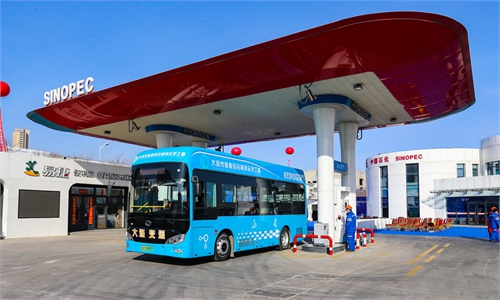
Less than two kilometers away stands China's first carbon-neutral hydrogen refueling station, which sources its green hydrogen from the "Oriental Hydrogen Island."
A special hydrogen tanker from Shandong-based Sino Hydrogen Co, a hydrogen supply solutions provider, slowly entered the station. "Refueling 35 kilograms of hydrogen takes only 15 minutes," said Gao Gang, a station worker. The tankers deliver green hydrogen to downstream users. "We also refuel some of Qingdao's hydrogen fuel‑cell buses - that process takes about eight minutes and provides enough energy for a full day of operation."
Experts note that fast refueling and zero emissions, as only water vapor is released when power is generated, are key advantages of hydrogen energy. When applied to urban transportation, hydrogen fuel cell vehicles can add significant "greenness" to the city's mobility transition.
The outline of China's 15th Five-Year Plan (2026-30), recently released, calls for focusing on key areas that will drive future development, building a full-chain cultivation system for future industries, and promoting hydrogen energy and nuclear fusion as new economic growth points.
Shandong Province, a major energy and chemical hub, stands to benefit greatly from this technology. A Sinopec Qingdao manager said that seawater-based hydrogen production can support deep decarbonization efforts at coastal steel and petrochemical sectors, enable zero-carbon scenarios for hydrogen-powered heavy trucks, ocean-going vessels, and island energy supply, and help create zero-carbon industrial clusters.
An innovation park that hears the sea's call
Qingdao, China's second-largest foreign trade port, is not only harnessing the sea for clean energy but also leveraging its coastal location to attract global talent, technology, and investment. Just a short drive from the port, in the city's West Coast New Area, lies an elegant business park set against a backdrop of hills and water. On a black marble pedestal by a waterfront terrace, some 30 national flags flutter in the breeze - a visible sign of the park's international character. This is the Sino-German Ecopark.
Amid the greenery and birdsong, the rumble of container trucks can be heard if sea winds blow from the direction of the nearby Qingdao Port. "Proximity to the port is a top consideration for our tenants," Kerstin Kaehler, branch manager of the German Enterprise Centre Qingdao, told the Global Times. Kaehler, who is in her early 50s, has spent 27 years in China fostering business communication and helping German and other foreign companies successfully establish themselves in the country.
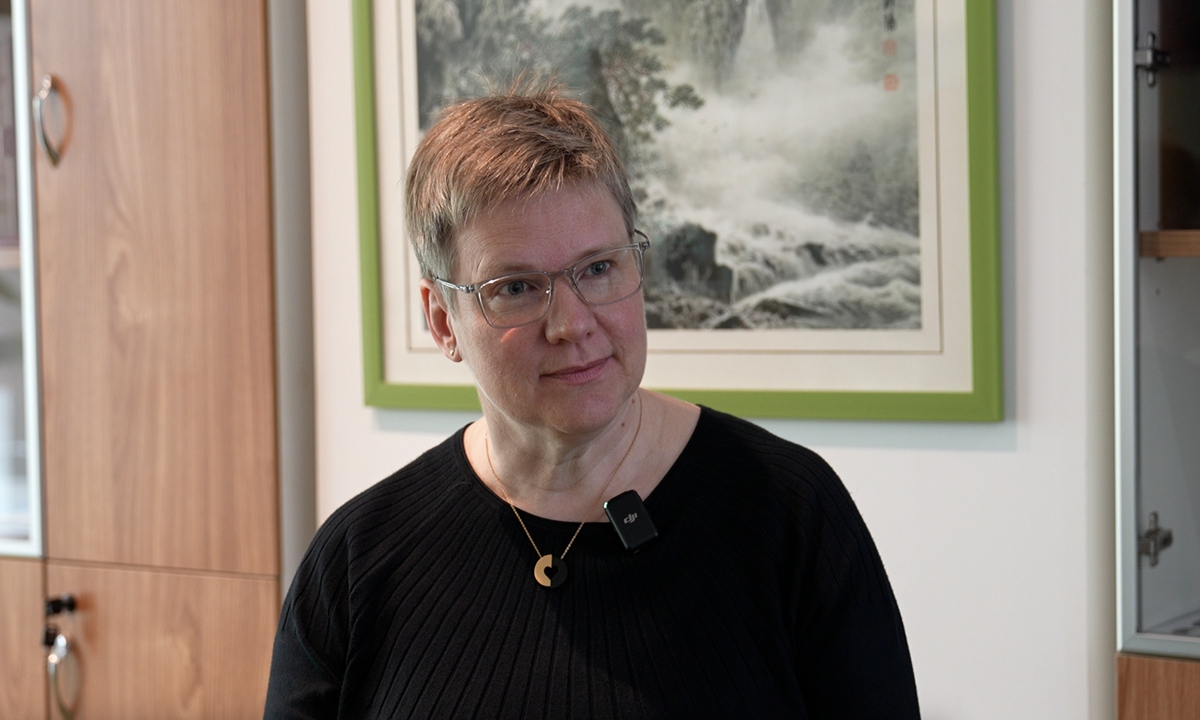
Kerstin Kaehler, branch manager of the German Enterprise Centre Qingdao Photo: Chu Daye/GT
The center currently houses 44 tenants, most of them small and medium-sized enterprises (SMEs). Half are Chinese companies; the other half come from Germany, the US, Japan, the UK, Singapore, and other nations. "At the end of 2019, we had 27 tenants. Now we have 44," Kaehler said.
Despite changing market dynamics, she noted that foreign companies' interest in the Chinese market has not waned. Notably, demand for co-working spaces or small offices is strong, a trend she expects to continue.
"If a company is a world market leader, it is usually also innovative. If they are, then they are willing and able to learn and draw inspiration from everything happening in China in that field," Kaehler said. "Especially now, as China is rolling out its new five-year economic plan, I believe that foreign companies - especially German SMEs - have a big role to play in China's efforts to build a modern industrial system."
From extracting green hydrogen from the sea to attracting foreign expertise and investing in coastal health and wellness resources, Qingdao is steadily implementing the central government's strategy to advance Chinese modernization by efficiently utilizing marine resources, promoting the high-quality development of the marine economy, and forging a Chinese path of leveraging marine resources to achieve strength.
RELATED ARTICLES