IN-DEPTH / IN-DEPTH
CPC’s people-centered performance mindset reflects commitment to perseverance, empathy and tangible progress: American influencer
Farmer Bus
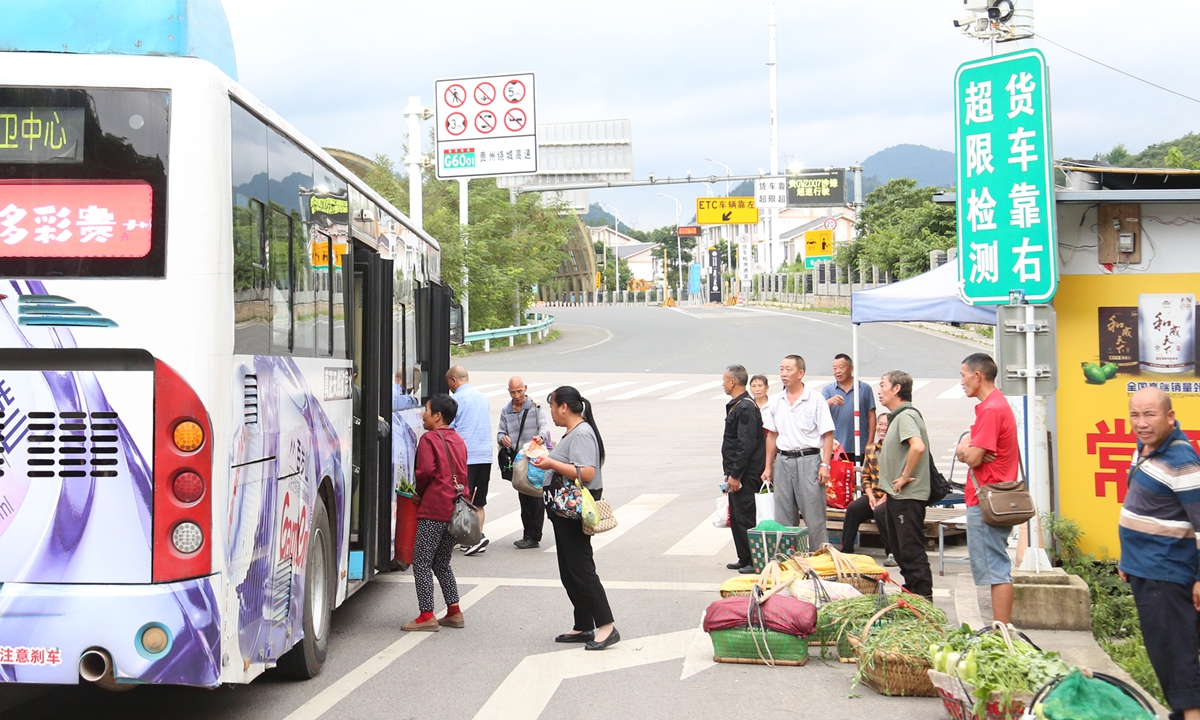
Farmers board the Route 252 "famer bus" with their freshly harvested produce in Guiyang, Southwest China's Guizhou Province.
Editor's Note:Chinese President Xi Jinping has pointed out, "to understand China today, one must learn to understand the Communist Party of China (CPC)." With the rapid development of China's economy and society, and the steady advancement of the Chinese path to modernization, the notable achievements of the CPC have drawn extensive international attention and scholarly interest. Against this backdrop, the Global Times has launched the "CPC in Global Eyes" column, focusing on the feelings, perspectives and insights of international friends from various fields regarding the CPC's historical path and achievements.
They include those who have toured China, who deeply study the CPC in academic fields, who work, live, study, seek employment or do business in various fields in China, and who, though having not visited China in person, pay close attention to the CPC's policies and trends. Through their vivid personal experiences, we aim to present a multifaceted overseas view of the CPC.
In the thirteenth installment of this series, we follow Jackson Hinkle, an American social media influencer, on a journey in Guiyang, Southwest China's Guizhou Province, where he boards a "farmer bus" tailored for local vegetable growers. Through his camera lens, Hinkle captures how this tailored public transport solution, born from grass-roots feedback and iterative governance, has transformed local farmers' livelihoods, revealing the CPC's people-centered performance mindset.
"It's currently 5 am. It's earlier than I usually wake up, but we are here for a very important reason. Today, we are going to be taking a look at how [Guizhou Province in] China was able to lift [over] 9.2 million people out of poverty within eight years."
These words open a YouTube vlog by American influencer Jackson Hinkle, filmed on a pre-dawn street in Guiyang, Southwest China's Guizhou Province.
For farmers in Guizhou, the scene unfolding before his camera was merely another ordinary morning: a line of villagers carrying bamboo baskets brimming with fresh vegetables, waiting for a bus that has redefined their livelihoods.
For Hinkle, this uncharacteristically early wake-up experience has become a revelatory journey - one that laid bare a governance philosophy rarely highlighted in Western media. His subsequent vlog has garnered over 800,000 views, according to the Xinhua News Agency, sparking global conversations about China's approach to poverty alleviation and grass-roots governance.
Route 252
The bus Hinkle boarded that day, Route 252, is no ordinary commuter line. Locally dubbed the "farmer bus," its primary passengers are not office workers but farmers and their harvests destined for city markets.
In his vlog, an awestruck Hinkle narrated the scene: "As you can see here, there are tons of beautiful fresh-picked food that is headed into the city. Now, the farmers market. They have specific areas set up at the farmers market for these farmers to sell their goods. And it is just everywhere. It looks amazing."
His conversation with an elderly woman on the bus laid bare the transformation.
"You like the bus?" Hinkle asked.
"Yes," she replied with a smile.
Her answer to his next question - how she managed before - painted a stark picture of the past: for over a decade, she had relied on private vans, requiring her to leave home as early as 2 am, full two hours earlier than the current bus schedule. Now this bus made her trip to the market far more comfortable.

Jackson Hinkle talks with an elderly farmer on the Route 252 bus. Photo: Courtesy of Hinkle
The story begins with Route 252 itself, which was once a regular commuter line connecting Guiyang's Yunyan and Wudang districts. For farmers in Wudang's Xiaba, Shuitian and Baiyi towns, this bus was their lifeline to urban markets, but it was a flawed one.Before the dedicated farmers' service launched in June 2024, the 35-stop journey from Songjiaba Station in Wudang to Dayingpo Station in Yunyan took over an hour, winding through residential areas and office parks. The buses were overcrowded with both commuters and farmers, their baskets and crates leaving little room to stand.
"Office workers often couldn't squeeze on," recalled Liao Sha, marketing team leader of Guiyang Public Transport Co., Ltd. "And farmers struggled too - if they didn't take the bus, they had to carpool with other villagers, paying at least 30 yuan ($4.38) round-trip to transport themselves and their goods."
The turning point came in March 2024, when Zhang Guilin, a driver on Route 252, reported the ongoing conflict between commuters and farmers to his company. "This route was caught between two critical needs: office workers trying to get to their jobs on time, and farmers trying to make a living," Liao said.
The answer was a dedicated farmers' service, adjusted to meet the unique needs of those hauling produce to market. After six community meetings with villagers in three towns and six villages, the final plan emerged: the route was streamlined from 35 stops to just five key locations, slashing travel time to 40 minutes. The fare structure was equally tailored: 2 yuan per person (free for those over 70 with senior cards), plus 3 yuan for one basket, 5 yuan for two, with a maximum 7-yuan fee for multiple containers.
"So now the farmers have their own bus," Hinkle summarized in his vlog. "Now they can come in here practically free and the government's provided this to bring tons and tons of agricultural products to the city every day. So, it's a beautiful program and it's provided a lot of opportunities for the farmers here in Guiyang."
When initial rides revealed overcrowding from baskets, the company installed overhead storage racks. According to the Guiyang News, by March 2026, Guiyang had expanded the program to 41 such routes, serving 780,000 passengers and transporting 1,800 tons of produce.
A four-level coordination mechanism, which links farmers, villages, towns and the bus company, ensures demand is met, with additional buses dispatched if 10 or more farmers sign up via a WeChat group.
People-centered vision in action
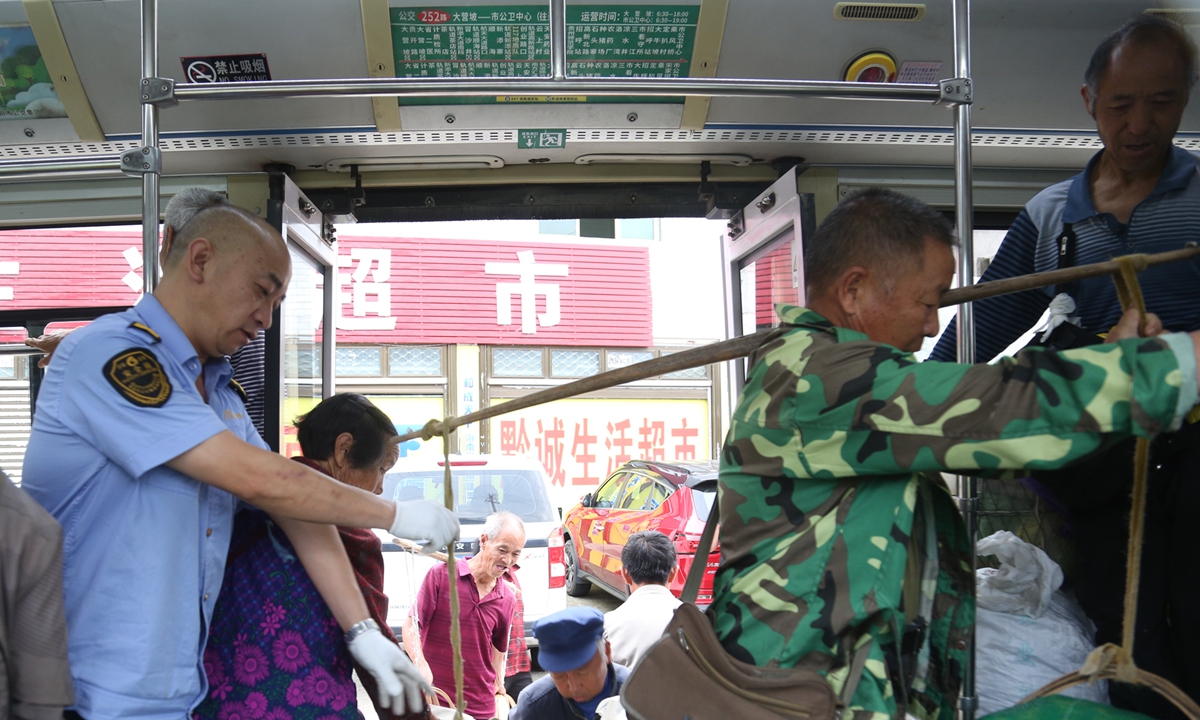
The driver helps farmers with their bags as they get off the Route 252 bus. Photo: Courtesy of Yang Guangwei
In his video, Hinkle repeatedly used one word to describe what he saw: "beautiful." The scene of "fresh picked food" and the pre-dawn energy of the farmers, who appeared spirited and smiling despite the early hour, led him to call the bus initiative "a beautiful program.""I saw farmers who were genuinely proud of how many crops they could produce and how much their incomes had grown. I met villagers who had replaced worn, patched clothing with new and modern attire. I spoke with restaurant owners who had gone from offering only basic dishes like potatoes and a limited range of imported, expensive goods to serving a diverse selection of locally-sourced Guizhou cuisine," Hinkle told the Global Times after his trip in Guizhou.
For Hinkle, these details gave meaning to the "people-centered" development philosophy of the Communist Party of China (CPC). "On paper, a bus line may not appear to be a major economic project," he noted. "But in reality, it directly improves livelihoods, increases incomes, reduces daily burdens and restores dignity… These outcomes build trust, social cohesion and long-term stability."
The process behind the "farmer bus" - the village meetings, driver feedback and subsequent adjustments struck him as a hallmark of "action-oriented governance and continuous feedback." This practical, responsive approach embodies a different governing logic from the West, he argued. "It is proactive, responsive and results-driven. Policies are not static decisions, but evolving solutions shaped by the people they serve."
Together, these efforts painted a picture. "What I observed across Guizhou was a strong sense of unity and shared purpose. That did not feel accidental. It reflects a system that consistently emphasizes service to the people and practical results," the US influencer said.
Together, these small but powerful practices shaped his understanding of China's governance and answered the very question he posed at the start of his journey - how China was able to lift so many people out of poverty.
By the end of 2020, China had lifted 98.99 million impoverished rural residents out of poverty, removing 832 counties and 128,000 villages from the national poverty list, as reported by Xinhua.
Beyond the bus, Hinkle found more vivid examples of the CPC's performance philosophy rooted in people's well-being. One was meeting with Huang Dafa, former Party chief of Guizhou's Tuanjie village, known locally as the "modern Yu Gong" - a reference to a legendary figure in Chinese folklore who insisted on moving two mountains in front of his home to lead a more convenient life.
Huang spent 36 years chiseling a nearly 9-kilometer canal through steep mountains to bring reliable water to villagers, lifting thousands out of hardship and supporting long-term poverty alleviation.
Hinkle said the canal project advanced after Huang became a local Party leader. "He was empowered not only by his position, but by a deep personal commitment to eradicating poverty and improving the lives of the people around him. He shared that his determination was rooted in the spirit of the Long March."
Hinkle frequently invoked the historic Long March in his reflections, both in his vlog and interview with the Global Times.
The Long March (1934-1936) was a military maneuver by the Chinese Workers' and Peasants' Red Army that later became a defining episode in modern Chinese history, symbolizing endurance and perseverance as troops crossed some of the country's harshest terrain to establish a new revolutionary base. Some marched as far as 12,500 kilometers, Xinhua reported.
The spirit of the Long March, Hinkle believed, is not just a historic legacy but a living force that shapes the CPC's people-centered performance mindset: a commitment to perseverance, empathy and tangible progress that transcends grand gestures to focus on life-changing details.
"No matter how big or small, every effort to improve the lives of your fellow citizens is meaningful and worth pursuing. That is the lesson I took from the Farmer Bus, from Huang Dafa, from the Huajiang Grand Canyon Bridge, and above all, from the spirit of the Long March," he told the Global Times.
Lessons beyond borders
Hinkle's vlog struck a chord far beyond his usual audience, with comments pouring in from around the world, many praising China's approach and contrasting it with Western media narratives.
"China does socialism right," one top comment read. "Noticed they didn't give the villagers free money but help them to make money."
For Hinkle, the lessons from Guiyang's bus lines extend beyond China's borders, offering insights for other countries. He believes that transformative change does not require grand gestures, but "a consistent focus on solving real problems, no matter how local or modest they may seem, and a long-term dedication to improving the everyday lives of the people." This approach, he noted, stands in contrast to models that prioritize financial returns over broad-based social progress.
His China journey led him to outline a more effective governance model: public investment as a foundational economic driver, "not to maximize private profit, but to provide essential services such as transportation, education, healthcare, communications and utilities at low or subsidized cost."
Hinkle noted that the US itself once demonstrated the power of this approach through its historic investments in foundational public goods like canals, railroads and universal education. He expressed a hope that the US could draw from its own historical successes while remaining open to learning from the experiences of other nations, including China. "That sense of purpose is what can unite a society around the goal of shared prosperity and make the seemingly impossible achievable," he said.
The final scene in Hinkle's vlog on the Guizhou "farmer bus" is one of tranquil purpose. Dawn has broken. The farmers, having arrived in the city, disembark and, with the familiar assistance of local workers, shoulder their carrying poles laden with produce, moving in an orderly flow toward the market.
It is a quiet, routine procession. Yet the ripples it sends forth into the world continue to spread.
RELATED ARTICLES