ARTS / CULTURE & LEISURE
For more than three decades, an artifact conservator brings over 1,000 artifacts back to life
Dialogues with the past
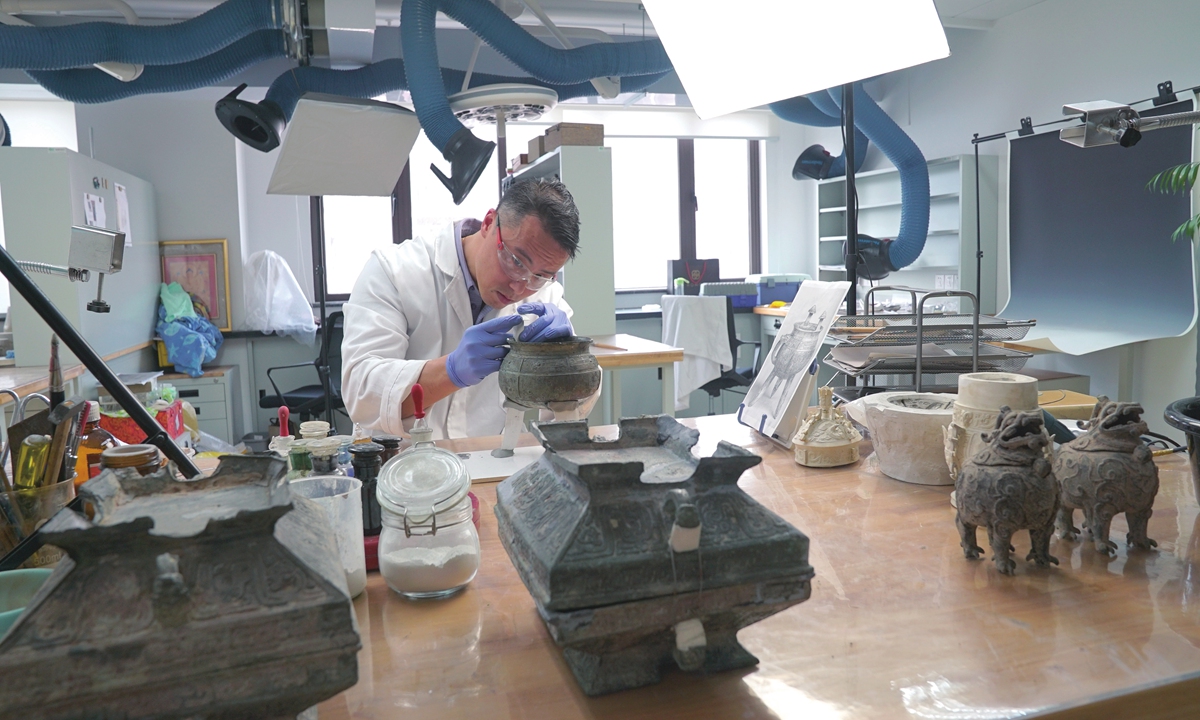
Zhang Peichen works on a bronze ware. Photos: Courtesy of Zhang Peichen
At first glance, Zhang Peichen does not quite fit the stereotype of a veteran artifact conservator with more than 30 years of experience.
Born in 1973, Zhang is often seen in a crisp white lab coat, performing "surgery" on ancient artifacts. Outside the lab, he keeps up a regular fitness routine and maintains an active online presence, where millions follow his work on China's X-like platform Sina Weibo.
Over the decades as a research curator at the Shanghai Museum, Zhang has restored more than 1,000 bronze artifacts from across the country. His tools include fine steel needles and engraving knives. One of his most notable projects involved carefully restoring a gold mask attached to a bronze head unearthed from the Sanxingdui archaeological site.
The Shanghai Museum is home to the world's most comprehensive exhibition of Chinese bronze artifacts, spanning different eras, regions, and vessel types. Its collection covers more than 3,000 years of history, from the Xia (c.2070BC-c.1600BC), Shang, and Zhou (1046BC-221BC) dynasties through the Ming (1368-1644) and Qing (1644-1911) dynasties, and includes a number of national treasures such as the Da Ke Ding and the Bells of Marquis Su.
Recently, Zhang was named among the one of China's 2025 National Master Craftsmen of Cultural Relics.
After his selection, an article on the official website of the National Cultural Heritage Administration described Zhang as "a rigorous and highly professional conservator," as well as "a warm and approachable educator in cultural heritage outreach."
For Zhang, this recognition serves as a significant milestone - reaffirming that his three decades of work have not been in vain, while also encouraging him to advance with renewed diligence and meticulous attention.
Describing himself as an introvert, he defines craftsmanship as doing one thing well, sustaining it over an extended period, and always maintaining a desire for improvement.
"There are no earth-shattering stories, just a lifelong commitment to a single craft, nothing more," he told the Global Times.
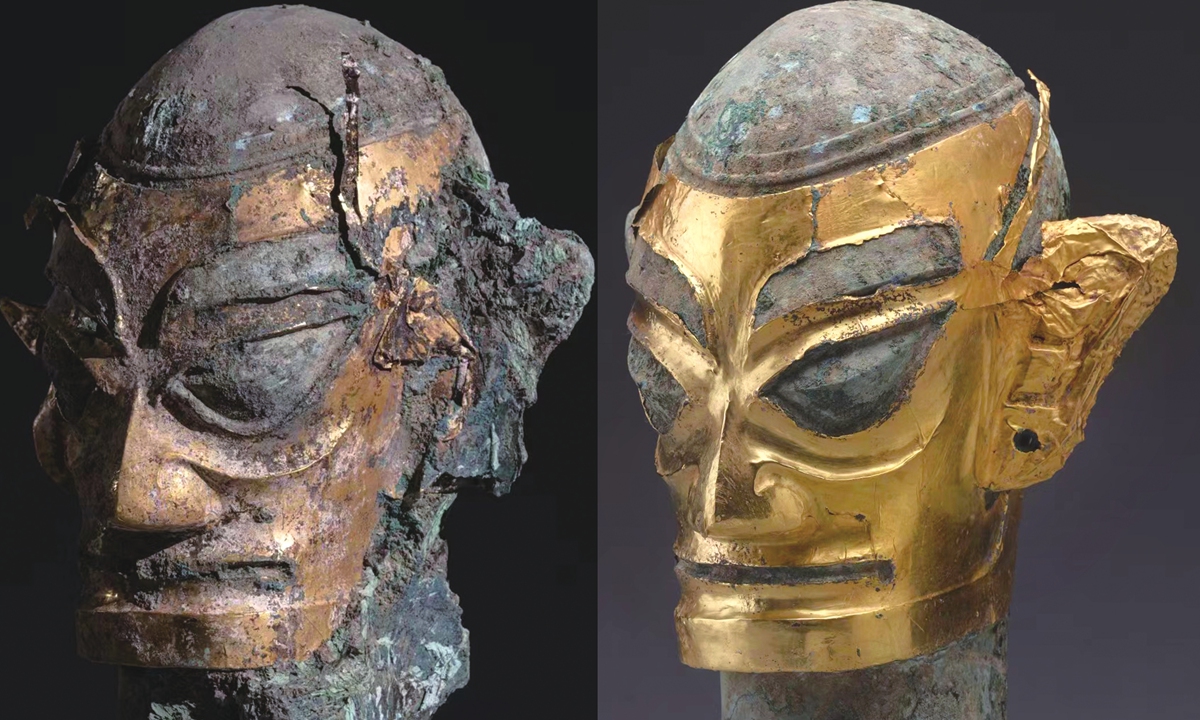
A bronze head with a gold mask before and after restoration Photo: Courtesy of Zhang Peichen
Immense challenges
Zhang's career in artifact conservation was far from planned. After training as an art student in 1993, he joined the Shanghai Museum with hopes of pursuing design or fine arts. But a chance internship brought him to Huang Rensheng, a master conservator who would become his mentor.
His first major test came with a late Shang Dynasty (c.1600BC-1046BC) bronze vessel after years of learning from Huang, a high-footed plate adorned with intricate animal mask patterns. When it was excavated, the piece was severely damaged and deformed.
"At the time, I didn't have much experience to rely on," Zhang recalled. "I had to move forward step by step, judging each decision as I went."
The process was slow and deliberate. But when the vessel's original form finally emerged, the sense of accomplishment was immediate.
"More importantly, it gave me confidence," he said. "That was when I truly understood what it meant to independently complete a restoration."
Among the many projects Zhang has undertaken, his work at the Sanxingdui site in Southwest China's Sichuan Province stands out as unforgettable. The excavation of discovered sacrificial pits yielded not only a large volume of artifacts but also unprecedented challenges.
Artifacts recovered from the site often bear little resemblance to the polished pieces eventually displayed in museums. One example is a bronze head with a gold mask, the only known instance of such a complete combination among more than 70 similar finds in one pit.
The piece was enveloped in compacted soil and fragmented ivory. The gold mask, in particular, had been severely distorted under sustained ground pressure.
The challenges were immense. Many artifacts were extremely fragile - burned, compressed, buried for centuries, and severely deformed. Each step had to preserve all archaeological information, all while meeting tight deadlines that demanded a careful balance between conservation, research, and exhibition.
Yet it is precisely these challenges that gave the work deeper meaning, going beyond simply "repairing an object," said Zhang.
For Zhang, the most memorable aspect was not a single object, but the ongoing process of recovery.
"In those moments, you can't help but think - people 3,000 years ago must have seen the same sunset," he said. "This work is not just about restoring artifacts; it feels more like a dialogue with history across time."
Tech-driven craft
In recent years, Zhang's work has increasingly incorporated new technologies, including CT scanning, augmented reality and artificial intelligence (AI). While some might see this as a shift away from traditional craftsmanship, Zhang holds a different perspective.
"It's not about replacing tradition with technology," he said. "It's about using technology to serve and enhance traditional skills."
For example, in the restoration of a bronze plaque inlaid with turquoise, a large section of the decorative stones had fallen away. Traditionally, conservators would rely on experience and aesthetic sense to reconstruct the missing parts.
Zhang's team took a brand new approach. Using AI, they compiled data from similar artifacts around the world and generated reconstruction models based on statistical analyses.
"The goal is to find the solution that is most neutral and closest to historical reality," Zhang said. "It reduces subjective bias."
In Zhang's view, the future of cultural relic restoration lies in this balance: A partnership where technology deepens understanding and traditional skills give it tangible form.
Besides, he is particularly focused on integrating digital tools into the workflow, from CT imaging and 3D modeling to AI-assisted analysis. Zhang's team is also exploring the use of multi-material 3D printing and CNC machining to improve precision and stability in restoration work.
"Ultimately, we want to transform parts of the process that used to rely purely on experience into methods that can be tested and repeated," he said.
That vision extends beyond individual projects. Zhang hopes to help build a restoration framework that is both scientifically rigorous and sustainably transferable to future generations.
What is being pursued is not making artifacts "more complete," but ensuring that, while preserving authenticity, they are more accurately understood and more safely passed on, Zhang said.
RELATED ARTICLES