What I witnessed from the technological transformation in rural Xinjiang changed my understanding of development
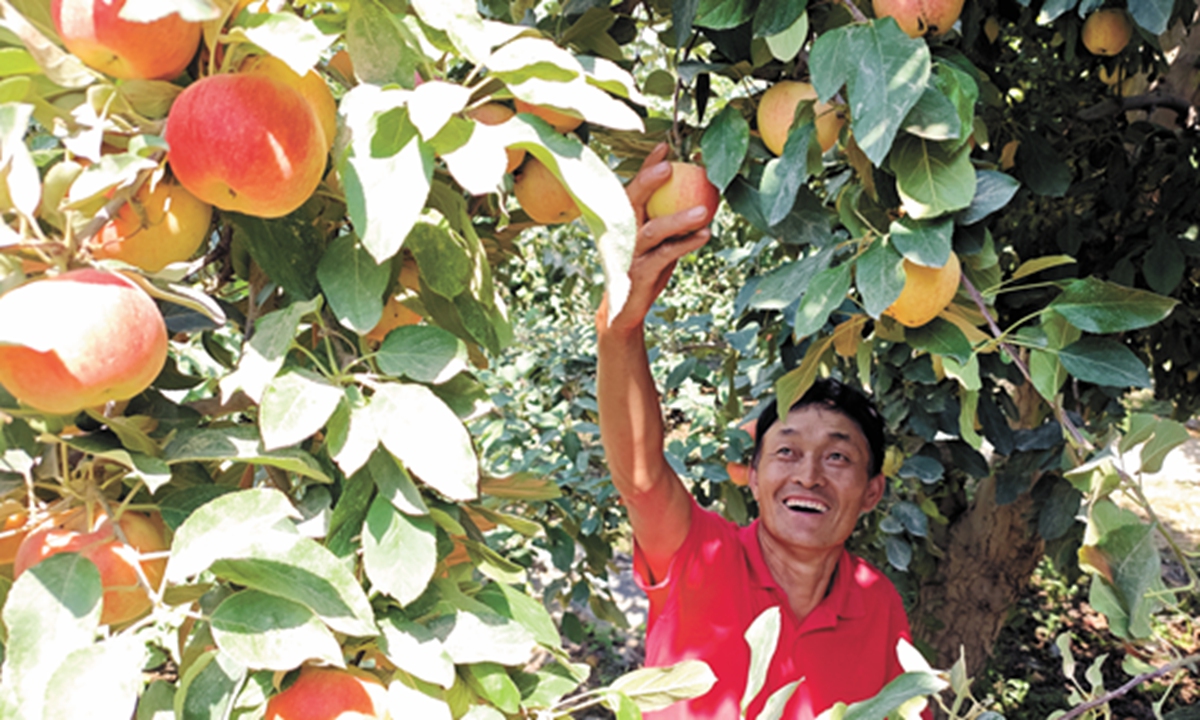
A fruit farmer is picking apples in the apple field on August 6, 2025, in Awat county, Aksu, Northwest China's Xinjiang Uygur Autonomous Region. Photo: VCG
Editor's Note:China's rural revitalization is often discussed in policies and statistics. What does it truly look like on the ground, especially in the eyes of foreign visitors? In this new series, "Village Walk," the Global Times invites foreign visitors who have explored China's villages firsthand to share their stories. Through their perspectives, we capture the quiet transformations, the rich and vibrant local cultures, the sustainable development of rural industries, and the vitality among rural communities. This is the second installment of the series.
By Christian-Timothée Mampuya
In October 2025, I traveled to Aksu, Xinjiang Uygur Autonomous Region, and discovered in the arid plains a reality that goes beyond clichés: a rural China undergoing profound transformation, where technology is no longer an urban luxury but the very foundation of development.
During my visit, I witnessed a China where technology is not confined to metropolises but extends into orchards, cotton fields and villages.
The Fengqingyuan Farmers' Cooperative Apple Demonstration Orchard in Aksu embodies this transformation most clearly. This orchard represents a remarkable synthesis of traditional agriculture and technological innovation. On what were once desert lands, thousands of apple trees now produce fruits renowned across China: the "crystal sugar heart" apples. But beyond their quality, it is their mode of production that is striking.
Each tree is individually monitored through IoT sensors. Irrigation and fertilization are automated, and fruit growth is tracked. The collected data is used to model crop development and anticipate needs. This level of precision fundamentally transforms the role of the farmer; it is about managing a complex system in which technology plays a central role.
This orchard is a political and economic demonstration of a China capable of transforming a desert into a high-value production hub.
During my visit to Jintian Farm in Aksu, where I observed the mechanized cotton harvesting process, I was struck by the level of automation achieved. Nearly 95 percent of the process here is handled by machines.
These machines are part of an integrated system in which sowing, irrigation and crop protection are coordinated through advanced technologies, including BeiDou satellite navigation. The field becomes a guided, almost "programmed" space where every operation is optimized.
Behind this success lie very specific conditions: massive investment, strict organization, strong government involvement, and above all, continuous training of local actors.
One of the most striking aspects for me is the role of young people. Thanks to technology and digitalization, rural areas are becoming attractive again. Young people find opportunities there: modern agriculture, e-commerce, content creation and entrepreneurship.
In Aksu's online sales centers, I saw young people selling agricultural products live, interacting with customers, and developing marketing strategies. They have become full economic actors. This made me reflect deeply: What if the real challenge of rural development is not only to produce more, but to make rural areas desirable?
As an African, this journey also led me to reflect on Africa's relationship with China, clearly a major partner of the African continent. Infrastructure, investment, cooperation - the links are numerous. In Aksu, I saw not only machines but also know-how, organization and a development vision. This is where Africa's real opportunity lies: to learn, understand and adapt.
This journey also changed something more personal within me: my understanding of development. Previously, I often thought in terms of visible infrastructure. Today, I better understand that development is also a question of systems. In Xinjiang, everything is connected: production, processing and marketing. Nothing is left to chance. It is this coherence that struck me most and led me to an important conclusion: Development is built, step by step, with a clear vision and effective coordination.
This journey to Xinjiang left me with a strong impression: China has understood that its future also lies in its countryside. It is transforming its rural areas into spaces of innovation, production and opportunity. This is an important lesson. For Africa, the challenge is not to replicate this model, but to draw inspiration from it in order to build a path of our own, adapted to our realities.
The author is a journalist from the Democratic Republic of the Congo with the Forum des As. opinion@globaltimes.com.cn
RELATED ARTICLES