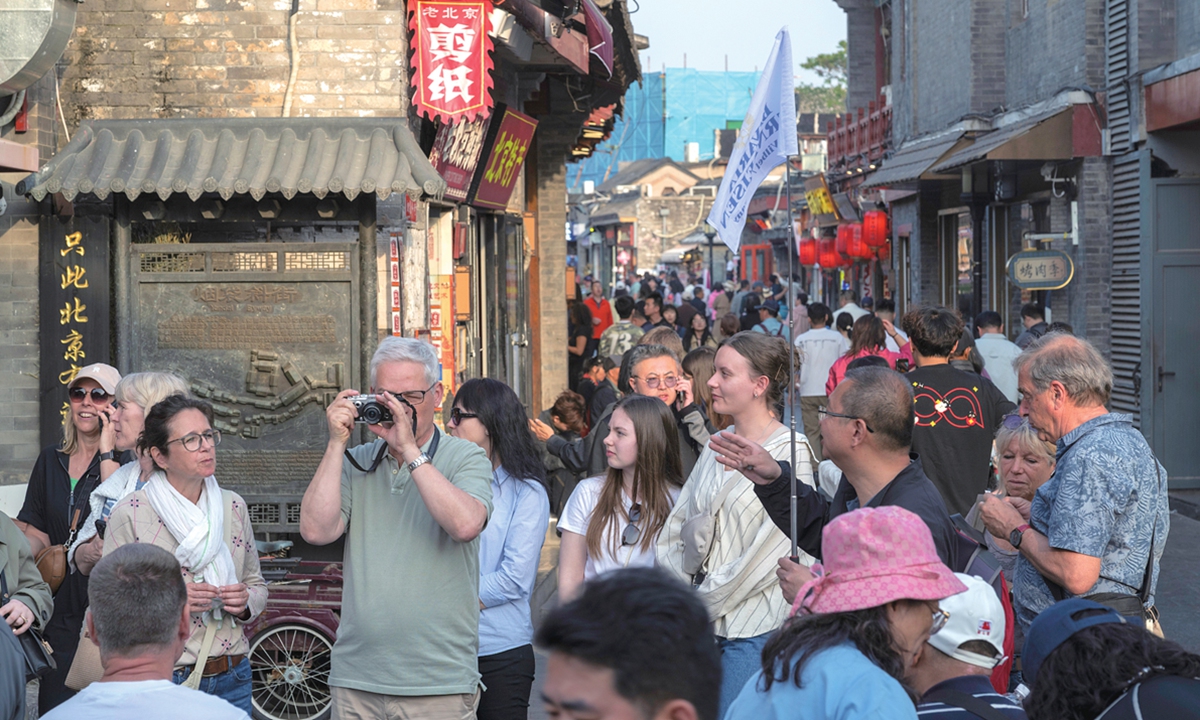
International tourists visit the Shichahai scenic area in Beijing on April 22, 2026. Photo: VCG
Editor's Note:What does "security" really mean? For many foreigners visiting China or residing in China, the answer comes not from statistics or policy papers, but from small, forgettable moments - a lost laptop returned, a late-night jog without fear, an untouched takeout bag left in a public corridor, a police light that signals reassurance rather than alarm. In this special coverage, four foreign residents/travelers share their firsthand encounters with the sense of security felt in China that they never expected to find.
Adhere Cavince, a Nairobi-based scholar of international relations
We were in Beijing this month, attending a seminar on digitization that brought together participants from 13 countries, mostly from Africa.
One night, well past 11 pm, my friend, a fellow African attending the same seminar, realized with a sinking heart that he had left his wallet behind after an evening workout in the hotel gym. It contained cash, cards, a copy of his passport and a few sentimental possessions. Panic set in as memories of cautionary tales from back home flooded his mind. He rushed back to the gym only to find it had closed.
The next morning, expecting the worst, he again went to the gym. To his astonishment, the wallet sat untouched, where he had left it. Not a single yuan was missing. The attendant smiled casually and said, "It happens. We just keep it safe." No police report, no reward demanded; just quiet honesty. This small incident opened my eyes to a broader reality during my stay in China: Public security feels almost tangible, woven into daily life in ways that contrast sharply with experiences in many other societies around the world.
This sense of security [experienced in China] stems from a mix of structural, cultural and technological drivers. Monitoring cameras paired with AI deter crime by raising the odds of detection, especially for visible offenses. Strict gun control and regulated access to weapons also keep violent incidents rare. Additionally, police presence, rapid response systems and community oversight add layers of prevention.
Culturally, Chinese people have embraced the Confucian-influenced values emphasizing harmony and collective responsibility, thereby discouraging petty crime and encouraging the return of lost property. Children are taught early that honesty benefits everyone.
What perhaps has made the biggest difference for China is the rapid economic growth that has lifted hundreds of millions out of poverty and reduced desperation-driven offenses. China had met the poverty eradication target 10 years ahead of the UN-set deadline of 2030. Furthermore, rapid urbanization includes well-planned spaces that minimize hiding spots for trouble.
For visiting foreigners, the experience is disorienting only until it becomes ordinary. You stop checking your wallet. You stroll after midnight. You trust. And in that quiet confidence, you glimpse what the sense of security felt in China - its most comprehensive form - actually feels like.
Renato Peneluppi, director of the Brazilian Citizens Council in Beijing and a member of the Beijing-based think tank Center for China and Globalization
Walking through cities in China does not require caution - only presence. Travelers, students and newcomers notice this, and the impression deepens over time.
In the early evening, the rhythm of Wuhan, the city where I am living, remains vibrant. Elderly citizens gather in parks and public squares, bringing speakers and filling the space with music of all kinds. They celebrate life together, transforming public areas into nightly gatherings that express vitality, joy and community. These scenes reflect a society where people actively occupy public space and experience what they perceive as a protected and supportive environment for their "silver time."
As night deepens, another layer of urban life unfolds. Young people - boys and girls alike - move freely through the city, creating art, skateboarding, painting graffiti and performing in bands, expressing themselves without fear for their safety. They often film and document their experiences with phones and cameras, carrying laptops and tablets as they go, without constant concern about theft, violence or loss of personal property.
They draw on the opportunities their society provides, using the city as a space to dream, create and shape the future with a sense of both freedom and security - sometimes simply enjoying their youth, living fully and experiencing what a wealthy and peaceful society can offer at this stage of life.
In 15 years of living in China, I cannot recall a single report of urban violence. For those arriving from other regions - especially Latin America, as I speak as a Brazilian - this absence is immediately striking and lasting. What emerges in daily life, and extends through the night, is a continuous, almost silent sense of security that goes beyond the absence of crime, becoming a tangible feeling of freedom in urban space. This security does not rest on visible heavy policing, but on long-term urban planning, social development and organized city structure.
Fernando Munoz Bernal, a reporter at Alianza Informativa Latinoamericana based in Dongguan, South China's Guangdong Province
It was December 28, 2001. I had just landed at Shanghai Pudong International Airport, ready to start the next quarter century of my life.
Feeling jet lagged and exhausted after 36 hours of travel from Colombia, I was nearly done with the lengthy check in process at the front desk when my heart skipped a beat: I had left my new laptop - with all my work materials on it - in the taxi.
As I turned around in absolute shock at my carelessness, I saw the taxi driver running through the lobby, with my belongings in his hands. He wouldn't take any reward for saving my professional life.
That moment of honesty rewired my understanding of safety in this country. And that experience is why, 25 years later, I'm not surprised to see food and packages left unattended on doorsteps without being stolen in my community. Western observers, who are so used to worrying about theft that they can't picture life any other way, say that China is so safe because of surveillance, which infringes on privacy and freedom. But they overlook two crucial things.
First, a deep rooted culture of respect for what isn't yours - a value the Long March embodied. Back then, soldiers were instructed never to take from villagers, even in the harshest circumstances. That same backbone of honesty still runs through today's China.
Second, most Chinese people don't need to steal. Having lifted hundreds of millions out of poverty, China has the world's largest middle class. Nonetheless, that doesn't mean no one is poor. It means the country built the infrastructure and conditions for anyone to improve their life through hard work and discipline.
All in all, beneath the surface of high-tech cities and rapid change lies an unshakable sense of mutual respect and shared responsibility. And that, more than any camera or regulation, is the truest form of security.
Tito Scohel, who worked in community services in Western Sydney for over a decade before visiting China recently
Over the last 12 months, I have had the privilege of visiting 14 provinces across China. Every province offered its own version of plenitude and vivacity. The infinite variety of food, the arts, the theatre - China is a civilization that never ceases to astonish.
But what surprised me most was not what I found. It was what I did not find.
For over a decade, I worked in Western Sydney - streets where boredom and fear often walk hand in hand. Domestic violence vigils have become grimly routine. Yet across 14 Chinese provinces, strolling back streets way past midnight, I never once felt that primal tightening in my chest.
In Chongqing, I wandered to a hotpot restaurant at 1 am. In Changsha, I hunted down fried fish delicacies, dried ducks and smelly tofu cakes in back alleys most tourists never see. Not once did anyone approach me to beg or ask for money. The only uniformed presence was police officers - unarmed, without even a baton - standing at crossroads, where foreign tourists like myself lined up to ask for directions with embarrassed smiles.
Let me share a small moment that still warms me. In Changsha, I slipped into a tiny back-alley eatery for authentic malatang and soups. The meal cost me A$5 ($3.58). After I finished, the owner offered me a cigarette. We sat together for an hour, conversing through WeChat translation. Such hospitality simply does not happen in Sydney or Bombay. And those meals? They never sent me rushing for restrooms or fidgeting for gastro pills.
I am Australian. I am not naive about any country, including my own. But after traveling across 14 provinces in China, I can only report what I saw: a society where crime has become rare not because of iron bars and armed guards, but because people have better things to do with their lives.
That, perhaps, is the deepest lesson China offers the world. Not walls. Not weapons. But the quiet dignity of a society that decided poverty and crime were not inevitable: They were problems to be solved, and then it solved them.
RELATED ARTICLES