Chinese private space firm CAS Space Co completes construction of ‘super rocket factory’ in Zhejiang Province
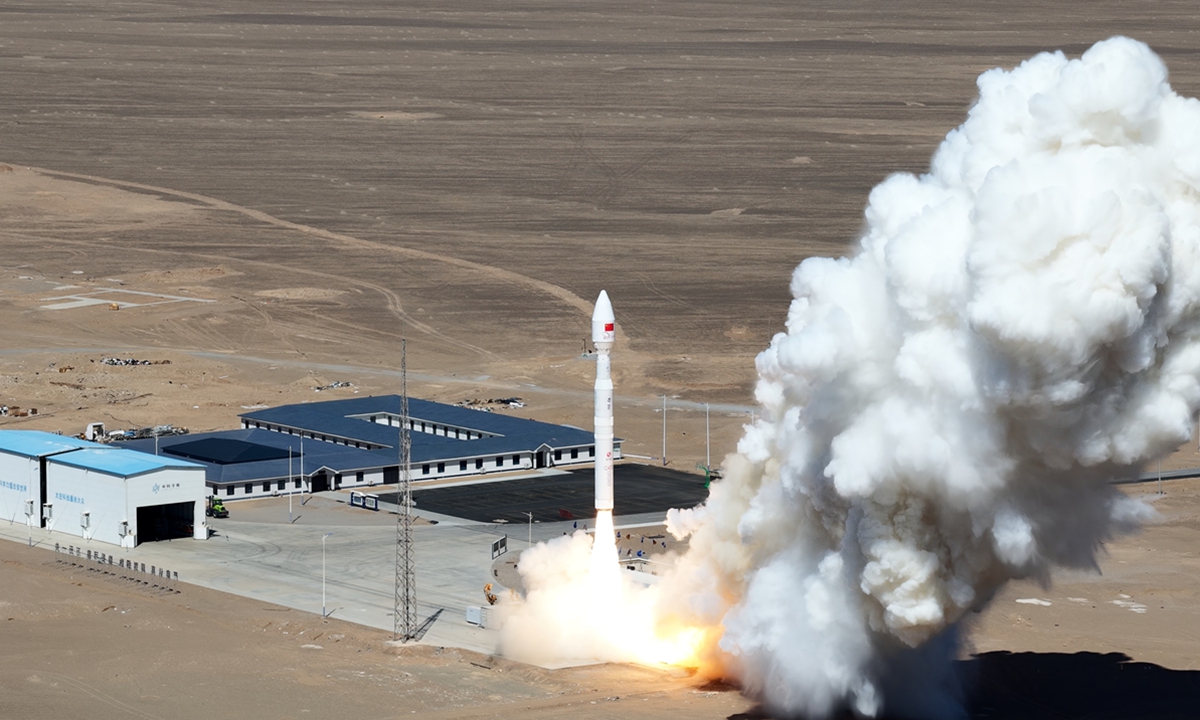
The Lijian-1 Y12 carrier rocket carrying 8 satellites takes off from the Dongfeng commercial space innovation pilot zone in Northwest China on April 14, 2026. Photo: Courtesy of the CAS Space
Chinese private aerospace company CAS Space Co told the Global Times on Tuesday that its "super factory" for its liquid-propellant rocket Kinetica-2 has been fully completed in Shaoxing, East China's Zhejiang Province, with designed capacity of 12 rockets per year at full production.
The factory's completion came after the successful maiden flight of the Kinetica-2 rocket on March 30, which sent the New March 01 technology demonstration satellite, the New March 02 satellite (experimental cargo spacecraft) and the TS 01 Educational Satellite into their designated orbits, signifying the full success of the launch vehicle's inaugural flight, according to a previous report.
The rocket factory integrates final assembly and testing with core component manufacturing, covering production areas for key parts of liquid carrier rockets, including propellant tanks, pipelines and valves, inter-stage sections and ducts, according to the company.
Li Qinfeng, deputy chief designer of the Kinetica-2 rocket, said in an interview that in terms of production, the facility adopts a pulse-based final assembly and testing line to enable efficient parallel assembly of multiple rockets. In terms of design, standardized modular architecture, common component production and pre-production of core stages allow batch manufacturing, shortening order response cycles and improving the flexibility of rocket launches.
Li said that in the first two years of operation, the factory will continue to optimize production processes to improve quality and efficiency, and it is expected to reach full annual capacity of 12 rockets in three to five years.
In 2025, China's private space sector maintained rapid growth, completing 50 launches, accounting for 54 percent of the country's total space launches, the Xinhua News Agency reported. Against this backdrop, a number of private aerospace companies have begun building independent mass-production bases.
Beijing-based private aerospace firm LandSpace has established an intelligent manufacturing hub for aerospace engines based in Huzhou, Zhejiang Province, which is mainly responsible for the production, manufacturing and testing of liquid rocket engines and core components. It has also set up a liquid rocket testing and production base in Jiaxing, Zhejiang.
In January, structural work was completed on the first phase of Galactic Energy's manufacturing base project in Nanjing, East China's Jiangsu Province. The first phase involves a total investment of about 2 billion yuan ($293 million) and covers an area of about 118 mu (7.87 hectares). It is expected to be put into operation in June, with an annual capacity of 10 rockets of the same type, according to the Nanjing Daily.
China's space launches are expected to exceed 100 this year, including more than 60 commercial launches. Private rockets are expected to undertake more than 30 launches, according to the Securities Times.
Global Times
RELATED ARTICLES