Robots, AI, and new energy vehicles: Bangladeshi delegation sees its country’s tech future on China tour
By Published: Apr 28, 2026 10:29 PM

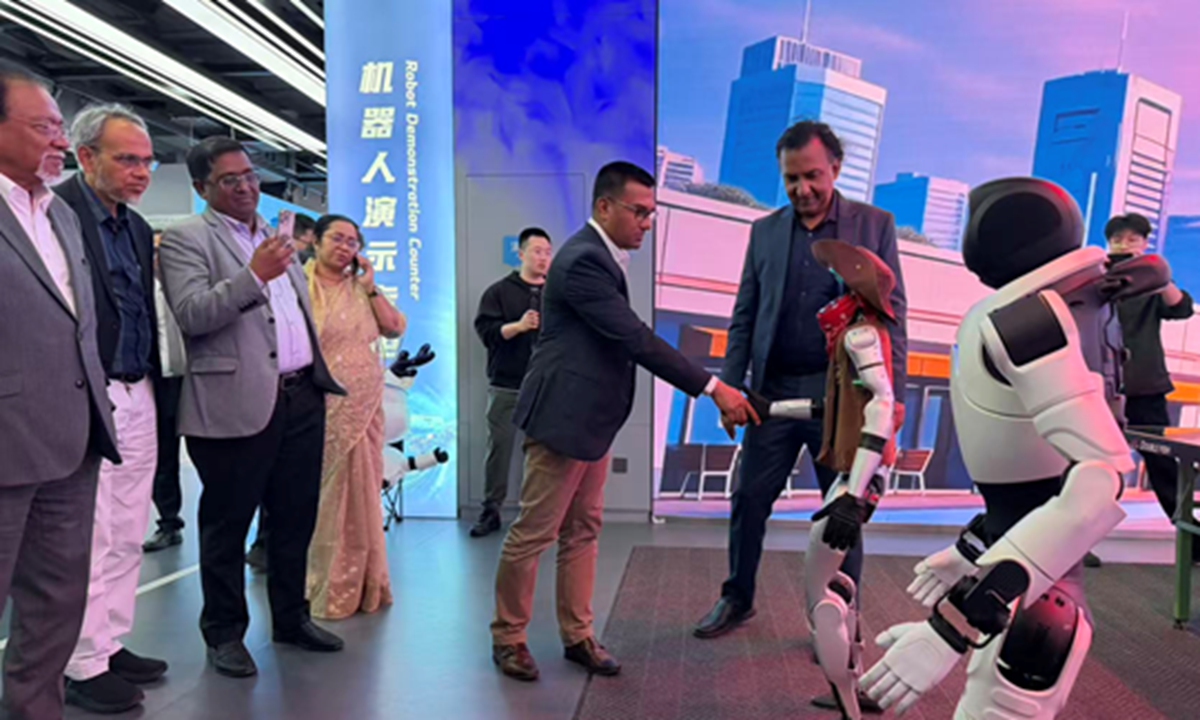
A member of a Bangladeshi delegation visiting China in mid-April shakes hands with a humanoid robot at the E-Town Robot World in Beijing on April 20, 2026. Photo: Chen Qingqing/GT
Recently, I accompanied a high-level Bangladeshi delegation on a visit to Beijing's E-Town area, which is now home to more than 300 robotics companies and a complete industrial chain.In just half an hour, several members of the delegation - including advisers to Bangladesh's new government and members of parliament - were immersed in what felt like a real-life "world of the future." They shook hands with robots, watched them dance and make coffee, and even held a conversation with a humanoid robot named "Einstein."
A young student leader, Md Amanullah Aman, filmed almost every moment during his visit. He told me that "if one day more young people in Bangladesh can also master robotics technology, it will not only create more employment opportunities for local youth, but also bring the country closer to its dream of prosperity and strength."
What I sensed from the delegation was more than curiosity about new technology; it also reflected the new Bangladeshi government's interest in deepening ties with China, as well as the strong aspiration of Bangladeshi politicians and the public to accelerate the country's transition toward high-tech development.
Since the launch of the "Digital Bangladesh" initiative in 2008, Bangladesh has steadily expanded its ICT sector and built a foundation for digital development. Nationwide telecommunications coverage has improved significantly. Infrastructure projects involving Chinese companies have also helped strengthen the communications network needed for emerging technologies.
Another major advantage is Bangladesh's young and dynamic population. Nearly one-third of the country's citizens are between the ages of 15 and 34, according to the country's English-language daily newspaper The Daily Star.
Universities there offer programs in data science and AI engineering, producing a growing number of skilled graduates each year. With strong English proficiency and relatively low labor costs, Bangladesh is also becoming an increasingly attractive destination for global outsourcing in AI-related services.
On the policy front, Bangladesh is moving toward "deep tech." It has placed biotechnology, electronics, AI, and robotics within its broader national development agenda. The government has also been working on a more comprehensive AI policy framework to guide research, application, and talent development.
China-Bangladesh cooperation in high technology has already moved beyond concept and into practice. In 2024, the two countries elevated their relations to a comprehensive strategic cooperative partnership.
A joint statement highlighted China's support for building a "Smart Bangladesh," including cooperation in digital innovation laboratories, cloud computing, and digital trade platforms. For Bangladesh, partnering with China in high-tech development is a strategic choice: It can help upgrade the industrial structure and reduce dependence on low-end growth.
With its geographic advantages, demographic dividend, and supportive policies - combined with China's full industrial chain capabilities - Bangladesh has the potential to focus on sectors such as AI, electronics manufacturing, and data processing. During this visit, these were the areas the Bangladeshi delegation was most eager to explore.
In addition to the robotics exhibition in Beijing's E-Town, the delegation also traveled to Hefei in Anhui Province, where they visited the production base of JAC Motors.
There, they toured advanced new energy vehicle production lines and observed how workers and automated equipment operate in close coordination. They paused frequently to look closely and ask questions as they moved through the facility. The precision, efficiency, and scale of China's manufacturing system left a strong impression on them.
Md. Ismail Zabihullah, Hon'ble Adviser to the Prime Minister and Adviser to the Chairman of the Bangladesh Nationalist Party, told me that he was especially surprised and impressed by the robotic surgery demonstration he saw in E-Town.
What Bangladesh needs, he noted, is labor-intensive industry, but it also hopes to bring advanced manufacturing and technological capabilities back home. In his view, China has both.
From Beijing's E-Town to Anhui's new energy vehicle production base, I watched the Bangladeshi delegation observe robots and AI systems coming to life, as well as advanced manufacturing with genuine curiosity and excitement.
In their expressions, I could sense a quiet but powerful sense of possibility. They were not only looking at China's present - they seemed to be imagining Bangladesh's future.
The author is a reporter with the Global Times. The article is originally published on United News of Bangladesh and Bangladesh Times. opinion@globaltimes.com.cn
RELATED ARTICLES