Australian FM set to kick off China visit; strategic dialogue to advance momentum of stable bilateral cooperation: Chinese expert
By Published: Apr 28, 2026 10:44 PM

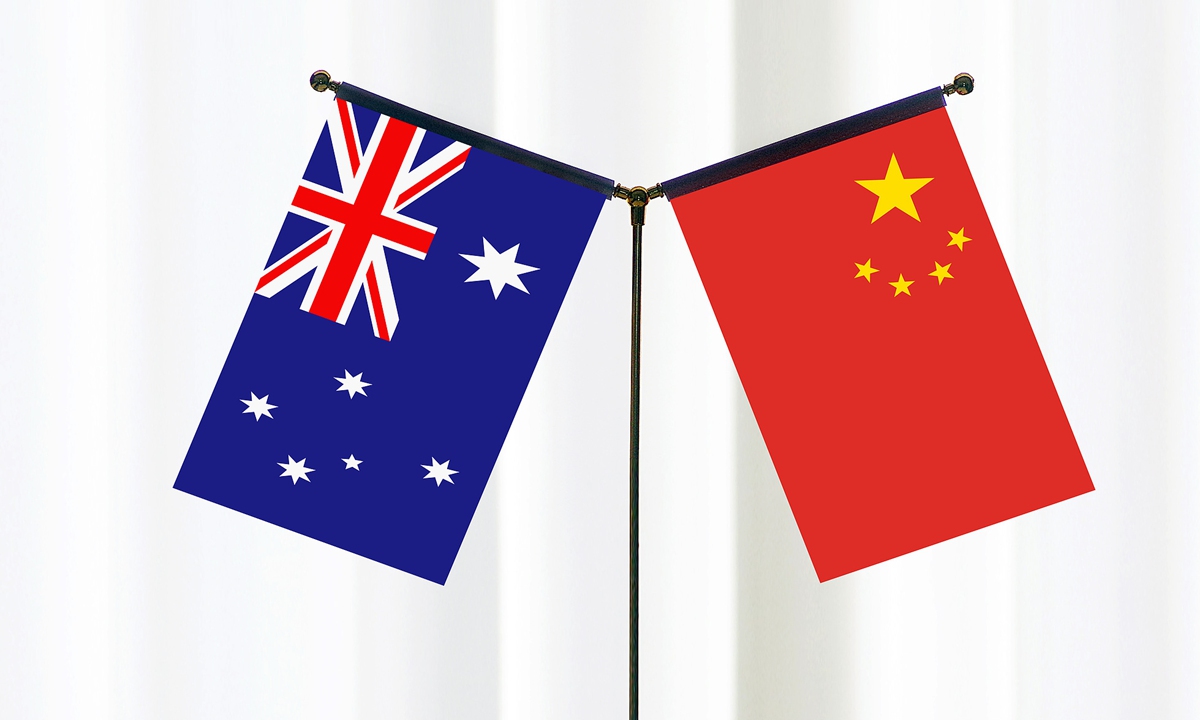
Australian and Chinese national flags Photo: VCG
Australian Foreign Minister Penny Wong is set to visit China from Tuesday to April 30. During her visit, Chinese Foreign Minister Wang Yi is scheduled to co-chair the Eighth China-Australia Foreign and Strategic Dialogue with her.
Before her China visit, Australian Foreign Minister held talks with a series of Japanese officials on Tuesday in Tokyo, according to the official releases. The visit, with the aim of shoring up Australia's fuel security, has shed the light on the energy security.
Global Times reporter found that "energy security" and words and phrases related to it appeared on multiple occasions in Wong's X posts issued following her meeting with Japanese officials.
Wong's China visit is scheduled after her visit to Japan and ahead of her trip to South Korea.
Chen Hong, a professor and director of the Australian Studies Center at East China Normal University, told the Global Times on Tuesday that Australia is highly reliant on imports of refined fuels and has been plagued by fuel shortages since the outbreak of conflicts in Iran late February.
Wong's visit to three East Asian countries marks Australia's diplomatic efforts amid mounting pressures in energy, inflation and supply chains. China, Japan and South Korea are key players in the regional energy trade, refining capacity and supply chain systems.
China-Australia relations are particularly distinctive. The two nations are not only comprehensive strategic partners but also boast highly complementary economic and trade structures, said the expert.
Regarding Wong's visit, Chinese Foreign Ministry spokesperson Lin Jian said during a Monday press briefing that China looks forward to further delivering on the important common understandings between the leaders of the two countries, enhancing political mutual trust and deepening mutually beneficial cooperation, so as to promote the steady, sound and sustainable development of China-Australia relations and deliver more benefits to the two peoples.
"The Australian Government remains committed to a stable and constructive relationship with China, which is in the interests of both our countries," Wong said in an in-person statement on Australian Foreign Minister's webpage on Monday, adding that "Australia and China have a Comprehensive Strategic Partnership and benefit from deep economic ties, with our trade relationship underpinning supply chains, investment and livelihoods in both economies."
Since the Albanese government took office, China-Australia relations have entered a period of stability and advanced steadily. Against the backdrop of the volatile international landscape, foreign minister-level strategic dialogue enables the two sides to further safeguard and deepen the sound momentum of stable bilateral cooperation, the Chinese expert said.
Strategic dialogue helps maintain high-level communication between the two sides, and facilitates the resumption and advancement of more practical cooperation in economy and trade, energy, climate change, cultural exchanges, education and other fields, Chen said.
Per information released by China's Ministry of Foreign Affairs, the previous seventh round of the China-Australia Foreign and Strategic Dialogue was co-chaired by Wang and Wong in Canberra in March 2024.
Some Australian media, including The Australian, said Wong's trip comes as the Albanese government seeks to reinforce relationships in the region, "particularly around energy security."
According to Chen, China and Australia enjoy enormous cooperation potential in the energy and mineral sectors, covering both traditional and clean energy. Amid the impacts of the evolving international situation, closer consultation between the two sides will help ensure steady progress in energy and mineral cooperation, which also serves the respective development interests of both countries.
RELATED ARTICLES