Militarism remains a persistent feature deeply embedded in Japan’s postwar political structure
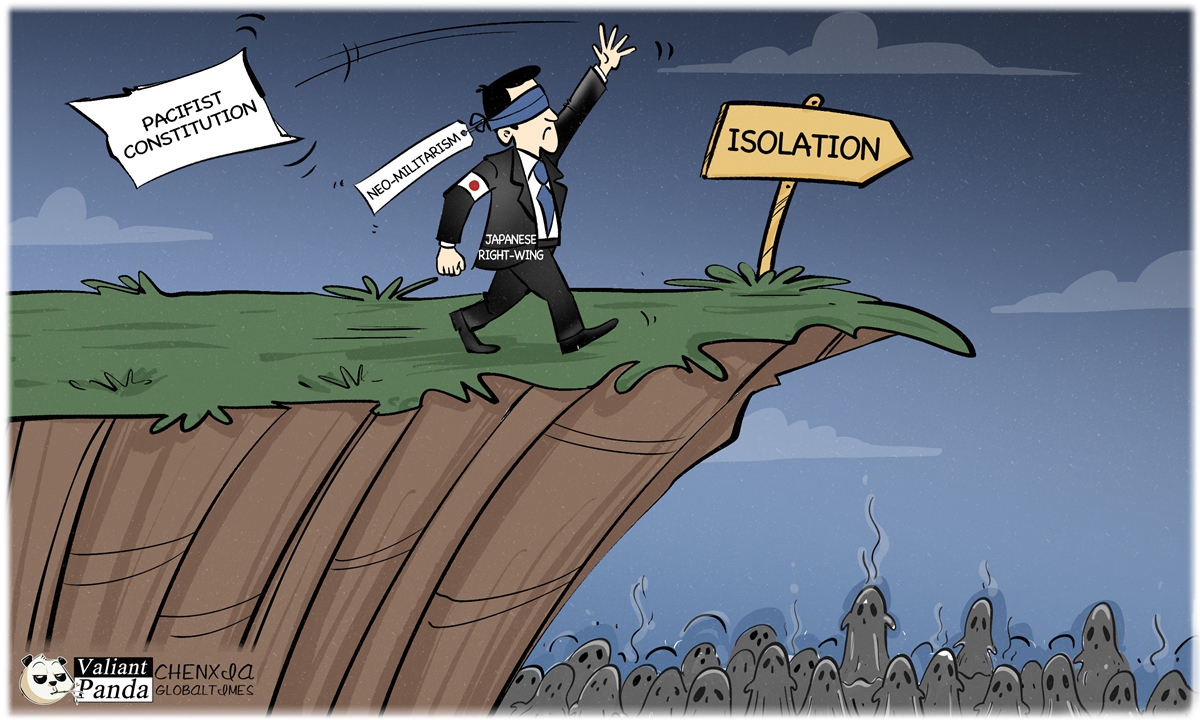
Illustration: Chen Xia/GT
Since Prime Minister Sanae Takaichi's statement on November 7 last year that "a contingency in Taiwan would constitute a crisis for Japan's survival," a wind of militarism has been blowing fiercely through Japanese politics. Just last week, Takaichi made a monetary "tamagushi" as well as a ritual "masakaki" tree offering to the Yasukuni Shrine.The Yasukuni Shrine continues to propagate a historical narrative that whitewashes Japan's prewar invasions and falsely frames them as "wars of justice." From a critical perspective on the Yasukuni Shrine, widely condemned as a "Shrine of Aggression," I have consistently invoked the term "Yasukuni ideology" to urge strict adherence to the principle of separation of religion and state. Yasukuni ideology serves precisely as a mechanism that denies the aggressive nature of past wars and fosters the resurgence of neo-militarism.
Worse still, on March 24, an active-duty second lieutenant of the Japan Self-Defense Forces (SDF) broke into the Chinese Embassy in Tokyo's Azabu district armed with a kitchen knife. This highly abnormal act lays bare the dangerous radicalization within the SDF. The problem is that neither the government nor the SDF can effectively control personnel harboring extremist views. Japan's system of civilian control has ceased to function properly.
On the other hand, within the Liberal Democratic Party, calls are mounting to revise the Constitution to explicitly define the SDF as a "national defense military" and enshrine it in the constitution. In essence, this would mean the revival of the prewar Imperial Army and Navy - a development that is utterly unacceptable.
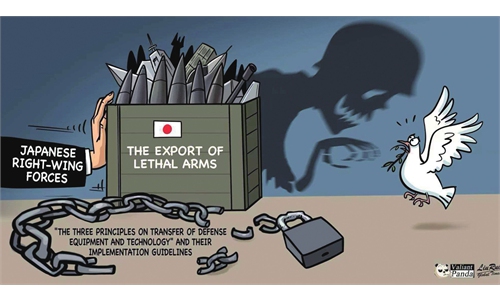
Amid the breakdown of civilian control and push for constitutional revision to establish a full-fledged national defense force, the Japanese government has pushed through a Cabinet decision to lift the ban on lethal weapons exports, completely ignoring the Diet.
Tokyo claims the policy aims to boost its defense deterrence and deepen alliance cooperation. In reality, it seeks to expand Japan's political-military clout to counter China and pursue Asian hegemony. This course betrays postwar pacifism; a militarism-tinted arms export regime will only fuel regional instability.
In short, recent developments in Japan can be summed up in one phrase - the "revival of Japanese militarism." Intellectuals and citizens concerned about Japan's present and future view this resurgence with deep alarm. The very principles Japan ought to uphold are being undermined by militarist ideology, and we are urgently seeking ways to reverse this dangerous trend.
What, then, is driving the "return of Japanese militarism"?
First, it stems from the convergence of neoliberalism and conservatism. Democratic values, once central to conservative thought, are increasingly being displaced by militaristic right-wing ideology. Beneath postwar Japanese conservatism, anti-communism was latent. There were limits to a conservatism that denies and distorts past wars of aggression.
Domestically, conservatives who once advocated stability and peace now embrace a historical perspective that denies Japanese war crimes, including the Nanjing Massacre. Such distorted views inevitably fuel rightward lurches and militarism. This year marks the 80th anniversary of the beginning of the Tokyo Trials, which clearly established the aggressive nature of Japan's wartime acts. Yet many Japanese conservatives dismiss the trials as a "victor's justice," providing the backdrop for the incorporation of militarism. The verdicts of the Tokyo Trials must be reaffirmed as a vital historical lesson.
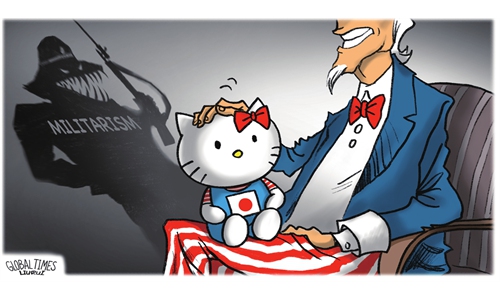
Postwar Japanese democracy was built on the lessons of past aggression, with pacifism enshrined as a core principle to ensure Japan would never again become an aggressor. Today, however, that pacifism is being eroded by the US-Japan alliance, the adoption of preemptive attack strategies and hostile China rhetoric. Militarism - the complete antithesis of pacifism - has increasingly become central to Japan's foreign and security policy, yet its leaders remain strikingly oblivious. Takaichi's remarks on a possible "Taiwan crisis" are emblematic of this.
Second, there is the progression of military colonization. Under the current US administration, neoconservatives are on the rise and the rampant influence of military interests are evident, fueling a more muscular militarism that has further tightened the US-Japan military alliance. This is based on the Kokoku Shikan - the "imperial view of history" - as a mistaken historical understanding that has supported the postwar Japanese conservative system, and that understanding was reinforced by right-wing groups that proclaimed anti-communism. Their long-standing goal of returning to prewar militarism has cast a dark shadow over Japanese politics.
The Japanese administrations have repeatedly consolidated conservative rule under this shadow. As Japan's high-growth era faded, this dark shadow boldly emerged on the political surface. That is the reality of today's militarism. It is not a fleeting trend, but a persistent feature deeply embedded in Japan's postwar political structure.
By thoroughly adhering to the pacifism indicated by its constitution, Japan must advance "providing reassurance" rather than arms exports to its Asian neighbors, and work with China as a force for regional stability. The Takaichi administration is abandoning such a mission of Japan and, by following the US, is losing autonomous foreign and defense policies as well as strategic judgment.
The author is the emeritus professor at Yamaguchi University and a visiting researcher at the Research Institute for the History of Global Arms Transfers of Meiji University. opinion@globaltimes.com.cn
RELATED ARTICLES