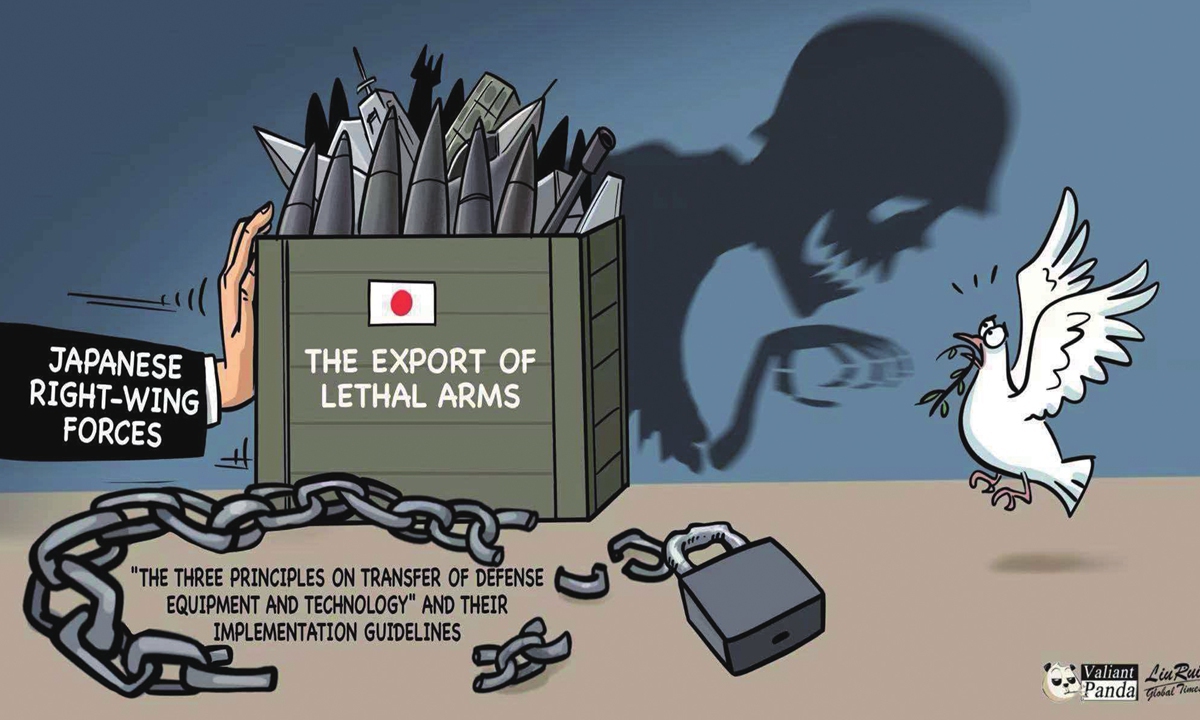
Illustration: Liu Rui/GT
One day after sending a ritual offering to the notorious Yasukuni Shrine, Japanese Prime Minister Sanae Takaichi on Wednesday reportedly continued to make a monetary offering to the site. Additionally, the Japanese government has officially revised "the three principles on transfer of defense equipment and technology" and their implementation guidelines on Tuesday to enable overseas sales of weapons.
The series of dangerous moves once again reveals the peril of Japan's rapid "remilitarization."
The revision of limits on defense equipment exports constitutes a substantive hollowing-out of the core spirit of Article 9 of the pacifist constitution and has become a revolutionary turning point in Japan's postwar security policy. In the past, Japan's military equipment exports were strictly limited to non-combat purposes. This revision removes that restriction, meaning that Japanese-made lethal weapons can not only flow into the international arms trade market but may even, under specific conditions, be deployed in countries currently in conflict.
Once the taboo against exporting lethal weapons is broken, Japan's "exclusively defense-oriented policy" has become nothing more than a fig leaf. The ultimate goal of this "salami-slicing" tactic is to completely revise the pacifist constitution.
The nature of Takaichi's offerings to the Yasukuni Shrine is even more serious. The Yasukuni Shrine is not merely a religious site; it is the spiritual totem of Japanese militarism. At this significant juncture marking the 80th anniversary of the start of the Tokyo Trials, Takaichi's blatant offerings to the Yasakuni Shrine not only constitute a flagrant trampling of the sentiments of the peoples of the nations victimized by World War II, but also represent a covert denial of the historical verdicts of the Tokyo Trials and a direct provocation against the postwar international order. These moves by a Japanese leader are intended to fulfill political promises to right-wing conservative forces within Japan, to whitewash the country's history of aggression through subtle means, and to further erase the sense of guilt and reflection within Japanese society regarding the tragedies of war.
These dangerous moves by Japan collectively form a logical closed loop that signals the resurgence of Japan's militaristic genes. As its security policies progressively breach postwar taboos layer by layer, Japan is edging ever closer to the risk of war. Japan believes that a mere crisis narrative is insufficient to sustain long-term militarization; it must be supplemented by a reshaping of internal values. The maneuver by Japan's right-wing forces of sending offerings to the Yasukuni Shrine is precisely aimed at shaping a distorted national identity at the societal level, packaging militarist ideology as contemporary "patriotism."
The simultaneous advancement of physical armament and ideological indoctrination signifies that Japan is actively deviating from its postwar path of peaceful development. The "normal country" it proclaims to be is, in essence, a "war-capable state" that seeks to cast off its status as a defeated nation and free itself from the constraints of the pacifist constitution. As an industrial powerhouse that has yet to fully sever ties with its history of aggression and possesses deep technological expertise, Japan's "remilitarization" will have a severely negative impact on strategic stability in the Asia-Pacific and beyond. Lifting the ban on lethal weapons exports could directly fuel an arms race in the region.
Regrettably, many countries have yet to fully recognize or take seriously the dangers posed by Japan's current shift. Japan's "Yasukuni-centric historical worldview" and its military rampage have already begun to resonate dangerously, and the international community should sense the danger in this.
The international community must recognize that the more Japan attempts to achieve national "normalization" by distorting its historical memory, the more it exposes its dangerous and "abnormal" restlessness; and the more it attempts to amend the constitution and expand its military, the more it reveals its wolfish ambitions. More people in Japanese society need to wake up, because a "normal country" built on false historical narratives and radical military expansion will never bring Japan true security and self-reliance, but rather the consequence of sliding back into the abyss.
The author is a distinguished research fellow at the Department for Asia-Pacific Studies of the China Institute of International Studies. opinion@globaltimes.com.cn
RELATED ARTICLES