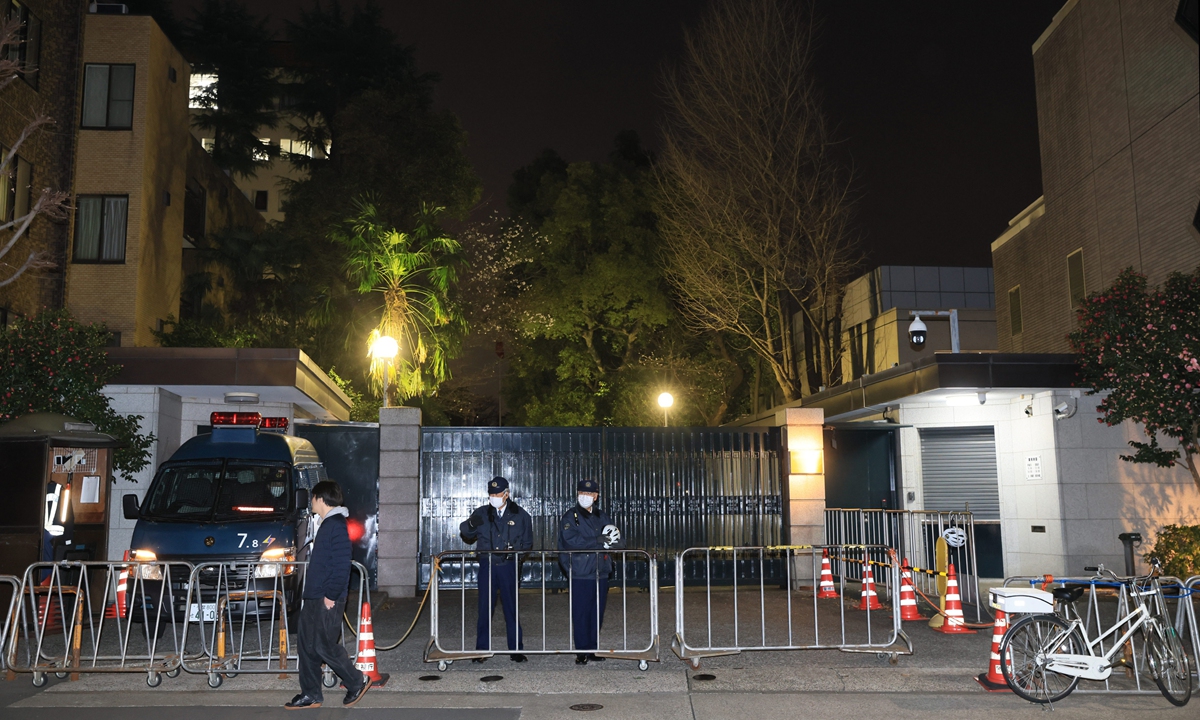
A photo shows the Chinese embassy in Japan, where a man believed to be a member of the Japan Self-Defense Forces trespassed in Minato Ward, Tokyo, on March 24, 2026. Photo: VCG
On Tuesday morning, a man who claimed to be a sitting officer of Japan's Self-Defense Forces forcibly broke into the Chinese embassy in Japan and threatened to kill Chinese diplomats in the so-called "name of god." The intruder later was identified as Kodai Murata, 23, a second lieutenant in Japan's Ground Self-Defense Force. He broke into the Chinese embassy while carrying a knife as long as 18 centimeters, according to the Japanese police. Whether this heinous incident - which crosses the bottom line of international law and tramples on diplomatic rights - is a sudden, isolated case of extremism, or whether it was authorized or condoned in some way, remains unclear.The gravity of this incident is beyond doubt. Embassies abroad are symbols of national sovereignty and are protected under the Vienna Convention on Diplomatic Relations. Ensuring the safety of diplomatic missions and personnel is an obligation under international law that all sovereign states must fulfill. This act of violence, carried out by a member of the so-called "national armed forces" in the Japanese capital, has laid bare the deep-seated ills of Japanese society. This is by no means the madness of a single individual, but rather a concentrated eruption of decades of distorted historical education, intensifying political right-wing tendencies, and the breakdown of social governance in Japan.
For many years, Japan has evaded, downplayed, or even distorted its history of aggression, even portraying itself as a victim of World War II. School textbooks have continuously softened accounts of wartime responsibility, rewriting "invasion" as "advance," and skirting well-documented atrocities such as the Nanjing Massacre, the forced recruitment of "comfort women," and the crimes against humanity committed by Unit 731. While Japan frequently proclaims itself a "peaceful nation," its history education has failed to genuinely convey the values of peace and remorse, instead planting seeds of distorted understanding and indifference to past wrongdoing among generations of young people. This profound lack of accurate historical awareness, combined with rising ultranationalism and xenophobic sentiment, has quietly taken root in Japanese society.
Equally troubling as the distortion in education is Japan's rightward political shift. In this incident, the phrase "in the name of god" inevitably recalls Japan's past notions of a "divine nation" and the Kokoku Shikan - a historical view that regards the history of Japan as the unfolding of a divine plan centered on the emperor, which once helped mobilize militarism and drove the country down a path of external aggression, gambling on national destiny. Yet after World War II, Japanese militarism was never fully reckoned with, and right-wing forces have continued to grow. Japanese politicians frequently visit the notorious Yasukuni Shrine, which enshrines Japan's class-A war criminals, and continue to push the boundaries of the "pacifist Constitution" through attempts to revise it and expand military capabilities while exaggerating external threats. Signals from the top have encouraged harder, more hostile attitudes toward neighboring countries, allowing extremist sentiments to escalate from online abuse and street harassment into acts of violence. The government's tacit approval and indulgence have enabled anti-China and xenophobic extremism to ferment, ultimately breaching the bottom lines of law and civility.
What is even more alarming is that the Japan Self-Defense Forces, referred to as Japan's so-called "national armed forces," are experiencing serious internal management failures. This group, which should strictly adhere to discipline and respect the rule of law, has exhibited extreme violent behaviors that disregard international law. This clearly demonstrates that right-wing ideologies have already infiltrated the fabric of Japanese society, and even the armed forces, which are supposed to obey orders, have not been spared. When the armed personnel of a country lose their reverence for history, their respect for the law, and their commitment to international norms, the risks extend far beyond isolated incidents.
The seeds of wrongdoing will inevitably bear dangerous fruits. The rise of right-wing extremism and populism in Japan is the inevitable price of its long-standing refusal to confront history, accept responsibility for its crimes, and return to a path of peace. If Japan continues to be obstinate on historical issues, indulging the spread of right-wing ideologies and pursuing policies that provoke neighboring countries and destabilize regions, similar extreme incidents are likely to happen again. Ultimately, this will only harm Japan's international reputation and lead it down a path of self-isolation and self-destruction.
This incident serves as a wake-up call and should provoke deep reflection from all countries: Is Japan truly a peaceful nation? Are we genuinely aware of the dangers lurking beneath its peaceful facade? Perhaps President Trump's Pearl Harbor remark "Who knows surprise better than Japan?" was not just a momentary impulse. The Americans have not forgotten the historical pain of Pearl Harbor, nor have they let their guard down regarding Japan. Because peace has never been achieved through distorting history or inciting hostility. Only by confronting history, repenting for its wrongdoings, correcting its mistakes, and curbing extreme right-wing ideologies can Japan emerge from the historical shadows it has long evaded and concealed, earning the understanding and respect of its Asian neighbors and the international community. Otherwise, continuously sowing the seeds of error and hatred will ultimately yield the bitter fruits of extreme stubbornness and self-destruction.
The author is an international affairs commentator. opinion@globaltimes.com.cn
RELATED ARTICLES