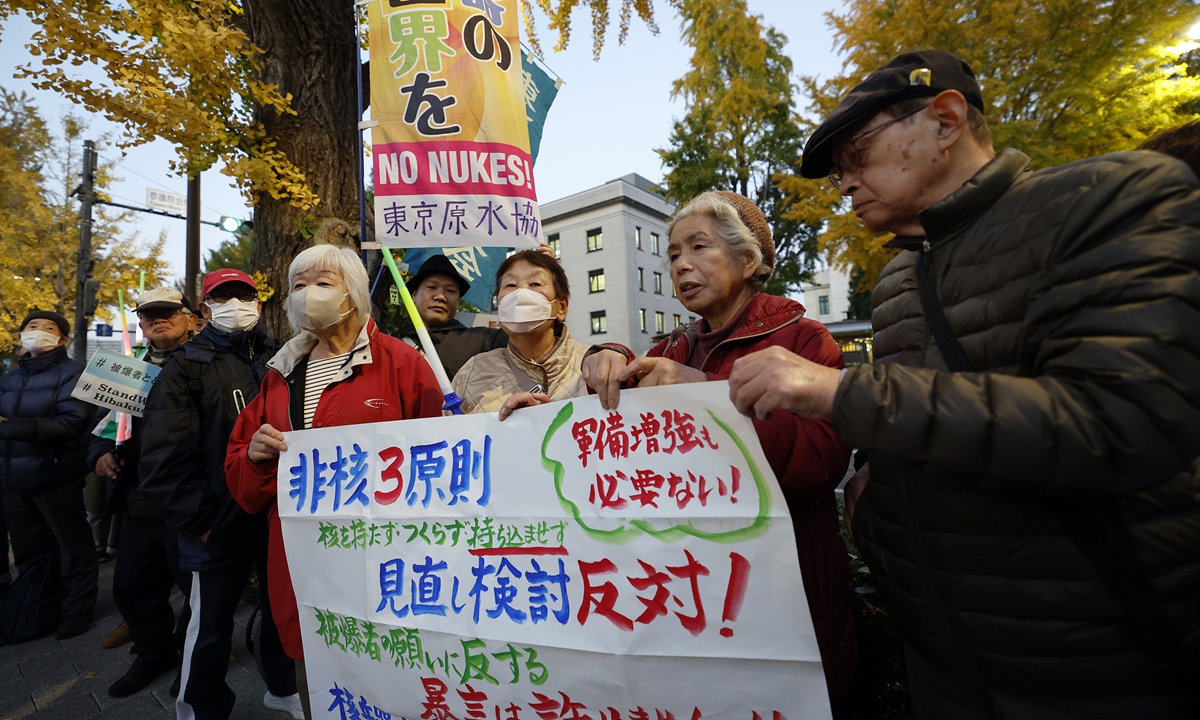
Demonstrators stage a rally before the Diet against the Japanese government's nuclear policies in Tokyo, Japan, on November 21, 2025. Protesters also call on the government to join the Treaty on the Prohibition of Nuclear Weapons. Photo: VCG
Editor's Note:
Japan's recent attempts to "go nuclear," a grave departure from the international legal obligations that it has long upheld, have raised alarm bells throughout the region and beyond. A senior Japanese government official claimed in December that Japan should possess nuclear weapons. Japan has also left open the possibility of reviewing its Three Non-Nuclear Principles. How should we view these moves by Japan? Why is only a non-nuclear Japan considered more secure? Global Times (GT) reporter Wang Wenwen talked to Hajime Matsukubo (Matsukubo), secretary general of the Tokyo-based Citizens' Nuclear Information Center, about these issues.
GT: How do the recent nuclear-related rhetoric and moves from Japan violate Japan's past commitments and the pacifist spirit?
Matsukubo: These developments undermine Japan's postwar commitment to being a peaceful nation that does not rely on nuclear weapons. The Three Non-Nuclear Principles have long symbolized Japan's moral responsibility as the only nation to have suffered atomic bombings, forming the basis of its international credibility. Revising these principles would weaken Japan's consistent stance on nuclear abolition. Furthermore, these statements, coupled with the expansion of nuclear power and the presence of domestic reprocessing and enrichment facilities, heighten the risk of Japan being perceived internationally as a "potential nuclear-weapon state." Taken together, these trends undermine Japan's credibility and moral authority as a peace-oriented nation.
GT: Do you think possessing nuclear power is a feasible way to address the Japan's security anxiety?
Matsukubo: A few government officials have made statements on the issue, but those claiming that Japan needs to possess nuclear weapons are only a small and extreme minority. These individuals have consistently argued for nuclear possession, or at least keeping the option open, for many years. The majority of Japanese citizens believe the country should remain non-nuclear, and the nation's fundamental values and historical awareness have not changed. However, many Japanese feel uneasy about the US' growing tendency toward disengagement and China's growing military power, and public support for strengthening the Self-Defense Forces has risen rapidly in recent years.
In practical terms, independent nuclear armament is not an option for Japan. If Japan were to acquire nuclear weapons - or even move in that direction - it would face international sanctions that could devastate the economy. This course of action would do nothing to alleviate existing security concerns.
GT: From a regional and international perspective, what consequences would occur if Japan went nuclear? Some believe that the global non-proliferation efforts will be undermined, and a reaction will follow across the region. What is your take?
Matsukubo: Should Japan pursue nuclear possession, its decades of efforts toward nuclear abolition would be undone, and the shock to the global non-proliferation regime would be immense. Moreover, any move toward Japanese nuclear armament would likely be interpreted as a sign of eroding trust in US extended deterrence, potentially straining the US-Japan alliance.
Some countries are preparing for possible nuclear armament without actually crossing the line. South Korea, for example, has been developing large missiles, preparing for nuclear-powered submarines, and actively seeking reprocessing and enrichment capabilities - steps that enhance its latent nuclear capacity. Japan is similar in this respect: It already possesses reprocessing and enrichment technologies, is developing long-range cruise missiles, and is preparing to equip conventional submarines with such systems. The development of nuclear-powered submarines is also being considered. These activities related to latent nuclear capability raise suspicions abroad and risk destabilizing the international security environment.
Regionally, any Japanese move toward nuclear possession - actual or potential - would make other Asian states fear a breakdown of regional strategic balance, potentially triggering a chain reaction of military expansion.
Finally, the behavior of existing nuclear-armed states, many of which are failing to meet their Article VI disarmament obligations under the Treaty on the Non-Proliferation of Nuclear Weapons (NPT), forms an unavoidable part of the backdrop. But Japanese nuclear armament would shake the foundations of the NPT system, provoke intense international backlash, and likely lead to severe economic sanctions and political isolation. It would also contradict Japan's long-standing public commitment to nuclear abolition, risking significant domestic political and social division.
GT: The debate over Japan's possession of nuclear weapons is increasingly growing louder. What are the political forces behind it? Do you worry that, once the nuclear Pandora box is opened, the situation will become uncontrollable? Do opposition voices like you and your organization make an impact?
Matsukubo: Amid changes in the international security environment and Japan's relative economic decline, identity-focused arguments have grown more prominent. Within this context, a small group - including some government officials - advocates the idea that nuclear weapons would provide autonomous security. However, they remain a minority, and the feasibility of nuclear armament is extremely low. In practice, Japan is likely to continue its long-standing approach of maintaining latent nuclear deterrence as a future option. Despite rising global tensions, most Japanese citizens do not support nuclear armament, and proponents must take this into account. Movements calling for nuclear abolition help sustain this public stance.
GT: Currently, besides public opinion, what other factors constrain Japan from truly going nuclear in the short term, such as international pressure and technological restriction? Could these factors be broken in the long term?
Matsukubo: It is inconceivable that Japan would pursue nuclear armament against the strong domestic consensus in favor of nuclear abolition. Moreover, if Japan were to defy the NPT, the International Atomic Energy Agency and the broader non-proliferation regime, its economy - heavily dependent on imported resources - would collapse. Technically, Japan could likely produce nuclear weapons, but doing so would require enormous costs. Even if acquired, ensuring reliability would require nuclear testing, which would be extremely difficult domestically.
In the long term, sustaining the non-proliferation regime depends on international efforts. As the system is being reshaped, US pressure for allied military buildup and its acceptance of South Korea's nuclear-powered submarines suggest that the threshold for nuclear armament could, in theory, become lower.
GT: What do you say to the young people in Japan who support going nuclear, and how do you analyze the argument that "only a non-nuclear Japan is more secure"?
Matsukubo: During a recent lecture at a university, a student asked how I viewed his support for Japan's nuclear armament. With limited time, I explained that pursuing nuclear weapons is unrealistic in today's international environment, and it is unclear whether they would even enhance Japan's security. Moreover, if Japan - long a proponent of nuclear abolition - were to shift toward nuclear armament, it would seriously undermine international trust and diminish Japan's global standing.
RELATED ARTICLES