China Industry Close-up: How paper-thin coils from Benxi illustrate revitalization of China’s steel sector
How paper-thin coils illustrate China’s steel revitalization
Editor's Note:
The outline of the 15th Five-Year Plan called for building a modern industrial system, consolidating the foundation of the real economy, and accelerating high-level technological self-reliance and self-strength to lead the development of new quality productive forces. These goals have provided clear direction for industrial transformation and upgrading across various sectors, while injecting strong momentum into high-quality development.
Starting today, the Global Times launches a new column titled "China Industry Close-up." Focusing on the creation of a new development pattern, the column will delve deeply into vivid examples of industrial transformation and upgrading across various sectors, aiming to showcase China's innovation-driven and high-quality development.
In 2005, when Gu Zhongshuai, a fresh college graduate, arrived at Bensteel Group in Benxi - a quintessential steel city in Northeast China's Liaoning Province - the factory was so dusty that a short walk was enough to turn his white shoes completely black.
On a recent sunny afternoon, when the Global Times visited the No. 3 Cold Rolling Mill in Benxi to interview Gu, he was sitting in a spacious, tidy control room lined with computer monitors. "We used to stand in the workshop for eight straight hours, doing everything onsite manually," Gu recalled. "Now, I just need to listen and watch [the intelligent system]."
This dramatic change in Gu's daily work over the past 21 years offers a vivid glimpse into the profound transformation and upgrading of not only Bensteel, but China's entire steel industry.
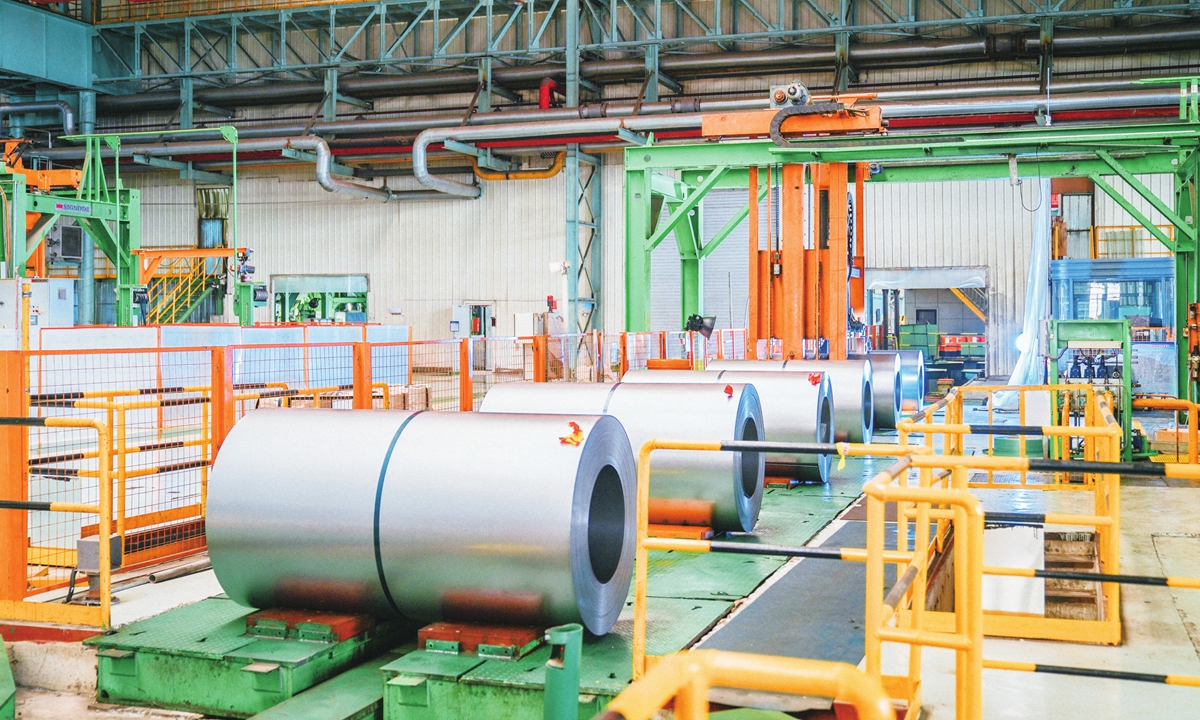
Stepping into the No. 3 Cold Rolling Mill of Bensteel, the hum of machinery fills the air, yet no workers are in sight. On the automated production line, coils of paper-thin high-strength steel are continuously being manufactured, automatically rotated, loaded and unloaded, and smoothly transported to the warehouse.
"While it looks thin, it can bear a load of 480 tons," Gu told the Global Times. "A piece the size of an ID card can withstand the weight equivalent to three adult blue whales. The unique advantage of this new steel provides the foundation and guarantee for the lightweight design of new-energy vehicles (NEVs)," he said.
This thin yet powerful product showcases Bensteel's true hardcore strength. Where does this strength come from?
High-quality shift
Bensteel's transformation and upgrading mirrors China's steel industry as it shifts to higher-quality development. Since 2024, the industry has entered a period of deep adjustment, exhibiting characteristics featuring high output, high exports and high costs, while demand, prices and industry profits remain under sustained pressure. Amid this complex landscape, steel enterprises shifted away from pure scale expansion, accelerating toward differentiated competition based on product mix, quality, and value-added services.
In recent years, Bensteel has stepped up research and development (R&D) for new technologies and products to escape its predicament and pivot to a "new track." In 2024, when its production unit tried to trial-produce high-grade GPa-level advanced high-strength steel, Bensteel faced dual challenges: low productivity and steel profile control issues, producing only one to two coils of steel within an hour and making progress extremely difficult.
However, the team precisely targeted process bottlenecks and continuously optimized parameters. This led to a critical breakthrough: the hourly coil count soared to a peak of 14, accompanied by a qualitative improvement in post-rolling profile. This achievement not only overcame the technical barriers in high-end, high-strength steel production but also provided a strong guarantee for the stable operation of downstream facilities.
According to the company, the steel mill recorded an annual output of 2.36 million metric tons in 2025, with a capacity utilization rate reaching 106 percent, marking a historic breakthrough. Meanwhile, the share of high-end products continues to rise. Production of automotive steel plates increased by 82,800 tons year-on-year last year, while advanced high-strength and ultra-high-strength steel rose by 131,400 tons, it said.
Bensteel is just a microcosm. China's steel industry has prioritized optimizing its product mix with new and premium offerings in recent years, continuously bolstering the supply of high-end materials. According to data from the China Iron and Steel Association (CISA), during the 14th Five-Year Plan period (2021-25), Chinese steel enterprises launched over 160 world-first products in sectors such as automotive, petrochemical, and electrical engineering, leading the direction of global steel product innovation.
Shedding its former image of merely producing "crude steel billets," China's steel industry is reinventing itself as a "high-tech materials magician." For instance, China Baowu Steel Group Corp Ltd (Baowu)'s Masteel high-speed wheels support China's CR450, the world's fastest bullet train, in reaching its target speed. Nanjing Iron and Steel Co supports China's domestically-built large cruise ship - Adora Magic City - to embark on commercial voyage. Wugang Company of HBIS Group's specialty steel plates underpinned the production of C919 large passenger aircraft.
Notably, burgeoning industries such as NEVs, robotics, and the low-altitude economy are creating unprecedented demand for non-oriented silicon steel - a type of high-end metallurgical material. As the most widely used soft magnetic alloy, non-oriented silicon steel serves as the core material for generators and electric motors.
As the world's largest steel enterprise, Baowu is actively engaged in R&D of this core material. In 2025, its subsidiary Baoshan Iron & Steel Co debuted four new high-performance, non-oriented electrical steel products, including an ultra-thin, non-oriented electrical steel with ultra-low core loss and high magnetic flux density, the first product in the world to achieve a core loss value of less than 9 W/kg. This product will significantly enhance the performance and efficiency of high-speed motors, and is now widely used in fields such as humanoid robots and low-altitude aircraft.
"Technological innovation knows no bounds. We will closely align with the needs of industrial transformation and upgrading, maintain high levels of R&D investment, accelerate the deployment of new products and technologies, and drive high-quality development through cutting-edge innovation," Baowu told the Global Times.
Smart manufacturing
Beyond products, this time-honored traditional industry is also embracing new technologies in its production process.
At the Fangchenggang base of Liuzhou Steel Group on Qisha Peninsula, South China's Guangxi Zhuang Autonomous Region, one is easily attracted by multiple trains rattling from time to time along rail tracks stretching around 2 kilometers, carrying molten iron with a temperature of 1,500 degrees from furnaces to converters for steelmaking.
The scorching heat is unbearable even two or three meters away from the molten iron ladle. Previously, a team of over 70 workers had to work in close proximity to molten metal. Under such extremely hazardous conditions, instructions were relayed via walkie-talkies, couplings were operated manually, and molten iron ladles were transported with open tops.
To overcome the challenge, Liuzhou Steel Group, in cooperation with Chinese tech giant Huawei and China Mobile, developed an intelligent molten iron transport system that deeply integrates industrial internet, 5G, and artificial intelligence (AI), achieving a leap from "human control" to "intelligent control."
The system consists of three core components: the "brain" - an intelligent dispatching system that integrates data from blast furnaces, transport lines, and steelmaking plants to autonomously plan tasks and optimal routes for molten iron transport vehicles; the "torso" - an intelligent driverless locomotive system equipped with cameras and radar that detects road conditions and obstacles in real time and independently handles acceleration, deceleration, and braking; and the "arm" - an intelligent molten iron vehicle featuring automatic coupler disconnection, automatic parking, and high-precision BeiDou positioning, which enables fully automated operations and completely eliminates the need for manual labor.
"Now, across the entire operation area, except for a few inspection and maintenance personnel, basically no one is in sight," Liao Liuqiang, a post-90s worker who previously worked as a shunter, told the Global Times.
This welcome change is just one example of the broader transformation.
On March 31, Liuzhou Steel Group, in collaboration with Huawei and China Mobile Guangxi, formally launched Guangxi's first AI large-language model for the steel industry - the Xuantie Steel Model. The model extends across every critical link of steel manufacturing, including raw material procurement, steelmaking, rolling production, quality control, as well as equipment maintenance and supply chain coordination.
"Liuzhou Steel has been pondering how to break free from traditional development models and achieve a shift in momentum - moving from 'scale and speed' to 'quality and efficiency.' Addressing this challenge of the era, Liuzhou Steel's answer is to firmly establish 'AI+' as the core engine for high-quality development," Li Bin, chairman of Liuzhou Steel Group, said at the launch ceremony of the Xuantie Steel Model held in Nanning, Guangxi.
Latest data reveal that 95 percent of key enterprises surveyed by the CISA have embedded digital transformation into their core strategies. The sector's smart manufacturing is evolving from "single-point pilots" to "holistic, system-wide implementation."
Meanwhile, the steel industry's adoption of AI could also help advance the technology itself.
"As a process industry with a relatively complete foundation in informatization, automation, and digitalization, the steel industry offers a complex real-world environment characterized by multimodal sensing, massive data, multi-objective constraints, diverse demands, and multi-layered application ecosystems. This provides an ideal 'testing ground' for honing advanced AI capabilities," said Li Yiren, vice president of the CISA.
Global significance
The Chinese steel industry's transformation also carries great global significance.
"The deepening of digitalization within China's steel industry facilitates not merely its own transformation and upgrading but also a more efficient, greener, collaborative, and resilient integration into global industrial chains, playing an important role in stabilizing global steel supply, optimizing the international division of labor, and achieving ecologically sustainable partnerships," Wang Guoqing, research director with the Beijing-based Lange Steel Information Research Center, told the Global Times.
While accelerating its own transformation and upgrading, China's steel industry is steadily advancing toward "intellectual sharing" and "ecosystem co-development." From the Jakarta-Bandung High-Speed Railway - the first high-speed train in Indonesia and Southeast Asia - to the China-Laos Railway, the first cross-border railway project that is linked to China's domestic rail system - and to Serbian section of the Hungary-Serbia railway, Chinese steel has provided the robust backbone for these infrastructure projects connecting the world.
In addition to their products, Chinese steelmakers are also actively "going global."
On January 17, the first shipment of iron ore from the Simandou project in Guinea arrived at Majishan port in Shengsi, East China's Zhejiang Province, marking the full activation of the global supply chain for one of the world's largest hematite mines - a project jointly invested in and developed by Baowu.
Baowu's subsidiary Sinosteel Engineering & Technology Co commissioned the Tosyali 1800 mm hot strip mill project in Türkiye. This is by far the most advanced and competitive hot rolling production line exported by a Chinese enterprise to date, demonstrating that China's steel industry has achieved independent innovation in key equipment.
Shanghai Baosteel Packaging Co, a subsidiary of Baowu, has accelerated the regional expansion of its metal packaging business in the extended product segment, establishing a strategic footprint across three countries, five regions, and seven production lines.
China's leading steel enterprises are also participating in and shaping global industry governance.
The China-Serbia Steel Green Manufacturing "Belt and Road" Joint Laboratory - jointly established by HBIS Group and the University of Belgrade in Serbia - was unveiled at the R&D Center of HBIS Group in December 2025. HBIS Group has also partnered with the World Steel Association and the University of Science and Technology Beijing to establish the World Steel Development Research Institute.
These two-way efforts serve as a vivid microcosm of the accelerated transformation and upgrading of China's steel industry and its pursuit of win-win cooperation with the rest of the world.
Back at Bensteel's Cold Rolling Mill in Benxi, pioneering new steel products remains a constant endeavor, and Gu remains fully confident about the industry and his job, as long as he keeps learning. "In the past, I just need to know steel rolling, but now I also need to learn intelligent control and management," he said.
The outline of the 15th Five-Year Plan called for building a modern industrial system, consolidating the foundation of the real economy, and accelerating high-level technological self-reliance and self-strength to lead the development of new quality productive forces. These goals have provided clear direction for industrial transformation and upgrading across various sectors, while injecting strong momentum into high-quality development.
Starting today, the Global Times launches a new column titled "China Industry Close-up." Focusing on the creation of a new development pattern, the column will delve deeply into vivid examples of industrial transformation and upgrading across various sectors, aiming to showcase China's innovation-driven and high-quality development.
High-end automotive steel plates roll off production lines at No. 3 Cold Rolling Mill of Bensteel Group in Benxi, Northeast China's Liaoning Province, on April 10, 2026. Photo: Courtesy of Bensteel
In 2005, when Gu Zhongshuai, a fresh college graduate, arrived at Bensteel Group in Benxi - a quintessential steel city in Northeast China's Liaoning Province - the factory was so dusty that a short walk was enough to turn his white shoes completely black.
On a recent sunny afternoon, when the Global Times visited the No. 3 Cold Rolling Mill in Benxi to interview Gu, he was sitting in a spacious, tidy control room lined with computer monitors. "We used to stand in the workshop for eight straight hours, doing everything onsite manually," Gu recalled. "Now, I just need to listen and watch [the intelligent system]."
This dramatic change in Gu's daily work over the past 21 years offers a vivid glimpse into the profound transformation and upgrading of not only Bensteel, but China's entire steel industry.
Stepping into the No. 3 Cold Rolling Mill of Bensteel, the hum of machinery fills the air, yet no workers are in sight. On the automated production line, coils of paper-thin high-strength steel are continuously being manufactured, automatically rotated, loaded and unloaded, and smoothly transported to the warehouse.
"While it looks thin, it can bear a load of 480 tons," Gu told the Global Times. "A piece the size of an ID card can withstand the weight equivalent to three adult blue whales. The unique advantage of this new steel provides the foundation and guarantee for the lightweight design of new-energy vehicles (NEVs)," he said.
This thin yet powerful product showcases Bensteel's true hardcore strength. Where does this strength come from?
High-quality shift
Bensteel's transformation and upgrading mirrors China's steel industry as it shifts to higher-quality development. Since 2024, the industry has entered a period of deep adjustment, exhibiting characteristics featuring high output, high exports and high costs, while demand, prices and industry profits remain under sustained pressure. Amid this complex landscape, steel enterprises shifted away from pure scale expansion, accelerating toward differentiated competition based on product mix, quality, and value-added services.
In recent years, Bensteel has stepped up research and development (R&D) for new technologies and products to escape its predicament and pivot to a "new track." In 2024, when its production unit tried to trial-produce high-grade GPa-level advanced high-strength steel, Bensteel faced dual challenges: low productivity and steel profile control issues, producing only one to two coils of steel within an hour and making progress extremely difficult.
However, the team precisely targeted process bottlenecks and continuously optimized parameters. This led to a critical breakthrough: the hourly coil count soared to a peak of 14, accompanied by a qualitative improvement in post-rolling profile. This achievement not only overcame the technical barriers in high-end, high-strength steel production but also provided a strong guarantee for the stable operation of downstream facilities.
According to the company, the steel mill recorded an annual output of 2.36 million metric tons in 2025, with a capacity utilization rate reaching 106 percent, marking a historic breakthrough. Meanwhile, the share of high-end products continues to rise. Production of automotive steel plates increased by 82,800 tons year-on-year last year, while advanced high-strength and ultra-high-strength steel rose by 131,400 tons, it said.
Bensteel is just a microcosm. China's steel industry has prioritized optimizing its product mix with new and premium offerings in recent years, continuously bolstering the supply of high-end materials. According to data from the China Iron and Steel Association (CISA), during the 14th Five-Year Plan period (2021-25), Chinese steel enterprises launched over 160 world-first products in sectors such as automotive, petrochemical, and electrical engineering, leading the direction of global steel product innovation.
Shedding its former image of merely producing "crude steel billets," China's steel industry is reinventing itself as a "high-tech materials magician." For instance, China Baowu Steel Group Corp Ltd (Baowu)'s Masteel high-speed wheels support China's CR450, the world's fastest bullet train, in reaching its target speed. Nanjing Iron and Steel Co supports China's domestically-built large cruise ship - Adora Magic City - to embark on commercial voyage. Wugang Company of HBIS Group's specialty steel plates underpinned the production of C919 large passenger aircraft.
Notably, burgeoning industries such as NEVs, robotics, and the low-altitude economy are creating unprecedented demand for non-oriented silicon steel - a type of high-end metallurgical material. As the most widely used soft magnetic alloy, non-oriented silicon steel serves as the core material for generators and electric motors.
As the world's largest steel enterprise, Baowu is actively engaged in R&D of this core material. In 2025, its subsidiary Baoshan Iron & Steel Co debuted four new high-performance, non-oriented electrical steel products, including an ultra-thin, non-oriented electrical steel with ultra-low core loss and high magnetic flux density, the first product in the world to achieve a core loss value of less than 9 W/kg. This product will significantly enhance the performance and efficiency of high-speed motors, and is now widely used in fields such as humanoid robots and low-altitude aircraft.
"Technological innovation knows no bounds. We will closely align with the needs of industrial transformation and upgrading, maintain high levels of R&D investment, accelerate the deployment of new products and technologies, and drive high-quality development through cutting-edge innovation," Baowu told the Global Times.
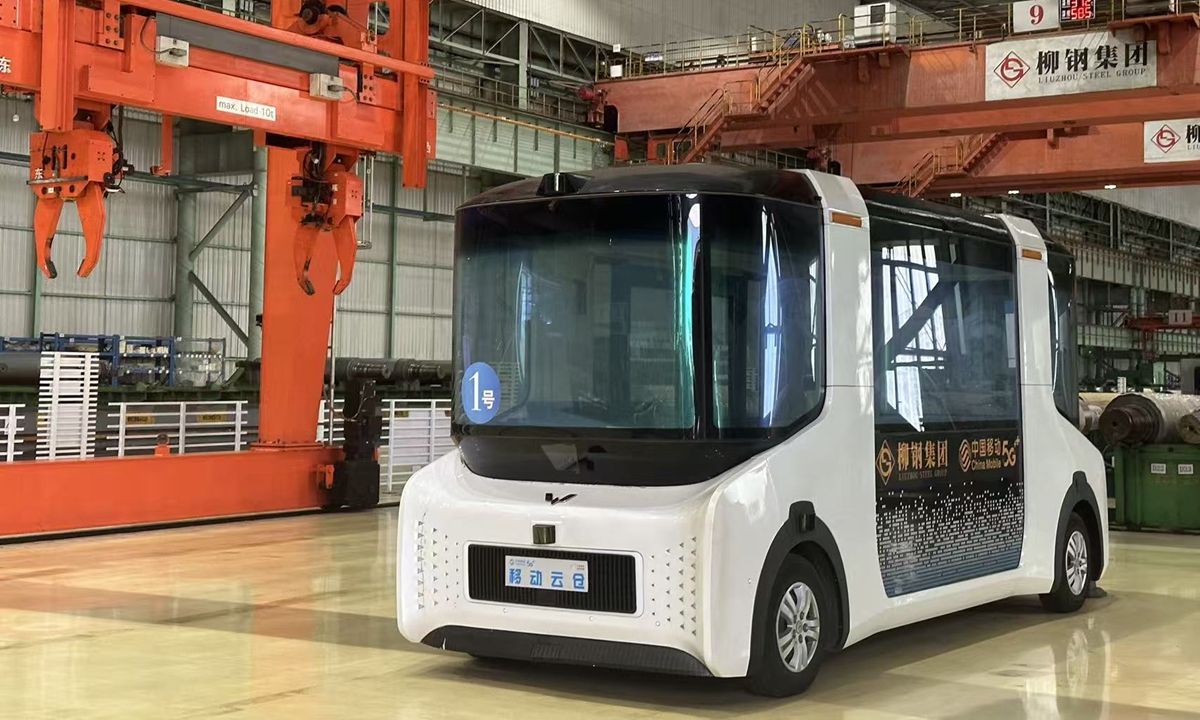
A mobile cloud warehouse is seen at the Fangchenggang base of Liuzhou Steel Group on March 31, 2026. Photo: Ma Jingjing/GT
Smart manufacturing
Beyond products, this time-honored traditional industry is also embracing new technologies in its production process.
At the Fangchenggang base of Liuzhou Steel Group on Qisha Peninsula, South China's Guangxi Zhuang Autonomous Region, one is easily attracted by multiple trains rattling from time to time along rail tracks stretching around 2 kilometers, carrying molten iron with a temperature of 1,500 degrees from furnaces to converters for steelmaking.
The scorching heat is unbearable even two or three meters away from the molten iron ladle. Previously, a team of over 70 workers had to work in close proximity to molten metal. Under such extremely hazardous conditions, instructions were relayed via walkie-talkies, couplings were operated manually, and molten iron ladles were transported with open tops.
To overcome the challenge, Liuzhou Steel Group, in cooperation with Chinese tech giant Huawei and China Mobile, developed an intelligent molten iron transport system that deeply integrates industrial internet, 5G, and artificial intelligence (AI), achieving a leap from "human control" to "intelligent control."
The system consists of three core components: the "brain" - an intelligent dispatching system that integrates data from blast furnaces, transport lines, and steelmaking plants to autonomously plan tasks and optimal routes for molten iron transport vehicles; the "torso" - an intelligent driverless locomotive system equipped with cameras and radar that detects road conditions and obstacles in real time and independently handles acceleration, deceleration, and braking; and the "arm" - an intelligent molten iron vehicle featuring automatic coupler disconnection, automatic parking, and high-precision BeiDou positioning, which enables fully automated operations and completely eliminates the need for manual labor.
"Now, across the entire operation area, except for a few inspection and maintenance personnel, basically no one is in sight," Liao Liuqiang, a post-90s worker who previously worked as a shunter, told the Global Times.
This welcome change is just one example of the broader transformation.
On March 31, Liuzhou Steel Group, in collaboration with Huawei and China Mobile Guangxi, formally launched Guangxi's first AI large-language model for the steel industry - the Xuantie Steel Model. The model extends across every critical link of steel manufacturing, including raw material procurement, steelmaking, rolling production, quality control, as well as equipment maintenance and supply chain coordination.
"Liuzhou Steel has been pondering how to break free from traditional development models and achieve a shift in momentum - moving from 'scale and speed' to 'quality and efficiency.' Addressing this challenge of the era, Liuzhou Steel's answer is to firmly establish 'AI+' as the core engine for high-quality development," Li Bin, chairman of Liuzhou Steel Group, said at the launch ceremony of the Xuantie Steel Model held in Nanning, Guangxi.
Latest data reveal that 95 percent of key enterprises surveyed by the CISA have embedded digital transformation into their core strategies. The sector's smart manufacturing is evolving from "single-point pilots" to "holistic, system-wide implementation."
Meanwhile, the steel industry's adoption of AI could also help advance the technology itself.
"As a process industry with a relatively complete foundation in informatization, automation, and digitalization, the steel industry offers a complex real-world environment characterized by multimodal sensing, massive data, multi-objective constraints, diverse demands, and multi-layered application ecosystems. This provides an ideal 'testing ground' for honing advanced AI capabilities," said Li Yiren, vice president of the CISA.
Global significance
The Chinese steel industry's transformation also carries great global significance.
"The deepening of digitalization within China's steel industry facilitates not merely its own transformation and upgrading but also a more efficient, greener, collaborative, and resilient integration into global industrial chains, playing an important role in stabilizing global steel supply, optimizing the international division of labor, and achieving ecologically sustainable partnerships," Wang Guoqing, research director with the Beijing-based Lange Steel Information Research Center, told the Global Times.
While accelerating its own transformation and upgrading, China's steel industry is steadily advancing toward "intellectual sharing" and "ecosystem co-development." From the Jakarta-Bandung High-Speed Railway - the first high-speed train in Indonesia and Southeast Asia - to the China-Laos Railway, the first cross-border railway project that is linked to China's domestic rail system - and to Serbian section of the Hungary-Serbia railway, Chinese steel has provided the robust backbone for these infrastructure projects connecting the world.
In addition to their products, Chinese steelmakers are also actively "going global."
On January 17, the first shipment of iron ore from the Simandou project in Guinea arrived at Majishan port in Shengsi, East China's Zhejiang Province, marking the full activation of the global supply chain for one of the world's largest hematite mines - a project jointly invested in and developed by Baowu.
Baowu's subsidiary Sinosteel Engineering & Technology Co commissioned the Tosyali 1800 mm hot strip mill project in Türkiye. This is by far the most advanced and competitive hot rolling production line exported by a Chinese enterprise to date, demonstrating that China's steel industry has achieved independent innovation in key equipment.
Shanghai Baosteel Packaging Co, a subsidiary of Baowu, has accelerated the regional expansion of its metal packaging business in the extended product segment, establishing a strategic footprint across three countries, five regions, and seven production lines.
China's leading steel enterprises are also participating in and shaping global industry governance.
The China-Serbia Steel Green Manufacturing "Belt and Road" Joint Laboratory - jointly established by HBIS Group and the University of Belgrade in Serbia - was unveiled at the R&D Center of HBIS Group in December 2025. HBIS Group has also partnered with the World Steel Association and the University of Science and Technology Beijing to establish the World Steel Development Research Institute.
These two-way efforts serve as a vivid microcosm of the accelerated transformation and upgrading of China's steel industry and its pursuit of win-win cooperation with the rest of the world.
Back at Bensteel's Cold Rolling Mill in Benxi, pioneering new steel products remains a constant endeavor, and Gu remains fully confident about the industry and his job, as long as he keeps learning. "In the past, I just need to know steel rolling, but now I also need to learn intelligent control and management," he said.
RELATED ARTICLES