Who’s the ‘Big Bad Wolf’ in China-Latin America cooperation? The US should look in the mirror
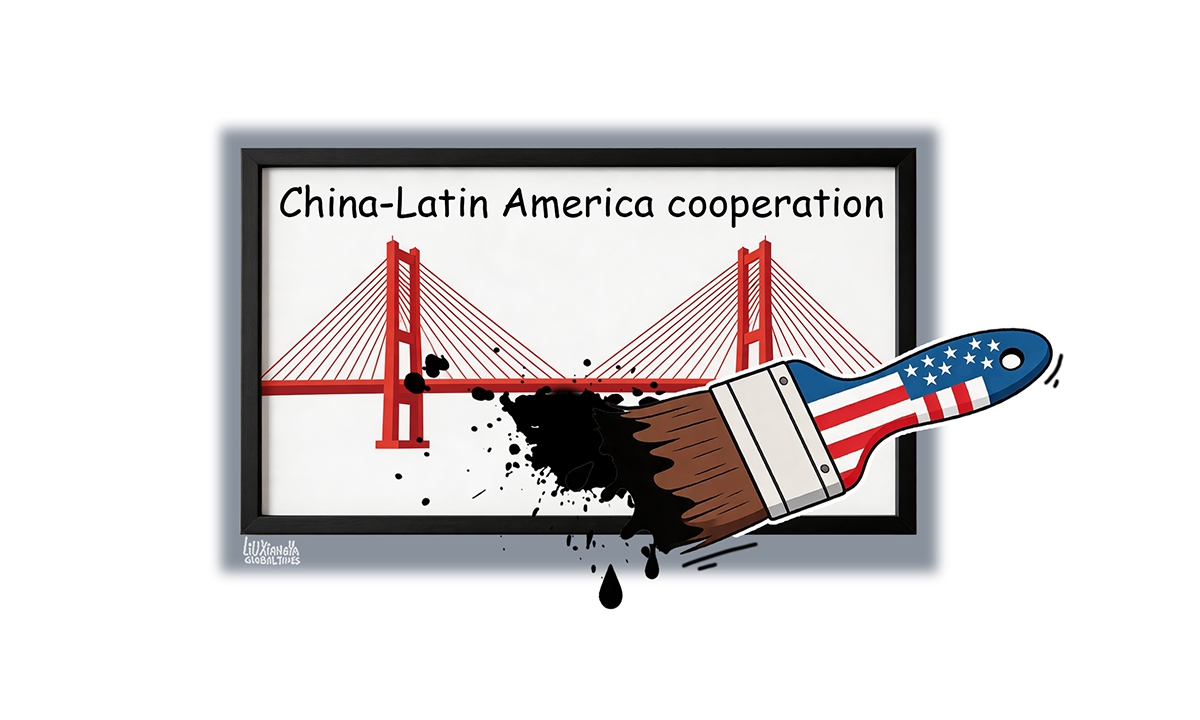
Illustration: Liu Xiangya/GT
On April 27, US Ambassador to Peru Bernie Navarro drew an unprovoked comparison between China and the Big Bad Wolf from Little Red Riding Hood - the fairy-tale villain who deceives and devours the weak under a mask of goodwill - in a deliberate attempt to smear China's cooperation with Peru and other Latin American nations.China's Ambassador to Colombia, Zhu Jingyang, fired back: "Dear colleague, when you describe the Big Bad Wolf in Little Red Riding Hood, aren't you looking in a mirror? You shout 'free choice' but wave the stick of sanctions; you play the 'mature country' but resort to cheap mockery... With this, you only make it crystal clear who the real Big Bad Wolf is."
The exchange is the latest in a series of provocations from Ambassador Navarro.
Earlier this month, Navarro warned Peru that failing to purchase F-16 fighter jets would trigger US retaliation, highlighting Washington's leverage over Peruvian decision-making. Ambassador Zhu responded: "This is not diplomatic language - it's direct, pure, and raw coercion."
Buying weapons is a matter within a nation's sovereign jurisdiction. The fact that a US ambassador made arrogant remarks interfering with another country's sovereignty clearly reveals the sinister nature of US hegemony.
Navarro's moves this year - including his stunt demand for Peru to change the menu from "Chifa" (a uniquely Peruvian-Chinese fusion cuisine) to hamburger - reflect Washington's drive to reassert US strategic dominance over the entire Western Hemisphere, from the Arctic to Tierra del Fuego, and to roll back Chinese influence at every turn.
Earlier this year, the US designated Peru a "Major Non-NATO Ally," with plans for military sales and a naval base, threatening Peru's sovereignty and evoking concern about external control.
It is the US ambassador - wielding arms sales and diplomatic threats - who poses a real threat to Peruvian sovereignty, unlike Chinese companies that built ports and created jobs. This false choice also fundamentally misunderstands Latin America.
Peru was one of the first Latin American countries to establish diplomatic relations with the People's Republic of China, and the relationship between the two countries has evolved into a deeply significant economic partnership.
China is now Peru's single largest trading partner, a testament to the strength and depth of their commercial ties. This significant economic relationship serves as a powerful indicator of Peru's ability to chart its own course in the international arena. The substantial trade volume and overall economic importance of the relationship with China should foster a sense of pride among Peruvians and instill confidence in the nation's capacity to pursue independent development.
This independent development path allows Peru to navigate its own future, guided by its own interests and priorities. As Diego García-Sayán, who previously served as the foreign minister of Peru, articulated to the Christian Science Monitor, shedding light on Peru's unique perspective: "There's no question we have a different geopolitical view when it comes to China" compared with Washington.
This statement underscores that Peru's relationship with China is based on its own strategic calculations and national interests, independent of external pressures or influences.
What truly unsettles Washington is that China-Latin America cooperation rests on solid, tangible foundations. The Chancay deep-water port, built with Chinese investment, is located some 60 miles north of Lima and has rapidly become a logistics hub for the entire continent.
"Chancay is rather quickly becoming a hub for all of South America, with about half of the commerce passing through the port destined for other countries," said Cynthia Sanborn, director of the Center for China and Asia-Pacific Studies at Universidad del Pacífico in Lima, according to the Christian Science Monitor.
Where American capital withdrew or hesitated, Chinese infrastructure investment and trade filled a real development gap. That is not "infiltration." It is a demand. It is a mutual benefit.
Raw power may generate noise, but for people who need real development, things like ports and roads are what matter the most.
As Ambassador Zhu wrote: "The China-Peru friendship is as solid as a rock. No children's tale is going to stop it."
Who's the 'Big Bad Wolf' in China-Latin America cooperation? The US should look in the mirror.
RELATED ARTICLES