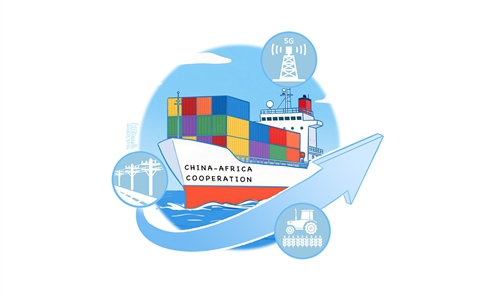
Expanding the pie of China-Africa cooperation through ‘subtraction’: Global Times editorial
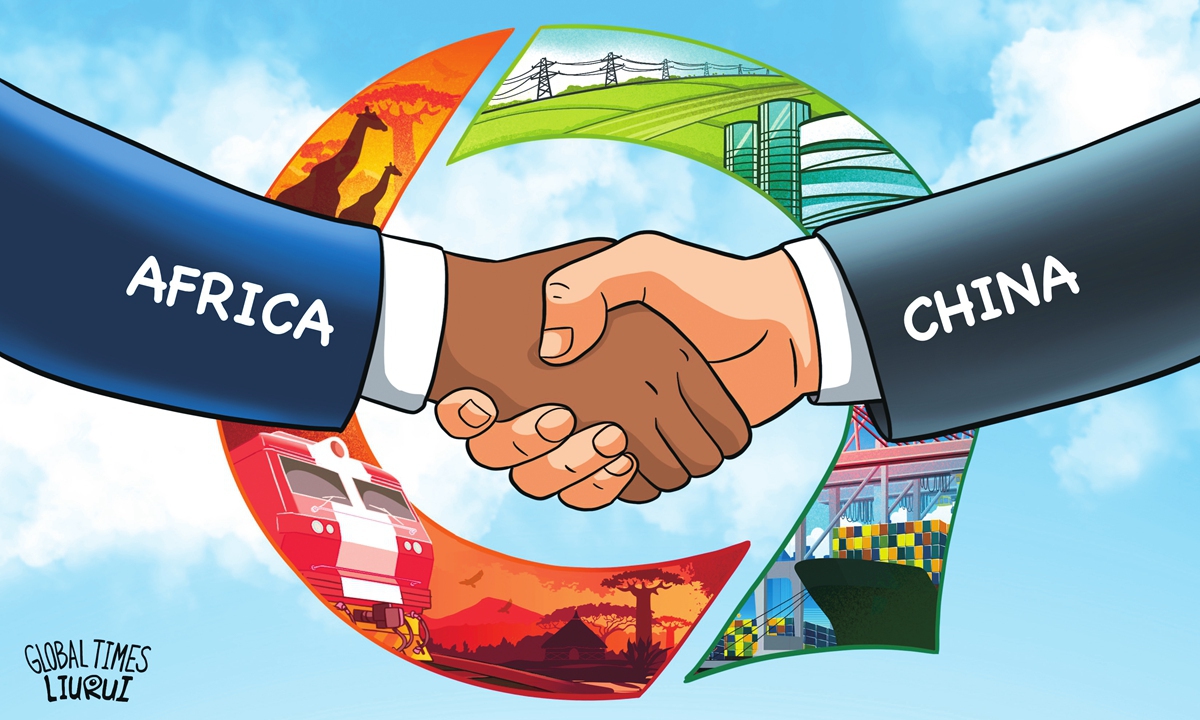
Illustration: Liu Rui/GT
China will implement zero-tariff treatment for 53 African countries that have diplomatic relations with it, starting May 1. This major policy initiative positions China as the first major economy in the world to grant unilateral and comprehensive zero-tariff treatment to all African countries that have diplomatic relations with China, as well as to all least developed countries that maintain diplomatic relations with China. This "unilateral and full-coverage" arrangement is not just a "subtraction" in tariffs, but also an "addition" for development, a "multiplication" for people's livelihoods, and a "division" of arbitrary tariff impositions. From this, people can see China's policy philosophy of sincerity, real results, amity, and good faith toward Africa, as well as its correct view of justice and interests.Many years ago, at multilateral forums such as the Forum on China-Africa Cooperation (FOCAC), China committed to gradually expanding tariff preferences for African countries to help them integrate into the global trading system. Starting in 2005 with zero-tariff treatment for certain products from the least developed countries in Africa, and granting zero-tariff treatment on 100 percent of tariff lines for least developed African countries by the end of 2024, as well as further extending the preference to all African countries with diplomatic relations with China by 2026, China has consistently fulfilled every commitment to Africa with steady and practical actions. Not once has it wavered due to global economic fluctuations. This commitment to "honoring its words with concrete actions" has not only solidified the foundation of mutual trust between China and Africa but also demonstrated the credibility of China as a responsible major country, setting an example for the international community in honoring promises and upholding integrity.
Currently, global trade growth faces mounting pressure, largely due to rising policy uncertainty, increasing tariff frictions, and heightened anxiety over supply chain security. In this context, China's implementation of comprehensive zero-tariff treatment for African countries that have diplomatic relations with it sends not only a general signal of trade preference but also provides the international market with a clear, stable, and predictable institutional arrangement. The tariff cost for African products entering the Chinese market will be systematically reduced, while trade rules and cooperation expectations become more stable. On the one hand, this demonstrates China's continued commitment to high-level opening-up and the development of an open global economy. Against the backdrop of certain countries using tariffs as a tool of coercion and promoting "decoupling and supply chain disruption," China's zero-tariff policy for African countries that have diplomatic relations with it represents a voluntary opening-up choice based on its own development stage, its vast domestic market, and its sense of global responsibility. On the other hand, China has always been a staunch supporter of the common development of the Global South. The measure helps African countries reduce their dependence on traditional single markets and primary product export models while enhancing the ability of Global South countries to make independent choices within the international economic system.
Western opinion often accuses China of practicing "neo-colonialism" in Africa, which only shows that they themselves have a guilty conscience. In modern history, colonialism has left deep scars on Africa - not only through the plundering of African resources via unequal trade, but also through "aid" laden with harsh political conditions, all in service of geopolitical strategies. Even today, the mind-set of treating Africa as a "pawn" remains prevalent in Western strategic circles.
In contrast, China's tariff reduction measures respond to the common expectations of African countries, attach no political conditions, and do not require reciprocal opening-up from African nations. These measures are not only consistent with WTO rules but also demonstrate respect for the sovereignty of African countries and support for their right to development, thus receiving broad welcome from African nations. Rwandan President Paul Kagame once stated that "China relates to Africa as an equal," and that Rwanda's partnership with China is based on mutual respect and shared interests.
It is important to recognize that this initiative is not a one-way "granting of preferences," but a win-win move that benefits Africa, China, and relevant trading partners around the world. For Africa, zero tariffs will significantly reduce the cost of exporting its specialty products to China. For example, cocoa from Côte d'Ivoire and Ghana, coffee and avocados from Kenya, and tangerines and wine from South Africa previously faced tariffs ranging from 8 percent to 30 percent. With the implementation of zero tariffs, their competitiveness in the Chinese market will be notably enhanced. At the same time, opening the market helps Africa translate its resource endowments, demographic dividend, and industrial potential into sustainable development capabilities. For China, high-quality and distinctive African products will enrich the supply in the domestic market and meet the diverse needs of Chinese consumers. As trade improves the business environment in Africa, zero tariffs will help attract other trading partners, including China, to increase investment in Africa, creating more cooperation opportunities for all countries and fostering a new, open, inclusive, and mutually beneficial global trade landscape.
Zero tariffs also serve as an important policy foundation for China and Africa to jointly advance modernization and build an all-weather China-Africa community with a shared future for the new era. China not only provides immediate measures to help Africa address current challenges, but also commits to long-term and stable institutional safeguards through equal consultation. At the historic juncture marking the 70th anniversary of the establishment of diplomatic relations between China and Africa, the two sides are taking zero tariffs as a new starting point to jointly implement the outcomes of the FOCAC Beijing summit and translate the 10 partnership actions into reality. This path of cooperation and shared success is bound to grow broader and broader.
RELATED ARTICLES