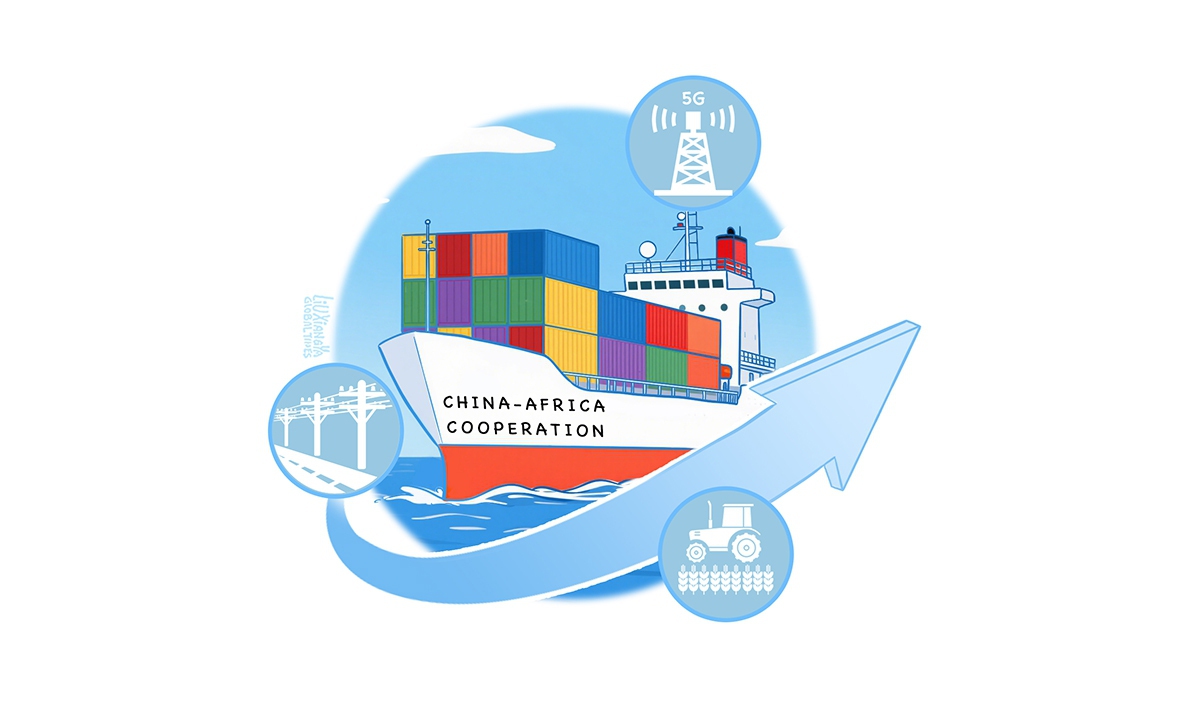
Illustration: Liu Xiangya/GT
A high-level symposium, themed "Zero Tariffs, Infinite Opportunities," co-hosted by the Chinese Embassy in Kenya and Kenya's Ministry of Foreign and Diaspora Affairs, was held on Monday in Nairobi, the capital of Kenya, the Xinhua News Agency reported on Tuesday.At the same time, at the 66th Zimbabwe International Trade Fair, "zero tariffs" became a buzzword, according to another Xinhua report on Sunday.
Starting on May 1, China will grant zero-tariff treatment to products from 53 African countries with which it has diplomatic ties. From the symposium in Nairobi to the discussions at the Zimbabwe trade fair, the enthusiasm from African businesses sends a clear message: What the zero-tariff policy will bring is not just a change in trade figures, but a strong and sustainable new driving force for Africa's in-depth integration into the global industrial chain and the development of its manufacturing industry.
What makes this policy particularly noteworthy is the broader global context. As protectionist headwinds intensify in many parts of the world, China has stayed committed to expanding opening-up. Its zero-tariff offer to 53 African countries sends a clear signal: use wider openness to counter protectionism, use stable economic expectations to support the Global South's development agenda, and use sustainable market opportunities to push the international division of labor toward a more balanced pattern.
In the short term, China's zero-tariff policy for African countries will significantly facilitate exports of African agricultural and resource-based products to China, further boosting bilateral trade. After the implementation of the zero-tariff measures, a large number of high-quality agricultural products from Africa's least-developed countries (LDCs), such as Beninese pineapples, Ethiopian coffee, Rwandan chili peppers, Tanzanian honey, and Malagasy mutton, will accelerate their alignment with China's market demand, bringing greater development opportunities for African businesses and driving the economic development of LDCs.
Data from Chinese customs showed that China-Africa trade reached $348 billion in 2025, a year-on-year increase of 17.7 percent, hitting a new record high.
Over the years, China and Africa have continuously strengthened economic and trade ties in both infrastructure and industrial cooperation. The zero-tariff policy is highly consistent with this model, and it is expected to inject new vitality into existing cooperation while further expanding the scale of trade. At the same time, the policy brings positive benefits to the Chinese market, as consumers will be able to enjoy fresher and more affordable fruits, coffee, nuts, and other imported products from Africa.
More notably, what the zero tariffs create is not just an increase in trade but also significant potential to promote Africa's manufacturing development and attract more industrial investment to African countries. As zero tariffs lower the threshold for African processed products to enter the Chinese market, it makes commercial sense for international companies to set up assembly or processing facilities on the continent, taking advantage of local cost competitiveness while targeting the Chinese market.
From the perspective of long-term China-Africa development cooperation, China's economic and trade policies toward Africa have been clear and stable for decades, providing investors with a predictable policy environment and enhancing investment confidence. This will help attract more long-term industrial capital and supporting industries to settle in Africa, extend existing industrial chains, form increasingly extensive and in-depth industrial linkages, and further promote the in-depth integration of China-Africa industrial chains.
For decades, Africa has been largely confined to the role of a supplier of unprocessed commodities - minerals, crude oil, cocoa, and timber. With the zero-tariff policy, the incentive structure changes. Investors begin to see Africa not just as a source of inputs, but as a production hub. Over time, as industrial clusters and supply chains develop and take root, African manufacturing competitiveness will grow, allowing the continent to gradually end its dependence on low-end resource exports and cultivate the vitality of local industries.
Zero tariffs only provide a good opportunity for Africa's industrialization. If African countries want to fully seize the dividends of this policy, they still need to make continuous efforts in various aspects such as logistics, energy supply, and policy stability.
To sum it up, China's zero-tariff policy is not just a one-way market-opening measure - it's also an important opportunity to promote Africa's economic development and transformation and accelerate the process of Africa's industrialization.
RELATED ARTICLES