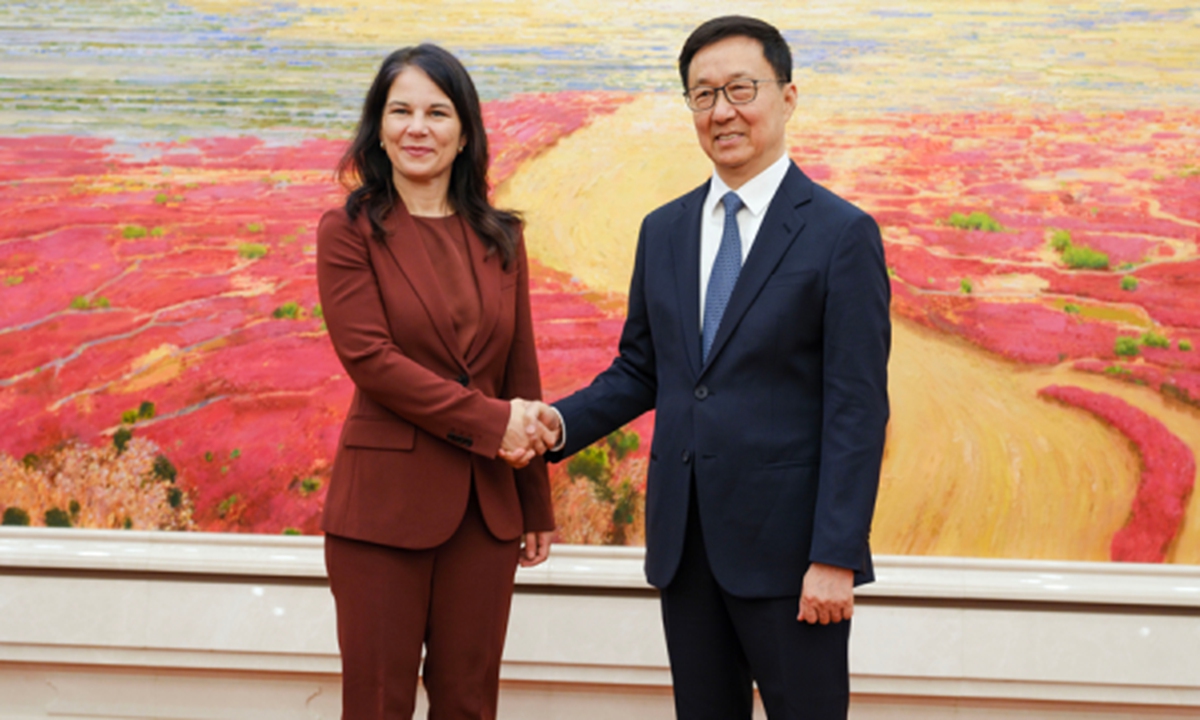
Chinese Vice President Han Zheng meets with President of the 80th Session of the United Nations General Assembly, Annalena Baerbock, on Wednesday in Beijing. Photo: Chinese Foreign Ministry
Chinese Vice President Han Zheng met with President of the 80th Session of the United Nations General Assembly, Annalena Baerbock, on Wednesday in Beijing, according to the Xinhua News Agency.
During their meeting, Han said China is willing to take the implementation of the Global Governance Initiative as an opportunity to continuously deepen cooperation with the UN, support the UNGA in adhering to true multilateralism, jointly safeguard world peace and security, and promote development and prosperity.
Baerbock said China is a key partner of the UN and an important pillar of multilateralism, adding that she appreciates the important initiative put forward by China and stands ready to deepen cooperation with China to revitalize multilateralism and jointly promote global peace and development.
Separately, Foreign Minister Wang Yi also met with Baerbock in Beijing on Wednesday. Wang said it is high time to support, reinvigorate and strengthen the UN amid growing turbulence and escalating hotspot issues, per Xinhua.
Wang said that certain countries, which have adopted a might-is-right approach, are challenging the status and role of the UN, presenting a significant challenge both to the UN and to multilateralism.
Chinese experts said that at a time when geopolitical conflicts and major-power rivalry are intensifying, China's consistent and unequivocal support for the UN remains crucial to safeguarding the international system with the UN at its core and upholding multilateralism.
"The role of the UN depends on the support and cooperation of its member states, especially major powers. But in recent years, competition and confrontation among major countries have significantly weakened the UN's role," Zhang Guihong, director of the Center for the Study of the United Nations and International Organizations at Fudan University, told the Global Times on Wednesday.
He noted that some recent military actions organized by countries such as the US were conducted outside the UN framework and ran counter to the organization's purposes and principles.
As president of the UN General Assembly, Baerbock's visit to China at this juncture also reflects hopes that China can provide stronger support for the UN, Zhang said. As some countries withdraw from UN agencies or pursue anti-UN tendencies, many middle-ranking powers and countries of the Global South increasingly expect China to help defend the existing international order and support the UN's positive role.
"Among all major countries today, China is the clearest and most steadfast supporter of the UN and of the international order centered on the UN. If Baerbock hopes to make the General Assembly play a stronger role, that cannot be separated from China's support and closer cooperation with China," Cui Hongjian, professor at the Academy of Regional and Global Governance at Beijing Foreign Studies University, told the Global Times on Wednesday.
Baerbock thanked China for its long-term and firm support for the work of the UN and the General Assembly, saying that China has played an important leading role in safeguarding multilateralism, safeguarding international law and promoting peace, development and human rights, according to Xinhua.
Her visit came as China has recently welcomed a string of foreign leaders and senior officials amid mounting strains in the global order. Recent visitors include Maxime Prévot, Belgium's deputy prime minister and minister of foreign affairs, and Penny Wong, Australia's minister for foreign affairs, as well as Pakistani President Asif Ali Zardari, who has visited multiple Chinese provinces.
On Wednesday, Chinese Vice President Han met with Australian Foreign Minister Penny Wong on bilateral relations in Beijing, according to Xinhua.
Chinese Foreign Minister Wang held the eighth China-Australia diplomatic and strategic dialogue with Wong in Beijing, per Xinhua.
Since beginning his China trip on April 25, the Pakistani president has been to Central China's Hunan Province and South China's Hainan Province, according to media reports. His itinerary has included meetings with provincial leaders, industrial tours and cooperation agreements as the two countries mark the 75th anniversary of diplomatic ties this year.
Prévot visited Hong Kong and Hangzhou. During his stay in Hangzhou, Prévot said he was optimistic about the future of Volvo Ghent after a visit to the research and development site of its parent company, Geely, according to Belga News Agency, Belgium's national news agency.
"I met the CEO of Geely, the owner of Volvo, at their headquarters to express the full support of the Belgian government for Volvo Ghent," he told Belga. "This was important, as they want to continue investing in Europe."
"China's attractiveness and influence in global affairs are continuing to rise, and this can be seen from the recent wave of high-level visits," Cui said, adding that China's stability, openness and advocacy for peace are increasingly winning support from the international community.
He added that as Belgium is one of the EU's core countries, Prévot's visit showed a strong willingness to better understand China. By engaging broadly during his trip, he may gain a more objective and comprehensive understanding of the country, which could also help some European countries that remain hesitant to view China more clearly.