China, Australia hold 8th foreign and strategic dialogue in Beijing; expert says mechanism helps enhance mutual trust, sustain sound ties
By and Zhang Yuying Published: Apr 30, 2026 09:15 AM

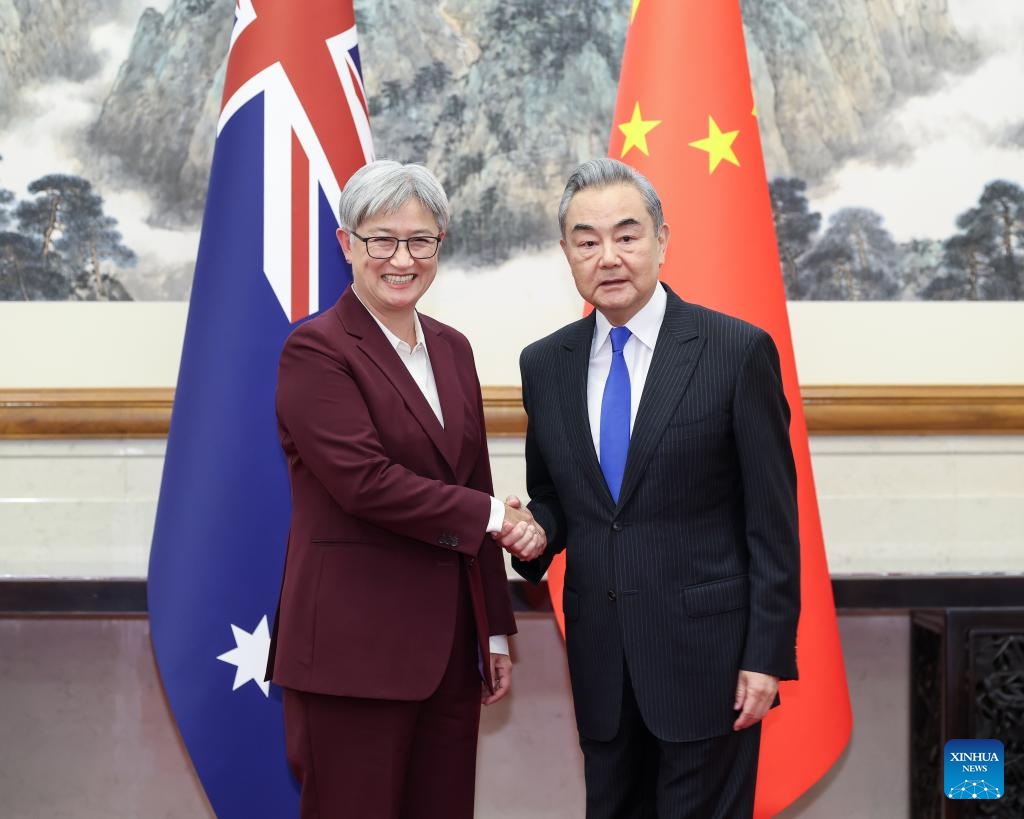
Chinese Foreign Minister Wang Yi, also a member of the Political Bureau of the Communist Party of China Central Committee, holds the eighth China-Australia diplomatic and strategic dialogue with Australian Foreign Minister Penny Wong in Beijing, capital of China, April 29, 2026. (Xinhua/Liu Bin)
China and Australia on Wednesday held the eighth China-Australia foreign and strategic dialogue in Beijing. A Chinese expert says that the development indicates that the two comprehensive strategic partners are taking a further step to sustain high-level interaction momentum and promote stable development of bilateral relations in a world fraught with turmoil and uncertainty.
The foreign and strategic dialogue, co-chaired by Chinese Foreign Minister Wang Yi and Australian Foreign Minister Penny Wong, marks the eighth edition since the mechanism was established in 2013. According to information released by China's Ministry of Foreign Affairs, the previous seventh round of the China-Australia Foreign and Strategic Dialogue was co-chaired by Wang and Wong in Canberra in March 2024.
During the eighth dialogue, Wang, also a member of the Political Bureau of the Communist Party of China Central Committee, said that the current global landscape is marked by intertwined changes and turmoil, with destabilizing and uncertain factors rising to an unprecedented level. China stands ready to work with Australia to deliver on the important consensus reached by the two leaders, step up communication and coordination, deepen mutually beneficial cooperation, consolidate the upward momentum of bilateral ties, and fully translate the comprehensive strategic partnership into concrete outcomes, so as to bring greater certainty to the region and the world at large, according to a readout from the Chinese Foreign Ministry on Wednesday.
China and Australia should maintain high-level exchanges, enhance strategic mutual trust, expand areas of cooperation, and continuously add positive factors to bilateral relations, Wang said.
He also elaborated on China's position on the Taiwan question, stressing that no one is allowed to separate the Taiwan region from China, and that the key to safeguarding peace and stability across the Taiwan Straits lies in resolutely opposing "Taiwan independence."
For her part, Wong said that Australia is committed to developing its relations with China, and is ready to engage in candid communication, enhance mutual understanding, strengthen cooperation, and properly manage differences.
The Australian side adheres to the one-China policy, opposes "Taiwan independence," and hopes that the Taiwan question can be peacefully resolved, Wong said.
The economies of Australia and China are highly complementary and close cooperation in various fields such as economy and trade is in the common interests of both sides, said the Australian foreign minister, according to Xinhua.
The momentum of senior-level engagements between Beijing and Canberra has been maintained. Before the foreign and strategic dialogue with Wang Yi, on Wednesday morning, Wong met with Chinese Vice President Han Zheng. Earlier this month, Chinese Premier Li Qiang and Australian Prime Minister Anthony Albanese had a phone conversation on April 7, during which Premier Li said that China stands ready to work with Australia to expand and upgrade bilateral trade, support enterprises of both countries in conducting cooperation based on market principles, and promote mutual benefit and win-win outcomes, according to the Xinhua News Agency.
Chen Hong, a professor and director of the Australian Studies Center at East China Normal University, told the Global Times that the strategic dialogue mechanism is not a one-off ceremonial meeting; rather, it serves as an institutional arrangement that serves as a calibrator for China-Australia relations.
Given the differences between the two countries in political systems, social governance models and cultural traditions, the continuous and predictable strategic communication mechanism is helpful in enhancing mutual trust and sustaining the sound and healthy development of bilateral ties, Chen said.
Beyond bilateral scope, Wang said that the world is undergoing profound changes unseen in a century, with unilateralism and hegemonism on the rise. He noted that China and Australia should jointly stand on the right side of history and on the side of multilateralism, jointly uphold the global free trade system and maintain the stability and smooth functioning of industrial and supply chains, play a constructive role in the political settlement of hotspot issues, and promote the building of a more just and equitable global governance system, per the readout from the Chinese Foreign Ministry.
Wong said that that Australia supports China in hosting the APEC Economic Leaders' Meeting, does not exclude any country from carrying out cooperation for the development of island nations, and is willing to work with China to safeguard international rules and ensure energy security.
Wong's visit to China marks the second leg of her Northeast Asia tour. Having just concluded her trip to Japan, Wong will next travel to South Korea, with energy security high on her agenda. China, Japan and South Korea are key players in the regional energy trade, refining capacity and supply chain systems.
Chen said that as major countries in the Asia-Pacific, China and Australia keeping communication channels open via strategic dialogue will benefit not only bilateral ties but also the basic stability of the regional situation.
Given that Australia is a major exporter of resources, energy and agricultural products, while China stands as a key player in global manufacturing, consumer markets and industrial supply chains, it is in the interests of both countries to safeguard free trade and stable industrial and supply chains, and this also meets the common expectations of the vast majority of Asia-Pacific economies, the expert noted.
RELATED ARTICLES