The US $25 billion Iran war bill lays bare political nature of serving certain interest groups: Chinese expert
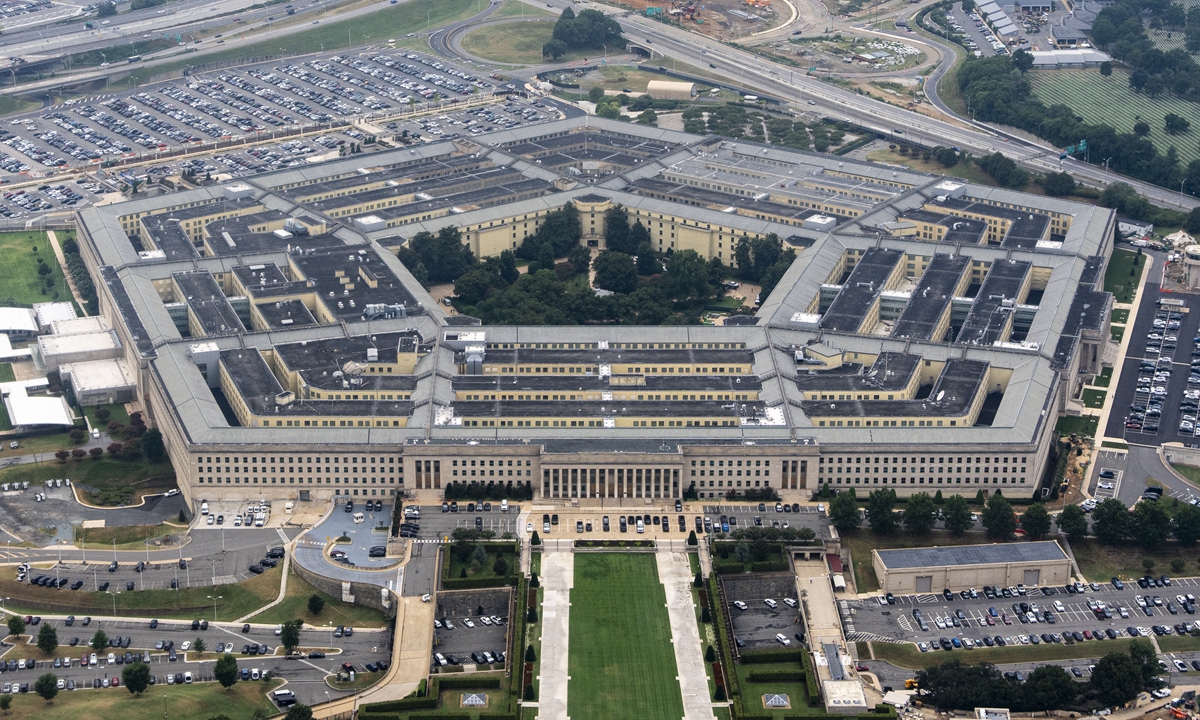
View of Pentagon Photo: VCG
The US war in Iran has cost $25 billion so far, Acting Pentagon Comptroller Jules Hurst said on Wednesday during a House Armed Services Committee hearing, according to Reuters. This is the first time the US military has disclosed the conflict's cost, most of which went toward munitions and roughly equals NASA's entire annual budget,Reuters reported. A Chinese expert said the strikes ultimately benefit US arms dealers and the military-industrial complex, while ordinary Americans bear the burden through higher fuel prices and rising inflation.
Hurst said that most of that money was for munitions, but he did not detail what that cost estimate included and whether it took into account the projected costs of rebuilding and repairing base infrastructure in the Middle East damaged in the conflict, per Reuters.
Several US media outlets noted that, after Hurst released the figures, Adam Smith, the top Democrat on the House Armed Services Committee, responded to Hurst: "I'm glad you answered that question. Because we've been asking for a hell of a long time, and no one's given us the number."
However, US media do not seem entirely convinced by this figure.
According to CNN, the $25 billion "is a lowball figure that does not include the cost of repairing extensive damage suffered by US bases in the region." And one source told the CNN that the real cost estimate is closer to $40-50 billion when accounting for the costs of rebuilding US military installations and replacing destroyed assets.
Politico also reported "that figure falls far behind many outside estimates."
Earlier this month, several US officials and congressional aides told NBC News that Iran has damaged American military bases and equipment in the Middle East far worse than publicly acknowledged and the damage could lead to billions of dollars in repairs.
"No matter how the US cost is estimated, in any case, it cannot obscure the fact that the US strikes against Iran ultimately benefit US arms dealers and the military-industrial complex," Li Haidong, a professor at China Foreign Affairs University, told the Global Times on Thursday.
Ordinary Americans are bearing the burden of the US strikes against Iran, as soaring fuel prices and rising inflation driven by the war are hitting American households directly and making affordability a top concern, the expert noted. "Therefore, US action against Iran has also intensified deeper divisions within American society," Li added.
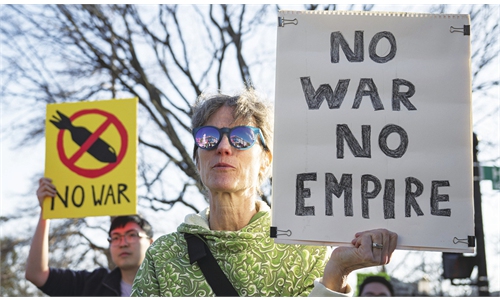
According to a report by The New York Times, in the hallway outside the hearing, protesters had gathered to register their opposition to the war.
In a Reuters/Ipsos poll released in March, 43 percent of Americans said they disapprove of US military strikes against Iran. Meanwhile, a Pew Research Center report also found that majorities of Americans said striking the country was the wrong decision.
Last month, Reuters reported that the first six days of the war had cost the US at least $11.3 billion, a figure that had already sparked widespread public discontent.
Repeatedly getting bogged down in protracted wars of attrition that are costly while benefiting only certain interest groups lays bare the nature of US politics, Li noted, saying that "American politics is ostensibly said to serve the people, but in reality, it does not; it serves the interests of specific groups."
At present, the ceasefire between the US and Iran has lasted for more than three weeks, but the conflict, which has already continued for over 60 days, still shows no signs of ending, and negotiations between the two sides remain deadlocked. US president will receive a briefing on new plans for potential military action in Iran on Thursday from CENTCOM Commander Adm. Brad Cooper, according to Axios on Thursday.
Global Times
RELATED ARTICLES