Exclusive: Auckland rejects ‘comfort women’ statue under pressure from Japan; campaign group vows to press on despite ‘extreme disappointment’
By Bai Yunyi and Published: Apr 30, 2026 12:43 AM

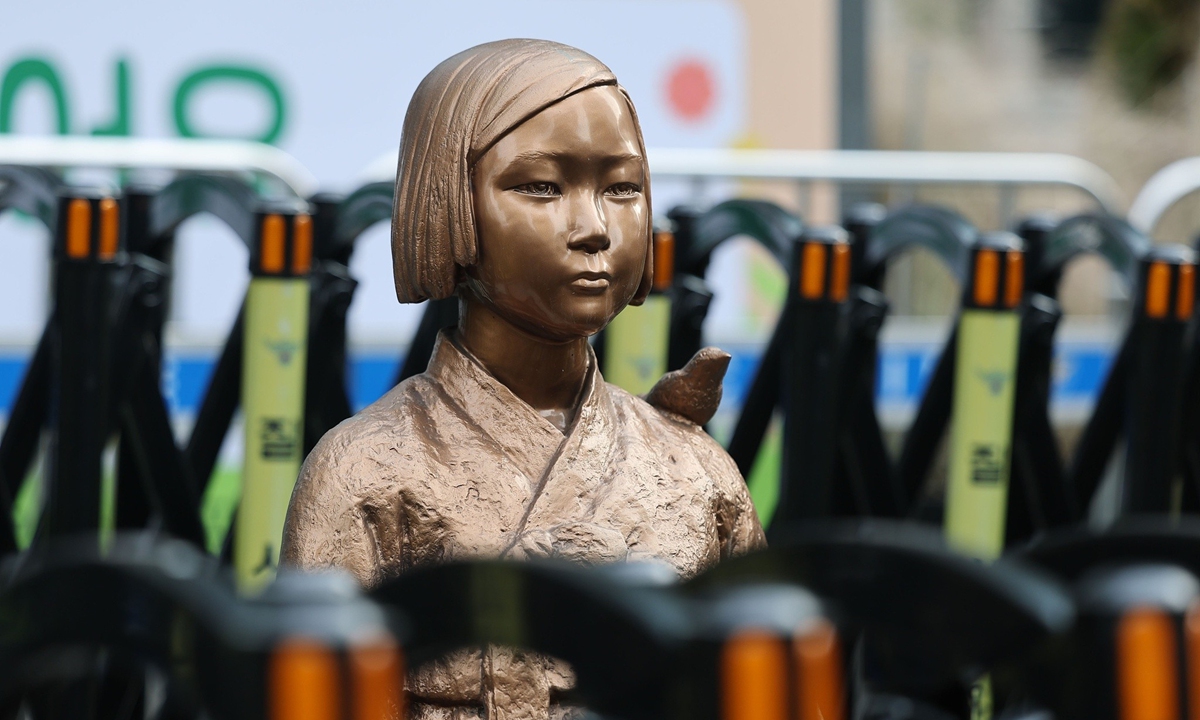
A statue of a seated girl symbolizing "comfort women," who were forced to work in Japanese wartime military brothels, stands in front of the Japanese Embassy in Seoul, South Korea, December 28, 2025. Photo: VCG
According to media reports, local officials in Auckland, New Zealand, decided on Tuesday not to allow the installation of a "comfort women" statue on public land in the city.Rebekah Jaung, chairperson of the Aotearoa New Zealand Statue of Peace committee, which has been promoting the statue's establishment, told the Global Times on Tuesday that she felt "extremely disappointed" with the decision. However, she emphasized that the committee will remain committed to standing with survivors of gender-based and conflict-related violence, and to continuing this work in whatever form they can.
According to reports by The Guardian and other media outlets, New Zealand had previously considered installing the "comfort women" statue - donated by a South Korean civic group - in Auckland, the country's largest city. The move has met with strong opposition from the Japanese Embassy, which claimed it could harm bilateral diplomatic relations.
Wellington's Ministry of Foreign Affairs and Trade said the Japanese government had made "formal representations" over the issue. The local board subsequently voted to reject the proposal.
According to the introduction, the proposed bronze statue depicts a girl seated beside an empty chair, intended to commemorate the victims of the "comfort women" system.
Submitters in favor were broadly in line with the proposal, which said the statue would "honor the courage and resilience of survivors, promote peace and remembrance, and support human rights education," New Zealand media outlet 1News reported.
"Since 2018, our group has worked to raise awareness in local communities in Aotearoa about a just resolution for the survivors and victims of Japanese military sexual slavery across the Asia-Pacific region," Jaung told the Global Times via e-mail.
Projects like the Statue also create public spaces for education and dialogue. They help connect historical wartime sexual violence to ongoing issues today, reinforcing the importance of prevention, accountability, and gender justice, Jaung said.
For those who are just now learning, the installation of the Statue offers an opportunity to engage with a largely overlooked and not widely known history. It creates a place where people can connect past injustices to present-day conversations about gender equity and human rights, she said.
For those who are just now learning, the installation of the Statue offers an opportunity to engage with a largely overlooked and not widely known history. It creates a place where people can connect past injustices to present-day conversations about gender equity and human rights, she added.
According to public records, in August 1993, then Chief Cabinet Secretary of Japan Yohei Kono issued the Kono Statement, acknowledging the forced recruitment of "comfort women" by Japan and offering an apology. However, in subsequent years, the Japanese government has not undertaken deep reflection on the issue; instead, it has repeatedly obstructed the establishment of "comfort women" statues and exerted pressure on other governments.
In March 2026, 16 experts from the special procedures of the United Nations Human Rights Council issued a joint press release expressing grave concern that Japan has deprived victims of the "comfort women" system of their rights to seek truth, justice, and reparations. They called on Japan to issue a formal apology, provide full compensation, and safeguard the historical record in school textbooks.
In response, Jaung said they were familiar with how the Japanese government has opposed similar memorials elsewhere, but it's shocking that a country like Japan would so blatantly try to silence a monument honoring women on the other side of the world.
Similarly, it is disappointing to think that this foreign influence has shaped local democratic processes in New Zealand, in opposition to the wishes of the local community, she said.
We are concerned that this silencing of survivor voices, led by the Japanese government and upheld by the local board, will cause harm to other survivors of gender-based and conflict-related violence, including discouraging those who wish to speak out for themselves, she told the Global Times.
"We are extremely disappointed by the decision to decline the proposal. At the same time, we feel heartened and deeply grateful for the support shown by our community throughout this campaign. We remain committed to standing with survivors of gender-based and conflict-related violence, and to continuing this work in whatever form we can," Jaung noted.
RELATED ARTICLES