Chinese senior officials hold calls with US counterparts; experts say exchanges show concerted effort to manage differences, urge Washington to create more conditions to stabilize ties
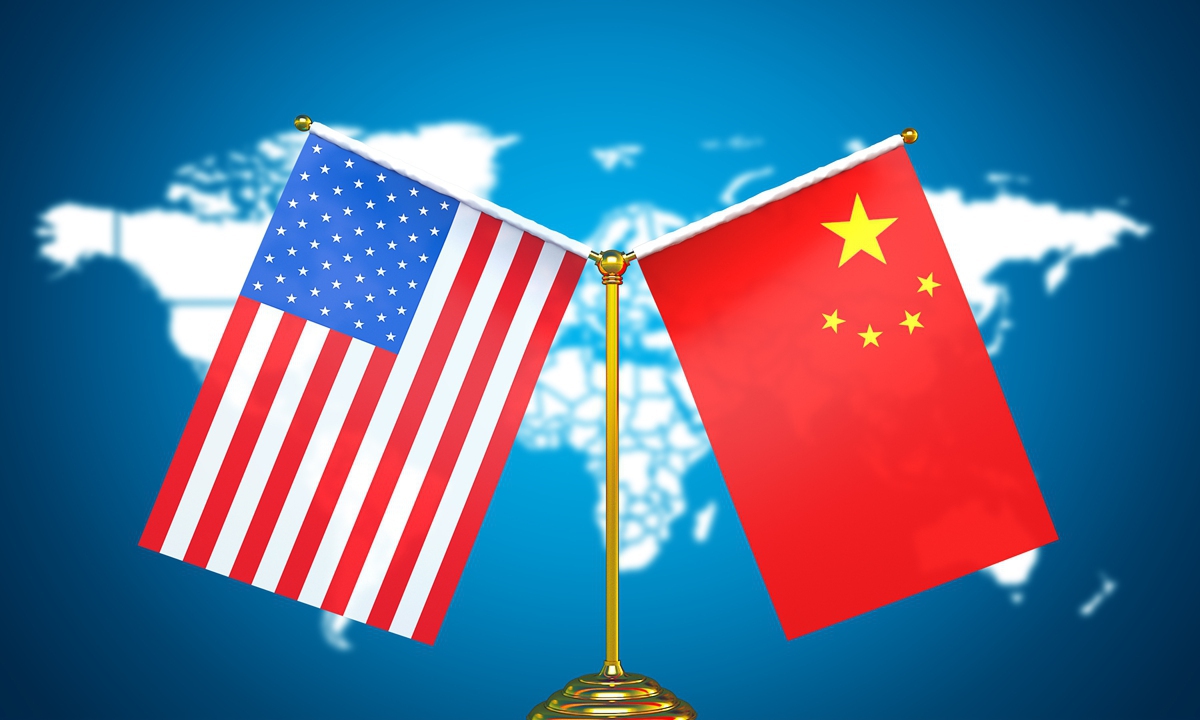
China US Photo: VCG
Chinese Foreign Minister Wang Yi on Thursday held a phone conversation with US Secretary of State Marco Rubio over China-US relations, and on the same day, Chinese Vice Premier He Lifeng held a video call with US Treasury Secretary Scott Bessent and US Trade Representative Jamieson Greer.
The phone conversation between senior diplomats of the two countries and the video call between their economic and trade officials on Thursday underscored a concerted effort to manage differences and further stabilize the bilateral relationship, Chinese experts said.
While China's policy to maintain stable ties with the US remains consistent, Washington's continuous restrictive moves against China showed it needs to demonstrate its sincerity through concrete actions to create the necessary conditions to further stabilize ties and lay a stable foundation for higher-level interactions, they said.
During his call with Rubio on Thursday, Wang, also a member of the Political Bureau of the Communist Party of China Central Committee, emphasized that the Taiwan question concerns China's core interests and constitutes the biggest risk in China-US relations, according to Xinhua News Agency. The US side should honor its commitments and make the right choices, opening new space for China-US cooperation and doing its part to promote world peace, Wang noted.
Head-of-state diplomacy has always been the "anchor" of China-US relations. Under the strategic guidance of the two heads of state, bilateral ties have generally remained stable. It serves the fundamental interests of both peoples and meets the common expectations of the international community, Wang said.
Both sides should safeguard the hard-won stability, prepare well for key high-level interaction agendas, expand areas of cooperation, manage differences, explore building a China-US relationship that is strategic, constructive and stable, and achieve mutual respect, peaceful coexistence and win-win cooperation, Wang noted.
For his part, Rubio said that the US-China relationship is the most important bilateral relationship in the world, and head-of-state diplomacy is at the core of the relationship, according to Xinhua.
Both sides should maintain communication and coordination, respect each other, properly handle differences, accumulate achievements for high-level interactions between the US and China, and seek strategic stability in US-China relations, said Rubio, Xinhua reported.
The two sides also exchanged views on the situation in the Middle East, among others, according to the report.
Li Haidong, a professor at the China Foreign Affairs University, told the Global Times that "stability," mentioned in Foreign Minister Wang's remarks, is the word that defines current expectations for China-US relations. "We have differences, but we cannot let those differences undermine stability," the Chinese scholar said.
Li added that sustained stability serves the needs of both countries and the broader international community. "A steady China-US relationship is a critical necessity, ensuring that various global challenges can be effectively managed through strategic coordination," he noted.
Separately on Thursday evening, Chinese Vice Premier He Lifeng, also China's lead person for China-US economic and trade affairs, held a video call with US Treasury Secretary Scott Bessent and US Trade Representative Jamieson Greer.
The two sides held candid, in-depth and constructive exchanges on implementing the important consensus reached between the two heads of state at their meeting in Busan and during previous calls, and on further properly addressing their respective concerns in the economic and trade sector and expanding pragmatic cooperation, reads a Xinhua report.
He Weiwen, a senior fellow at the Center for China and Globalization (CCG), told the Global Times on Friday that China's two senior officials held separate calls with their US counterparts on the same day, sending a positive and constructive signal.
"The core message was to stabilize bilateral relations, which also aligns with Washington's political needs - maintaining steady ties with China amid current global geopolitical tensions to help balance its broader global strategy," said He.
Concrete actions needed from Washington
The latest interactions follow a period of sustained contact between the two countries' high-level officials, coming on the heels of the China-US economic and trade consultations held in Paris in March.
Despite the emphasis on communication, Washington has continued to advance restrictive measures in key strategic sectors. On Friday, a spokesperson for China's Ministry of Commerce voiced firm opposition to the US Federal Communications Commission's latest proposed move to forbid Chinese telecom carriers from operating in the US, vowing to take necessary measures to safeguard the legal rights and interests of Chinese firms.
Furthermore, the legislative push for the "Multilateral Alignment of Technology Controls on Hardware (MATCH) Act" and reports of the US Commerce Department tightening export controls on semiconductor equipment to China's second-largest chipmaker Hua Hong continue to shadow bilateral tech cooperation.
Combined with the ongoing pressure from Washington for the island of Taiwan to pass its massive $40 billion supplemental defense budget, these actions illustrate that "while the US seeks dialogue with China, it has not abandoned its strategy of containment and pressure," analysts noted.
In the conversation between China-US economic and trade officials on Thursday, the Chinese side again expressed solemn concern over recent US restrictive measures against China in the economic and trade fields.
Both sides agreed to continue making full use of the China-US economic and trade consultation mechanism to build consensus, manage differences and enhance cooperation, so as to promote the healthy, stable and sustainable development of China-US economic and trade relations.
At the economic level, He, the CCG senior fellow, pointed out that the US continues to need dialogue and maintain overall stability with China, particularly as it relies on imports of agricultural products such as soybeans to ease domestic voters' pressure, while noting that the current US stance on economic and trade issues shows clear contradictions.
According to Bloomberg in mid-April, US Treasury Secretary Scott Bessent said tariffs could be reinstated as early as July through the implementation or review of Section 301.
"This reflects a dual-track approach: on the one hand, seeking stable engagement with China; on the other, maintaining restrictive measures," the Chinese scholar said.
In contrast, China's policy stance has remained consistent, He Weiwen noted. "The key to improving China-US relations lies in whether the US can adopt a more rational and balanced approach toward China."
Regarding the Taiwan question, Li Haidong noted that respecting core interests is the prerequisite for a stable relationship. "The US has played too many geopolitical competition tricks on the Taiwan question," Li said. "A stable relationship depends heavily on whether the US can act in accordance with the one-China principle and the three joint communiqués."
Chinese officials' emphasis on China's core interests was evident throughout these exchanges, Li noted. "Issues such as the Taiwan question and China's right to development are the critical dimensions we use to measure whether Washington is sincere in its China policy."
Li noted that these high-level calls are essential for "aligning views," urging that the US should demonstrate its sincerity through concrete actions to create the necessary conditions and a stable foundation for higher-level interactions between the two countries.
RELATED ARTICLES