ARTS / CULTURE & LEISURE
‘Outsider’ archaeologist excavates Bronze Age stories in Xinjiang
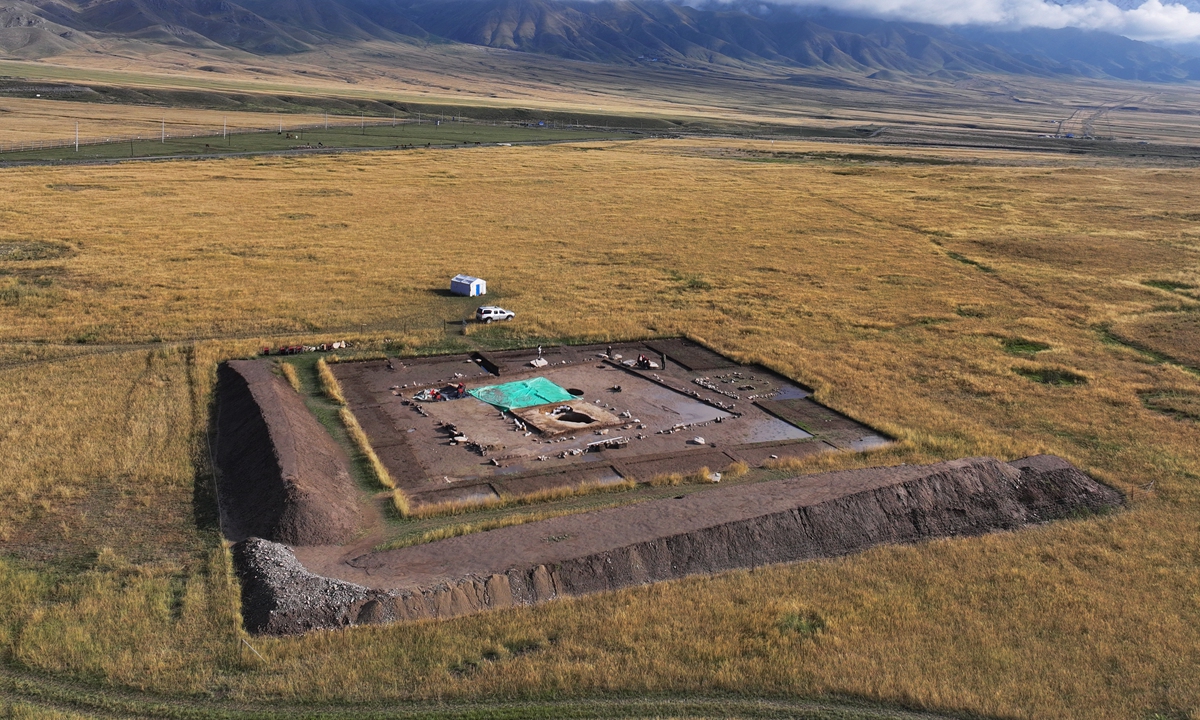
An aerial view of the Husta site in Northwest China's Xinjiang Uygur Autonomous Region. Photos: Courtesy of Wang Peng
Be it exploring an ancient Egyptian temple or a Romanian Copper Age settlement, Wang Peng, who grew up in a small county in Northeast China's Liaoning Province, has traveled far and wide because of his job. That same job has taught him a way of seeing the world through archaeology.
The seed to become an archaeologist was planted in Wang's heart in his student days. He is now 45 years old.
Driven by his curiosity and a personality that "does not like being in the city," Wang heads to destinations that are far-flung, and even a bit mysterious. That explains why he, a native of Northeast China, found his calling at the Husta site in Northwest China's Xinjiang Uygur Autonomous Region.
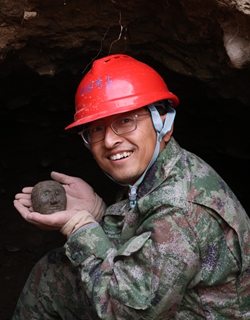
Wang Peng at the Husta site
3,600-year-old settlementLocated in Xinjiang's Bortala Mongolian autonomous prefecture, "Husta" means "a place where birch trees grow" in Mongolian language. The imagery describes the local lush vegetation and fertile grasslands. Yet beneath this landscape lay something unexpected: a large Bronze Age settlement dating back 3,600 years.
Covering an area of 12 square kilometers, the Husta site stands as the largest and earliest Bronze Age settlement ever discovered in the region. Wang has been leading the survey and excavation of the site since 2021. Recently, the site has been shortlisted as a final candidate for the National Top 10 Archaeological Discoveries of 2025.
One of the Husta site's greatest charms is its architectural layout, complex in structure and fully equipped with supporting facilities, all spread across a vast expanse. From a bird's-eye view, the site reveals a north-to-south arrangement of military lookouts, a core residential area, a main cemetery zone and more, forming a prehistoric settlement that integrated defensive and domestic functions.
"In the core zone, we discovered not just stone house foundations, but also water channels and flood prevention structures," Wang noted, revealing a sophisticated understanding of architectural planning in the Bronze Age.
During 2025, his team unearthed two small tombs, designated Z3 and Z4, in the eastern zone of the site. When Z3, a vertical-shaft tomb with a side chamber, was opened, they found the occupant lying supine with limbs extended, head facing north. A horse had been sacrificed and buried with iron stirrups and a bow. Tomb Z4, though in poorer condition, was similar in structure to Z3 but showed clear signs of ritual activity.
"Based on the burial customs and tomb structures, we were surprised to see that they actually belonged to the Sui (581-618) and Tang (618-907) dynasties," Wang noted. "That tells us that this cemetery was used over a long stretch of time."
Humanity in artifacts
Beyond architecture, Wang and his team have uncovered astonishing works of human craftsmanship from the Husta site. For example, emitting the unique patina of ancient bronze, a tin-bronze knife was recovered from the site's Z1 tomb.
The knife was discovered broken into several fragments. Subsequent analysis left archaeologists stunned: The knife had been produced between 2600 and 2800 BC, making it one of the earliest bronze artifacts ever discovered in China.
Including this knife, Tomb Z1 was like a treasure trove, yielding over 300 artifacts. Among them were ornaments made of precious turquoise and agate, as well as pottery censers and jars. But the find that left the deepest impression on Wang was a scepter, particularly the scepter's head.
The scepter head was designed in the likeness of a human face. The object was no bigger than the palm of Wang's hand. Yet on a piece of stone that small, someone managed to carve a face with prominent cheekbones, a high-bridged nose, a faintly stern expression, and a flat cap atop its head. Most uniquely, it had turquoise-green bronze inlaid in the eye area, making them round and striking.
"This is not merely an embodiment of ancient bronze craftsmanship; it also manifests ancient people's aesthetic sensibilities, their imaginative vision, and their comprehension of identity and authority," Wang Xue, an art historian, told the Global Times.
Comparing these artifacts with burial customs from other tombs of the same period, Wang Peng found that Z1 contained elements from both sides of the Altai Mountains - west into the Eurasian steppe and east into the neighboring regions. "That makes the Husta site a meeting point for Eastern and Western civilizations and technology," Wang Peng said.
Mind over matter
Years of living and working on-site have turned Wang, once a non-native, into a new Xinjiang local. He no longer suffers from acclimatization struggles. At the archaeological base, his team has found more than ancient artifacts: they've found friends among the neighboring herders, and a black-and-white border collie that has become their loyal work companion.
Yet this transformation was never simply a matter of time. It demanded something deeper: dedication.
He still recalls those early days working on the frontier. The long stretches of drought, punctuated by sudden rainstorms, kept the archaeological team constantly on edge. When floods came, the members were too anxious to sleep.
In such an outlying remote area, the initial feeling was not total devotion to work, but a faint unease. During the first few years of fieldwork, local supplies were scarce. A trip to the county seat for a shower and daily necessities could only be made once every 10 days or twice a month.
"And another thing was the highly venomous grassland vipers that were everywhere in the field," Wang said, noting that having encountered both large and small ones, he and his team have learned to take them in stride.
Now, Wang looks back at these hardships as nothing more than anecdotes. The excavation at Husta may one day come to an end, but the site will remain a part of him, he noted, because archaeology, after all, is just a way of experiencing the world.
RELATED ARTICLES