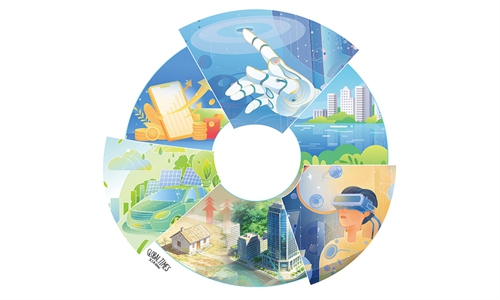
Illustration: Liu Rui/GT
As China enters its 15th Five-Year Plan (2026-30) period, a new opportunity has emerged that Bangladesh must assess, accept and manage prudently.China's 15th Five-Year Plan is an evolution from infrastructure investment to a new type of investment that emphasizes digital sovereignty, smart technologies and standards. The "model-chip-cloud-application" ecosystem is part of this strategy to integrate partner countries with China's technology ecosystem. This offers Bangladesh a policy and development road map for rapid growth.
The "model" is the first step, which includes deploying artificial intelligence (AI) technologies from China. For Bangladesh, these could revolutionize governance, administration and disaster management. AI tools for agriculture, urban development and climate change adaptation could enhance their efficiency in a country susceptible to climate change.
The "chip," the second component, is supplying Chinese semiconductors and chips to power critical infrastructure. Affordable, scalable hardware is attractive for Bangladesh's digitalization. This might save the country money, import components from the West and accelerate the technological shift.
The "cloud," such as Alibaba Cloud and Huawei Cloud, provides data storage and management for e-governance. Bangladesh can use cloud computing for e-governance, digital financial services and smart cities. They can also help automate and increase transparency.
Ultimately, the "application" layer is vast and includes applications such as smart port and smart energy. These are important for Bangladesh. For instance, integrating a smart logistics system into Bangladesh's ports will boost trade efficiency, minimize bottlenecks and enable Bangladesh to compete in international markets. Smart grids will increase energy efficiency and reduce waste in the electricity sector.
Besides smart infrastructure, China's integration strategy covers sectors in South Asia, many of which are critical to Bangladesh. In energy, smart grids with AI will increase energy efficiency. In maritime, digital integration will boost Bangladesh's trade. In governance, smart cities will enhance governance. These overlap with Bangladesh's desire to transition from a least developed to a developed country with smart infrastructure.
The prospects are good. Bangladesh has the opportunity to leapfrog its development by adopting new technologies, as outlined in China's 15th Five-Year Plan. This aligns with Bangladesh's own digital, diversified and sustainable development. The question is, how will Dhaka handle this opportunity?
First, Bangladesh should adopt a phased roll-out of technology. Second, investing in education, training and research will ensure that Bangladesh not only uses but also innovates in technology. Third, transparency in the negotiation and procurement process will help to build confidence. Last but not least, China-Bangladesh is a progressive and interdependent relationship. The past 50 years have laid a foundation of trust, cooperation and enhancement. The next step, as part of China's 15th Five-Year Plan, will see the relationship reach a deeper level of vision, policy and institutional preparedness.
For Bangladesh, it is about globalization leadership. If Bangladesh can lead the race by being responsive to China's new priorities in a balanced, transparent and progressive manner, then the country will be free of problems and become a safe, empowered and connected digital country.
China's 15th Five-Year Plan can help Bangladesh get the development right. Given that China's priorities are green technologies, low-carbon industries and sustainable development, Bangladesh can take the opportunity to absorb China's investment, technological and policy development experiences to enhance its sustainable development. This would help the country partner with China to develop renewable energy, climate-resilient infrastructure, smart manufacturing and green finance to move from traditional to inclusive and sustainable development.
This requires policy harmonization, transparent project approval and a national plan focused on environmental and economic sustainability.
China's 15th Five-Year Plan can be an opportunity for Bangladesh to build a sustainable, innovative economy by 2030 and beyond through a development partnership.
The author is a professor in the Department of International Relations, University of Chittagong, Bangladesh, and the deputy director of the Hong Kong Research Center for Asian Studies. opinion@globaltimes.com.cn
RELATED ARTICLES