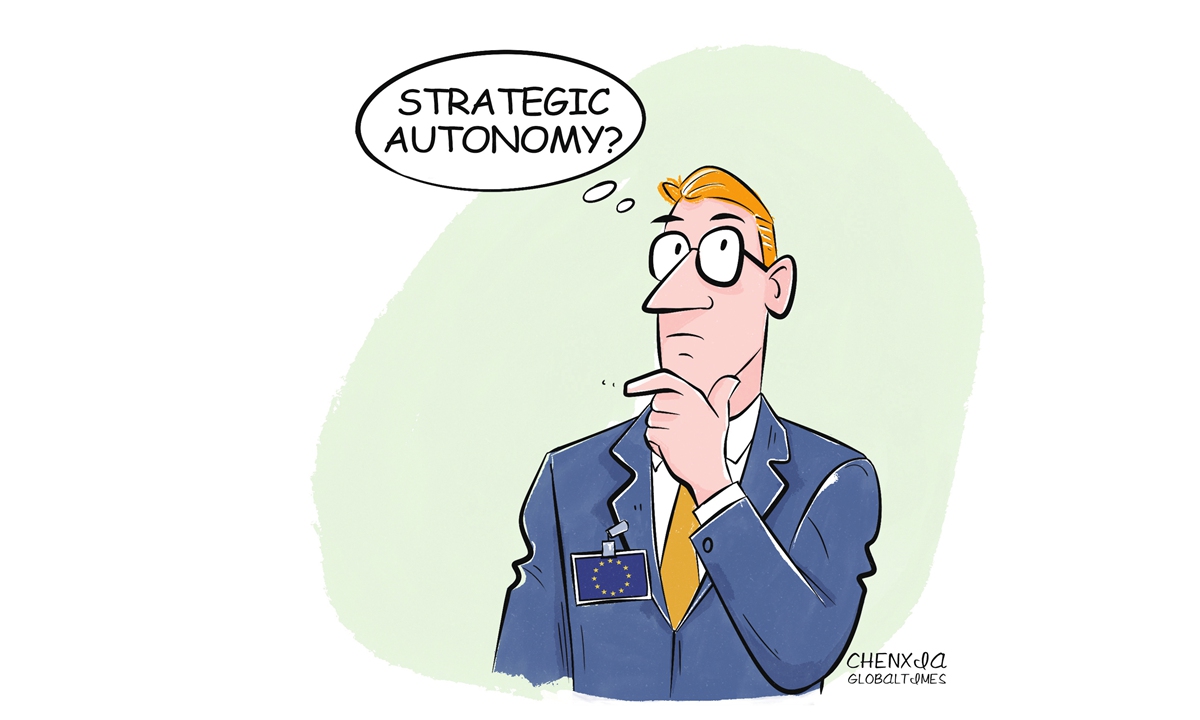
Illustration: Chen Xia/GT
As the American umbrella is pulled away, Europe appears to be finally waking up to the real urgency: it must take its destiny into its own hands.
After Washington announced the withdrawal of thousands of US troops from Germany, European leaders, gathered in Yerevan, Armenia, for a meeting of the European Political Community, "put a brave face," but warned that "it was proof Europe needs to step up for its own security, and fast," according to AFP.
"There has been a talk about withdrawal US troops for a long time from Europe," EU foreign policy chief Kaja Kallas said. "But of course, the timing of this announcement comes as a surprise."
French President Emmanuel Macron said, "Europeans are taking their destiny into their own hands, increasing their defence and security spending, and building their own common solutions."
Even before the US announcement, Joschka Fischer, Germany's former foreign minister and vice chancellor, put it bluntly in an article on Project Dyndicate: "Ready or Not, Europe's Post-American Future Has Arrived." He argued that "Europeans must accept that they are already on their own."
Indeed, transatlantic tensions have been escalating since the US and Israel launched military attacks against Iran, and this reached a new level recently, when Washington threatened to pull troops from Germany, Spain, and Italy - citing their reluctance to support operations in the Strait of Hormuz.
The reality Europe now faces is that US security guarantees are no longer guaranteed. In addition, market access is becoming another lever of US political pressure: fall in line, or pay the economic price. On May 1, Washington announced to raise tariffs to 25 percent on European cars and trucks.
The core disagreement is clear: Washington wants Europe to help shoulder the military costs of its Middle East operations, while many European countries have little desire to be drawn into a war that is not theirs. Hence this fresh wave of calls for strategic autonomy.
Since former French president Charles de Gaulle's time, European politicians have been repeating the call for "strategic autonomy." The phrase has echoed through summit declarations and speeches. Yet this has largely remained on papers.
After WWII, the US took the lead in founding NATO and provided Europe with security guarantees. But the central goal was always to maintain the US' own strategic presence and influence over European affairs.
By the time the Cold War ended, Europe had already slipped into a habit of dependence. But today as the world is changing dramatically, can Europe still afford to cling to this old reliance?
Interests between the US and Europe sometimes overlap. In critical moments, the answer has too often been: not necessarily. NATO is no longer the tightly unified military alliance it once claimed to be. And there is a growing conflict of interests among its members.
The war in Ukraine has already shown this clearly. While Washington profited from the conflict, Europe footed much of the bill - paying for weapons sent to Ukraine and imposing sweeping sanctions on Russia. In return, Europe largely lost access to Russian oil and gas. Energy prices soared, export competitiveness suffered, and the cost of living for ordinary citizens rose sharply.
For decades, Europe has failed to achieve real strategic autonomy - not because it lacked economic strength, but because it lacked sufficient strategic will. Will this time be different? In late April, Germany unveiled first-ever military strategy for Bundeswehr (German armed forces), with the clear goal of turning it into Europe's strongest conventional force.
Yet real strategic autonomy goes far beyond military buildup. It demands a broader vision: a more pragmatic stance toward other major countries to escape zero-sum confrontation, and a willingness to ease excessive distrust of others by moving beyond trade barriers and discriminatory policies. That could give Europe's economy a much-needed boost and prove a smart move in today's multipolar world.
China has always regarded Europe as an important pole in a multipolar world, firmly supported European integration, and backed the EU's pursuit of strategic autonomy. In practice, however, Europe's China policy still largely follows Washington's lead. This approach is not only shortsighted, it ultimately weakens Europe's own aspirations for true autonomy.
For Europe, strategic autonomy is not a choice - it is a compulsory question that must be answered. In this era of profound global change, will Europe finally get serious about its strategic autonomy? The answer may not come overnight, but history may yet remember the spring of 2026 as a pivotal turning point.
RELATED ARTICLES