China slams Japan's first post-WWII offensive missile launch overseas, says Tokyo’s surging neo- militarism threatens regional peace, stability
By Published: May 06, 2026 09:20 PM

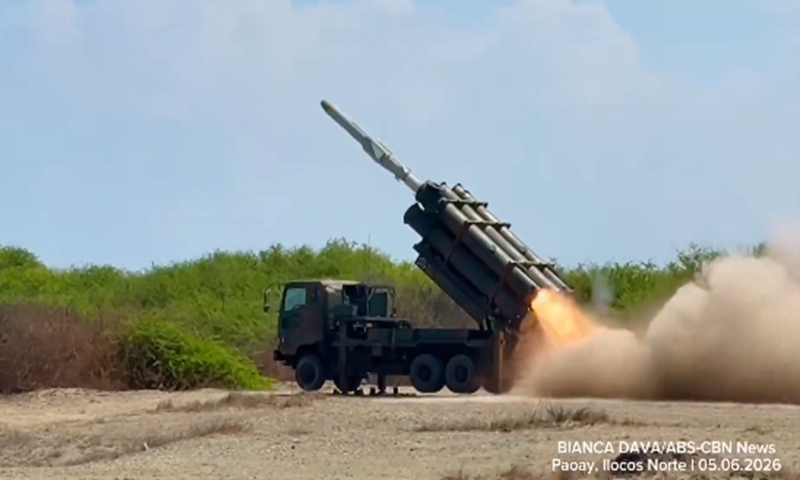
Japan fires Type 88 surface-to-ship missiles on May 6, 2026 during the Balikatan 2026 joint military exercise in Philippines. Photo: screenshot from the video released by Philippine media outlet ABS-CBN News on X.
With deafening sound and thick smoke, missiles roared off from a dark green missile launcher parked on an open ground…This 29-second video clip released by Philippine media on social media is not a random military drill footage, but an extremely dangerous signal - Japan, participating in the 2026 US-Philippines Balikatan joint military exercise, fired a Type 88 surface-to-ship missiles on Wednesday, which the China Media Group said to be Japan's first overseas launch of offensive missiles since the end of World War II.
Hours after the launch, China's Foreign Ministry commented that "This is yet another example of the Japanese right-wing forces' push for accelerated remilitarization of Japan. They have repeatedly breached Japan's exclusively defense-oriented policy and relevant rules in international and domestic laws. Some of their policies and moves have gone far beyond the scope of self-defense." The serious lack of education on true history, the fundamentally wrong historical views, compounded by strategies for military rearmament and preparation for war, have led to the malevolent emergence of neo-militarism in Japan and put regional peace and stability under threat.
Chinese Foreign Ministry spokesperson Lin Jian said at a press conference on Wednesday, that Japan once invaded and imposed colonial rule over the Philippines and other Southeast Asian countries, and thus shoulder grave historical responsibilities. As the world marks 80 years of the opening of the Tokyo Trial, not only has Japan, the aggressor, failed to deeply reflect on its historical crimes, it has even sent military forces overseas and fired offensive missiles under the pretext of security cooperation.
Chinese analysts viewed Japan's move as a major and dangerous gamble, warning that it blatantly violates Japan's post-war military constraints, is an abandonment of its long-standing exclusively defense-oriented policy, and represents a significant step toward exercising the right of collective self-defense.
Dangerous move
"Japan unleashes its Type 88 surface-to-ship missiles during the Balikatan 2026 maritime strike, hitting the target - decommissioned Philippine Navy warship BRP Quezon - within six minutes, about 75 kilometers off the shores of Paoay, Ilocos Norte," ABS-CBN News claimed in an X post on Wednesday, with a 29-second video showing the firing.
"This year marks Japan's shift from observer status to active participation in the annual drills," the same X post said.
Unlike Philippine media, Global Times reporters found that Japan's mainstream media had barely covered this offensive missile launch in the first instance on Wednesday morning. In a report on Wednesday afternoon, the Japan Times described the firing of the Type 88 missile as breaking another "postwar taboo" and also mentioned that China's Taiwan region "sits just about 400 kilometers north of where Wednesday's exercises took place."
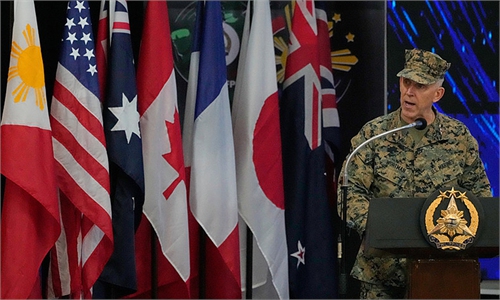
The ongoing Balikatan 2026 joint military exercises, held from April 20 to May 8 and led mainly by the Philippines and the US, have become a key window to observe the intensifying military cooperation between Japan and the Philippines.
According to the Philippine Star, this year's Balikatan drill is the largest edition since the 1990s. Media reports noted that the drill marks the first time Japan has deployed combat forces to Philippine soil since World War II. During the Balikatan exercises, live-fire drills are taking place in northern Luzon, facing the Taiwan Straits, and in Palawan, overlooking the South China Sea, the Philippine media outlet reported.
Chinese military affairs expert Song Zhongping told the Global Times on Wednesday that the Type 88 shore-based anti-ship missile was developed based on the US Harpoon missile, yet its technology is relatively outdated and its actual combat capability is limited. Lacking hypersonic speed and stealth design, the missile has very limited penetration capability.
Against countries with strong military capabilities, the Type 88 system can barely maintain effective combat capability, Song said.
Despite the missile's outdated performance, Japan's first overseas launch of such missiles in the Philippines after WWII signifies a major and dangerous move, Song said. "It indicates Japan has broken through the long-standing restriction on exercising military force overseas, substantially hollowing out its exclusive defense policy and blatantly shifting toward the exercise of collective self-defense," the expert said.
Deepening collusion
Behind the offensive missile firing lies rapid advancements in Japan-Philippines defense ties.
Citing the Philippines' president office, Reuters reported that Japanese Defense Minister Shinjiro Koizumi and Philippine National Defense Secretary Gilberto Teodoro Jr. witnessed the live missile firing on the ground on Wednesday.
On Tuesday, the two defense chiefs agreed to set up a new bilateral working group to promote defense equipment-related and technological cooperation, according to Jiji Press.
The NHK report claimed that the two sides have agreed that the working group will discuss concrete steps for an early transfer to the Philippines of Abukuma-class destroyer escorts scheduled for retirement by Japan's Maritime Self-Defense Force as well as TC-90 aircraft.
"Once they are exported and go into service, interoperability between Japan's Self-Defense Forces and the Philippine military is expected to increase, which would help improve the two countries' deterrence and response capabilities," the Jiji Press report claimed.
However, Song noted that other than the Type 88 surface-to-ship missiles, Japan has held back its more advanced Type 12 and Type 17 surface-to-ship missiles from the Balikatan drills.
"Japan's hidden calculation is to use joint military exercises in the Philippines as a weapon exhibition platform to promote its obsolete military equipment to Southeast Asian nations, while equipping its own Self-Defense Forces with the most advanced missile and naval systems," the expert said, "It seems Japan believes such outdated and inferior weapons are enough to satisfy the Philippine military."
But on the other hand, by aggressively selling arms to the Philippines and other Southeast Asian countries, Japan is attempting to expand its geopolitical influence and build an anti-China encirclement in the South China Sea, Song said.
According to Xiang Haoyu, a distinguished research fellow at the China Institute of International Studies, once tensions flare up, Japan can use the Philippines as a springboard to integrate geopolitical flashpoints in the East China Sea, the Taiwan Straits and the South China Sea through military linkages, and build a cross-regional containment architecture targeting China.
What deserves high vigilance is that the Japan-Philippines military collusion may evolve further toward greater alliance-like, combat-oriented, and normalized development, Xiang said.
As the exercises were being held, the Japanese government officially revised "the three principles on transfer of defense equipment and technology" and their implementation guidelines in late April to allow overseas sales of weapons, including those with lethal capabilities, despite large-scale domestic protests, local media reported.
In March this year, Japan handed over five coastal radar systems to the Philippines, which it said would strengthen the country's maritime domain awareness and coastal defense capabilities, according to multiple media reports from the two nations.
Tokyo continues to hype its so-called "China threat" rhetoric to create political and public support for its long-sought constitutional revision and further military expansion, Song said. "Japan's provocative moves severely destabilize the regional security landscape and cast a dark shadow over peace and stability in the Asia-Pacific," he noted.
RELATED ARTICLES