Japan’s SDF set to participate in Balikatan; move exposes Tokyo’s attempt to revive its militarism: Chinese expert
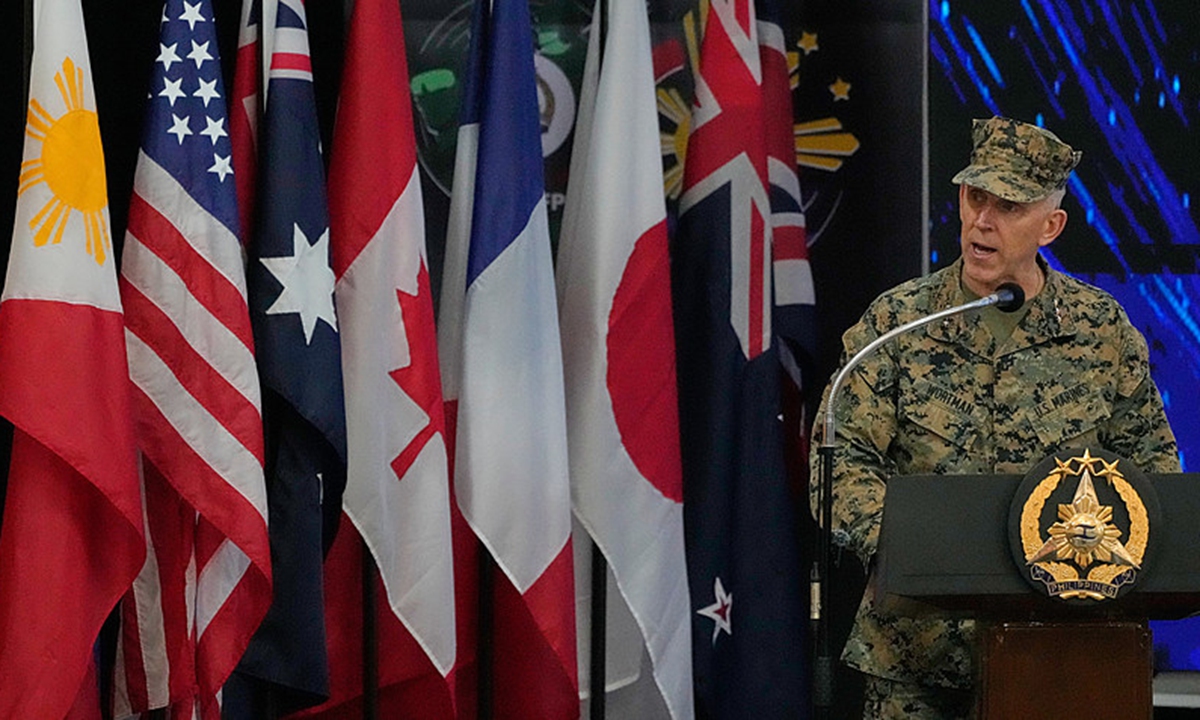
Lt. Gen. Christian Wortman, Commanding General of the US Marine Expeditionary Force, speaks during the opening ceremonies of the joint military exercise dubbed "Balikatan" or "Shoulder to Shoulder," on Monday, April 20, 2026 in Quezon city, Philippines. Photo: VCG
"We need to stress that Japan bears grave historical responsibilities for Southeast Asian countries, including the Philippines, due to its aggression and colonial rule during WWII," Chinese Foreign Ministry spokesperson Guo Jiakun said on Monday, when asked to comment on Japan's active participation in this year's annual Balikatan military drills, given Japan's destroyer, the Ikazuchi, which sailed through the Taiwan Straits was heading to these drills.Japan needs to seriously reflect on its history of aggression, and exercise prudence both in words and actions in military and security areas, rather than flexing muscles in the South China Sea and undermining stability in the region, Guo said.
Guo's remarks came after Japan's Self-Defense Forces (SDF) are set to participate in the largest iteration yet of the annual military exercise orchestrated by the Philippines and the US starting from Monday. For the first time since the end of World War II, Japanese combat-capable troops will return to the Philippines, media outlets reported.
A Chinese expert said that under the guise of the exercise, Japan is in fact seeking to realize its ambition of expanding military power overseas, representing yet another sign of the resurgence of Japanese militarism.
Named Balikatan, meaning "shoulder to shoulder" in Tagalog, the drill includes integrated air and missile defense, and a counterlanding live-fire exercise, running from Monday through May 8, Nikkei Asia reported on Monday.
The Asia Times reported that Japan is deploying a large, multi-service force to participate in Balikatan. It is not hiding behind a humanitarian assistance or disaster relief fig-leaf, nor just sending observers or a small unit that hovers on the edges of the training activities. Rather, the Japanese are going to train for combat, said the report.
In addition to 1,400 SDF members set to participate in the drills, the SDF will fire Type 88 missiles, a ground-to-surface missile, aiming to sink a decommissioned ship 40 nautical miles away, Nikkei Asia reported.
According to Japan Times, the deployment would also include one of Japan's largest warships, the Ise helicopter carrier. Also participating will be the Shimokita landing ship, Ikazuchi destroyer as well as C-130H transport and US-2 amphibious rescue aircraft, per Japan Times.
The equipment and combat troops deployed by Japan's SDF this time are endowed with substantive offensive combat capabilities, constituting a groundbreaking military operation, Zhang Junshe, a military affairs expert, told the Global Times on Monday.
Japan also seeks to make further provocations in the South China Sea through Balikatan, willingly acting as a pawn of the US in the Asia-Pacific region, said Zhang.
Philippines-based news outlet Rappler noted that it will be the first time for Japan combat personnel, likely to number in the hundreds, to set foot on Philippine soil since Imperial Japan invaded the Philippine islands in World War II.
Zhang said Japan's act directly breaches its post-war legal restrictions on overseas troop deployments, marking a complete abandonment of what Japan had long professed as its "exclusively defense-oriented policy."
Japan's move exemplifies its tactic of using external platforms to deploy forces overseas and signifies that Japan is straying from the post-war peaceful order, paving the way for its military expansion, and sending a clear signal of the resurgence of its militarism, Zhang added.
The report by Asia Times also noted that this year's US-Philippines Balikatan Exercise provides plenty of evidence Japan is outdistancing the ghosts of World War II and subsequent decades of faux pacifism.
The Philippines, a country once invaded and occupied by Japan, has insisted on pushing forward military cooperation with Japan, which is a typical case of forgetting the pain once the wound is healed and a short-sighted act of inviting a wolf into the house, Zhang said.
Still, the US cares nothing about the national security and well-being of the people of Japan and the Philippines, treating them merely as pawns and cannon fodder for its Asia-Pacific strategy, the expert said, adding that should the situation spiral out of control, the first to pay the price will inevitably be those nations lashed to the war chariot.
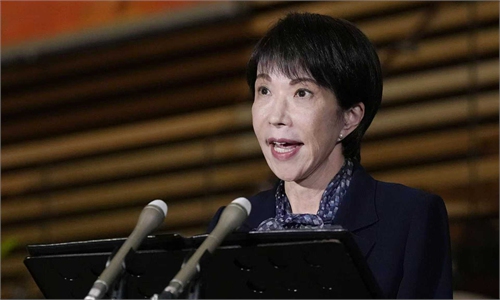
Japan's intensified militarization move has also triggered increasing domestic opposition. In response to another question that on the afternoon of April 19, 36,000 Japanese people gathered in front of the National Diet Building, strongly opposing moves by Sanae Takaichi's government to revise the Constitution, as demonstrators held placards reading "No to war," "Do not undermine Article 9" and "Takaichi step down," Chinese Foreign Ministry Spokesperson Guo said that Japanese militarists have not only committed atrocities to the people in China and other countries in Asia, but also brought profound sufferings to the Japanese people.
Japan's constitutional revision concerns the postwar international order and where Japan is going, and it has been closely watched by the international community and its Asian neighbors. However, so far, the Japanese side has failed to thoroughly reflect on its history of aggression, the spokesperson added.
RELATED ARTICLES