IN-DEPTH / IN-DEPTH
Anti-smuggling frontline: Law enforcement measures continue to be upgraded to counter evolving smuggling tactics
"Do you know which boats are the fastest at the dock?" Wang Supeng, a comrade-in-arms of martyr Qiao Helin, asked a Global Times reporter during an interview at the Fangcheng workstation of the Fangchenggang Coast Guard Bureau in South China's Guangxi Zhuang Autonomous Region, where Qiao worked before his death.
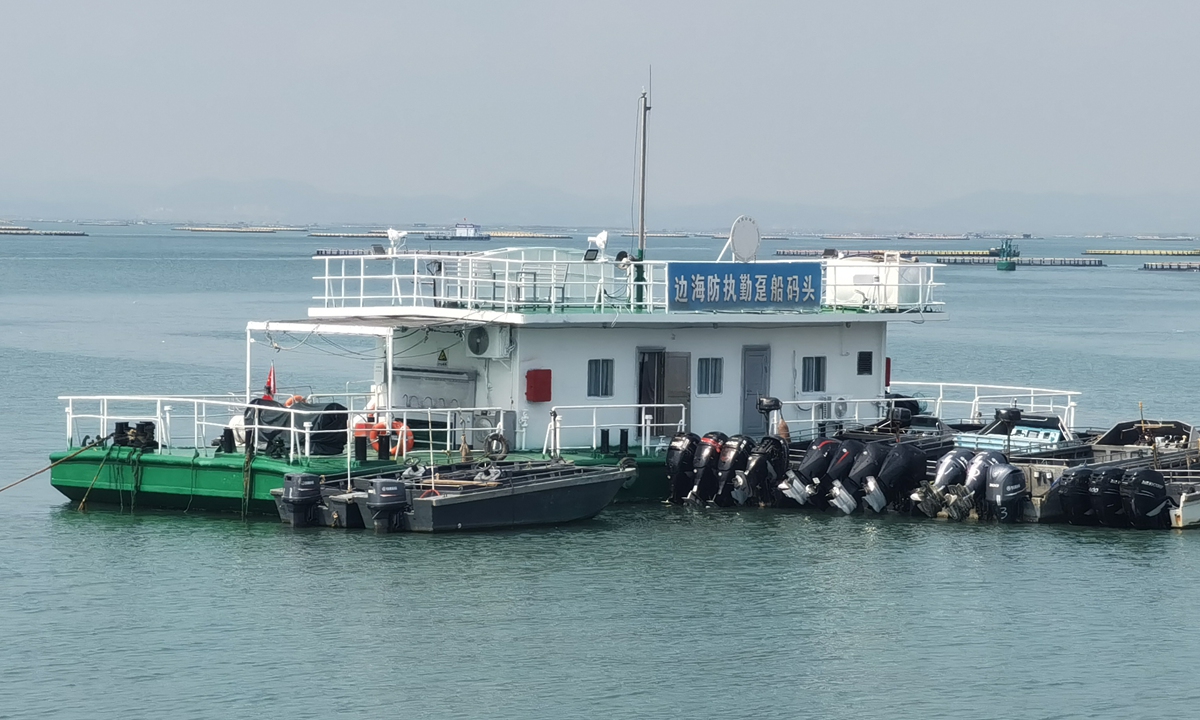
On the waters of the Beibu Gulf, China Coast Guard (CCG) law enforcement vessels sped past at high speed, but Wang pointed to several speedboats moored at a pontoon dock. "Ordinary boats cannot outrun these modified smuggling boats, commonly known as 'Dafei,'" he said.
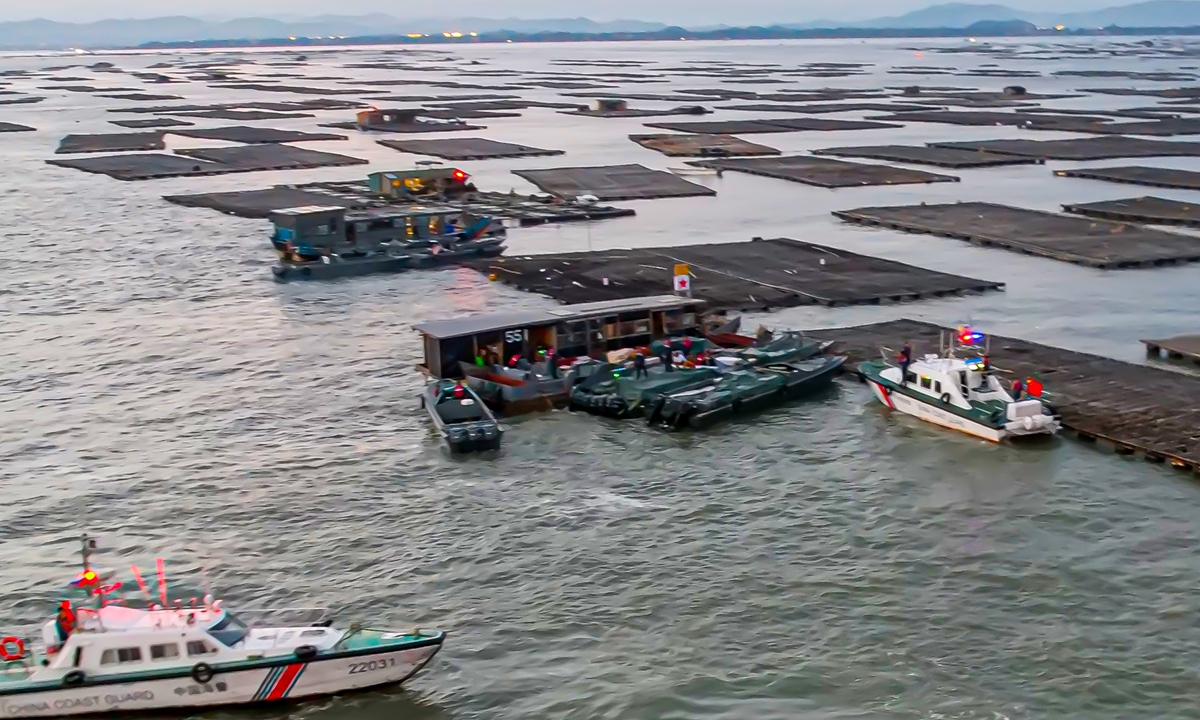
Beyond films and television dramas, smuggling crimes may seem far removed from the public. As the reporter sailed across the Beibu Gulf, oyster rafts the waters and rows of aquaculture cages stretched out, presenting a thriving scene of production.
But late at night, when the roaring engines of "Dafei" shatter this tranquility, CCG law enforcement officers always step forward at the earliest moment to intercept them. Behind the calm sea that people take for granted lie repeated fierce confrontations between law enforcement officers and smugglers.
'It takes just over 10 minutes'
In February, news of the death of a Coast Guard law enforcement officer went viral: The South China Sea Branch of the China Coast Guard held a ceremony to posthumously award Qiao Helin, a Coast Guard law enforcement officer who died while investigating and verifying a suspected smuggling vessel, a first-class citation for merit.
On March 24, 2023, Wang Xiaolong, a law enforcement officer from the Shanwei Coast Guard Bureau in South China's Guangdong Province, also fell into the sea and died while investigating a smuggling case.
Illegal smuggling has continued to surge beneath the calm surface. The Guangxi Coast Guard Bureau, where Qiao served before his death, handled more than half of all smuggling-related cases cracked by the CCG nationwide last year.
"Smuggling crimes occur in almost all coastal provinces across the country. Fangchenggang is the most convenient gateway linking Southwest China with ASEAN, and has long been a frontline position in anti-smuggling work," Liu Cong, a law enforcement officer at the Fangcheng workstation, said as he took out a situation map.
Along the winding coastline of the Beibu Gulf, dense markings indicated potential landing points for smugglers. "The Fangchenggang Coast Guard Bureau is responsible for controlling about 3.2 percent of the country's coastline, as well as 35.5 nautical miles of maritime boundary. Nearshore shoals, waterways and mangroves are intertwined here, and shoals, small 'wild docks' and similar areas are the focus of our crackdown, prevention and control efforts," Liu told the Global Times.
Liu then pointed to a stretch of land across the waters in front of the Fangcheng workstation. "Across the sea is foreign territory. The nearest point is about 15 kilometers from us. There is no natural barrier at sea, and it takes just over 10 minutes for criminals driving 'Dafei' to rush over," Liu said.
Having fought on the front line of anti-smuggling work year-round, law enforcement officers feel the weight of their responsibility deeply. After witnessing the harm caused by smuggling, their sense of mission and duty has grown even stronger.
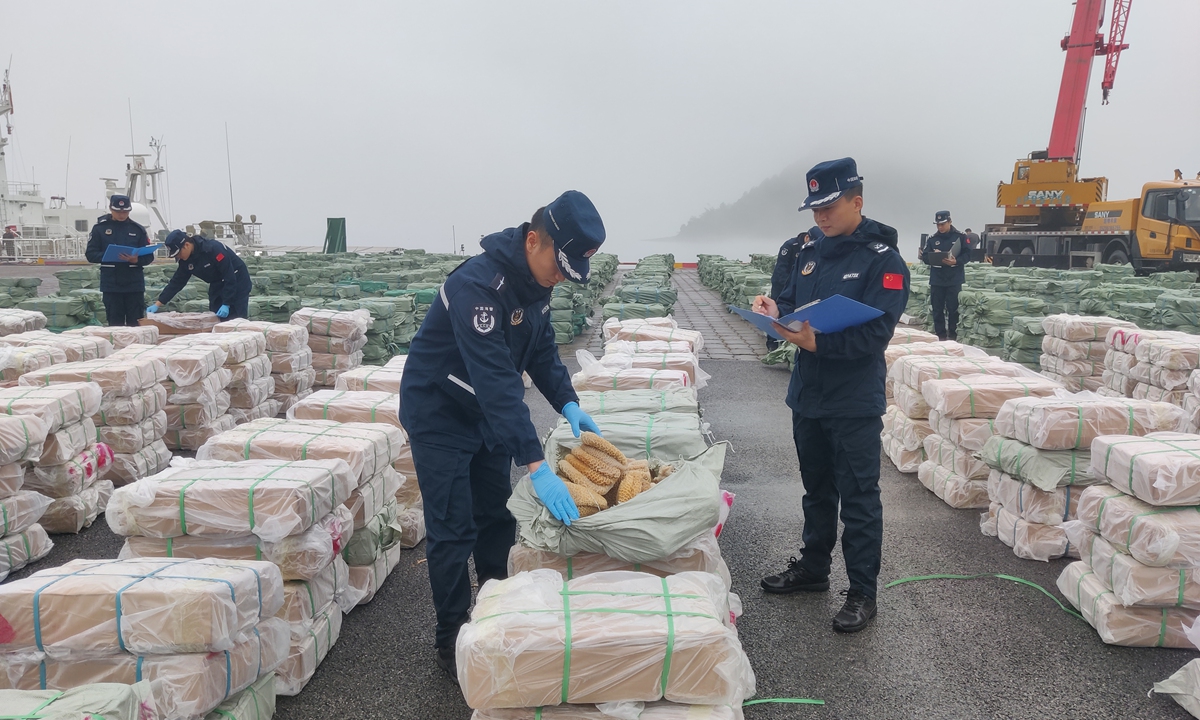
In addition to traditional smuggled goods such as cigarettes and foreign liquor, frozen meat products have gradually become the "mainstream" of smuggling in recent years. Low-priced frozen meats from Europe, the US and South Asia, including pork offal, beef offal and chicken feet, have become the new favorites of smugglers. These smuggled foods have not undergone formal inspection and quarantine; their production dates cannot be traced, and their origins are unknown.
Wang's computer contains photo evidence taken during anti-smuggling operations in recent years, including various kinds of smuggled frozen offal. He enlarged one photo, and the Global Times reporter saw that even thick frost could not conceal the abnormal color of the frozen goods. The labels no longer revealed the place of origin or the production date.
"To evade law enforcement supervision, smugglers often use cargo boats and trucks without refrigeration conditions during transshipment. This can cause some frozen products to thaw, or even rot and spoil, during transport," Wang said. For this reason, Wang and his colleagues are determined to keep such "zombie meat" outside the country's borders, because once it enters the domestic market, it may end up on people's dining tables.
"Why was Qiao Helin willing to give his life to guard this stretch of sea? Because we know all too well the harmful effects of this illegal trade if a smuggling boat gets away. One smuggling boat does not only cause economic losses to the country, but may also bring immeasurable safety risks to the public," Liu stressed.
A black industrial chain
Late at night in the Beibu Gulf, the sea is pitch-black. This is often the moment when Coast Guard officers and smugglers clash. When the roar of engines breaks the silence, a "cat-and-mouse" chase at sea is about to begin.
Today's smuggling is no longer simply about "concealing contraband" on cargo ships. It has become a highly organized and specialized form of small-boat smuggling, known in Chinese as "ant-moving" smuggling - moving contraband in repeated small batches.
In Fangchenggang, this contest often begins at the maritime boundary between two countries. There floats a special kind of "hotel ship," complete with living facilities. It serves both as a "stronghold" for smuggling gangs and as a huge transshipment warehouse. Smuggled goods are usually transferred from large ships on the high seas to these vessels, and then divided among smuggling boats docked alongside. The "hotel ships" are like "logistics centers" near the national boundary.
The journey from the "hotel ships" to the shore is the most hair-raising link in the smuggling chain. Smuggling boats tasked with "beaching" accelerate extremely fast after being fitted with high-horsepower engines, and their speed can usually exceed 60 knots. Smugglers also choose different power configurations according to their routes: In shallow waters of the bay, they use a combination of three 200-horsepower engines for flexibility and maneuverability; when transporting frozen products in deep waters offshore, they spare no cost in mounting six 300-horsepower engines, for more speed and to carry more. To adapt to Fangchenggang's complex terrain of shoals and dense mangroves, these smuggling boats are also modified with flat bottoms and have extremely shallow drafts.
"These 'Dafei' are fast, highly maneuverable and numerous," Wang said, noting that this is a contest of speed. Smuggling boats mostly use gasoline engines, which allow them to plane and accelerate quickly. They have small tonnage, shallow drafts and adjustable propellers, as well as advantages such as small turning radii, making them better suited to complex waters filled with shoals and mangroves.
In addition to "customized" equipment, smugglers in this black industrial chain have a clear division of labor: There are "dispatchers" who organize operations on the "hotel ships," "boatmen" who go to the boundary to make handovers and drive the "Dafei," and lookouts who "keep watch" onshore or at sea. Most of them are locals familiar with the maritime terrain. They are skilled drivers, habitually use "code words," and have strong counter-surveillance awareness and escape capabilities.
"Those who appear to be fishing may in fact be lookouts 'keeping watch,'" Wang said. "If you hear the beeping of walkie-talkies nearby, it is most likely someone responsible for 'keeping watch,' because ordinary people usually communicate by mobile phone."
Costly equipment, meticulous organization and cunning disguises - smugglers spare no expense and take desperate risks for huge profits. In recent years, domestic illegal vendors have generated demand for low-priced smuggled goods such as cigarettes and frozen products. Supply and demand have reinforced each other, making smuggling difficult to eradicate.
Liu has figured out how this black industrial chain works while handling cases. Many smuggled cigarettes are counterfeit, and smugglers also evade regulation and tariffs, bringing considerable profit from each boat on each trip. Driven by profit, some people, influenced by misguided ideas, participate in keeping watch, making connections and transporting goods, and are thus dragged into the profit chain, according to Liu.
Anti-smuggling at sea
Smugglers attempt to put up stubborn resistance through upgraded equipment and crowd tactics, while the CCG relies on technological strength and mass prevention and control to weave an inescapable net. To deal with increasingly cunning smugglers, more "technical prevention" and "human prevention" measures have been deployed in this "clean sea operation."
In the Beibu Gulf, technology has become a silent sentry. At the Fangchenggang Coast Guard Bureau, one can see that along the long coastline, electro-optical radar, thermal imaging and high-definition video equipment overlook every inch of the sea and shore 24 hours a day. The application of technologies such as long-endurance drones and big data analysis enables the analysis of and early warnings for abnormal vessel tracks and handover activities.
"Once the monitoring system detects an abnormally high-speed target heading toward the coastline, it sends an early warning to patrol boats and guides Coast Guard law enforcement officers to conduct checks," Liu said. He believes that the command platform built with these new technologies has transformed previously passive patrols into proactive predictions, gradually achieving a "dimensionality reduction strike" against high-speed smuggling speedboats.
Technological means have shaped this inescapable net, while local fishermen's determination to protect their home has made it even tighter. For fishermen who rely on the sea as their fields, the roaring smuggling boats are not only challengers to the law, but also destroyers of their livelihoods. To evade Coast Guard pursuit, smuggling boats speed through offshore aquaculture areas, rampaging and wantonly damaging oyster rafts and net cages, crushing fishermen's harvests and hopes. Therefore, for fishermen, cracking down on smuggling means protecting their home. Now, the CCG has smoothed reporting channels and broadened intelligence sources, and many members of the public have become the "eyes" and "ears" of the maritime defense line.
In recent years, local maritime smuggling activities have shown a rising trend of violent confrontation. Some smuggling gangs flee at high speed or ram law enforcement vessels when they encounter inspections. "Dafei" either flee abroad, or repeatedly make sharp S-turns to maliciously obstruct navigation. In the face of smugglers' desperate tactics, CCG law enforcement officers have always charged forward, forging a solid safety barrier with their flesh and blood.
"Qiao Helin was exactly the embodiment of this iron defense line," Liu recalled. On December 9, 2025, at the mouth of Zhenzhu Bay in the Beibu Gulf, Qiao did not flinch in the face of a smuggling boat violently resisting law enforcement. He unfortunately fell into the water while fighting with suspects.
It was not until two days later that his comrades-in-arms found him in the cold seawater. At the final moment of his life, the 25-year-old Coast Guard law enforcement officer still clenched his fists and maintained a fighting posture.
Like Qiao, Coast Guard law enforcement officers routinely throw themselves into danger without hesitation. During the interview, they told the Global Times that they all hold one belief in their hearts: They must personally catch the smugglers who have evaded capture and completely sever the maritime smuggling chain. Today, the CCG maintains a high-pressure posture in the Beibu Gulf waters at all times, conducting round-the-clock maritime patrols.
"'Changing personnel but not vessels' has become our normal practice. We must ensure that these vast blue waters remain calm and peaceful," Wang said.
On the waters of the Beibu Gulf, China Coast Guard (CCG) law enforcement vessels sped past at high speed, but Wang pointed to several speedboats moored at a pontoon dock. "Ordinary boats cannot outrun these modified smuggling boats, commonly known as 'Dafei,'" he said.
Beyond films and television dramas, smuggling crimes may seem far removed from the public. As the reporter sailed across the Beibu Gulf, oyster rafts the waters and rows of aquaculture cages stretched out, presenting a thriving scene of production.
But late at night, when the roaring engines of "Dafei" shatter this tranquility, CCG law enforcement officers always step forward at the earliest moment to intercept them. Behind the calm sea that people take for granted lie repeated fierce confrontations between law enforcement officers and smugglers.
Officers from the Guangxi Coast Guard Bureau seize smuggled frozen products on January 31, 2024. Photo: Courtesy of Guangxi Coast Guard Bureau
'It takes just over 10 minutes'
In February, news of the death of a Coast Guard law enforcement officer went viral: The South China Sea Branch of the China Coast Guard held a ceremony to posthumously award Qiao Helin, a Coast Guard law enforcement officer who died while investigating and verifying a suspected smuggling vessel, a first-class citation for merit.
On March 24, 2023, Wang Xiaolong, a law enforcement officer from the Shanwei Coast Guard Bureau in South China's Guangdong Province, also fell into the sea and died while investigating a smuggling case.
Illegal smuggling has continued to surge beneath the calm surface. The Guangxi Coast Guard Bureau, where Qiao served before his death, handled more than half of all smuggling-related cases cracked by the CCG nationwide last year.
"Smuggling crimes occur in almost all coastal provinces across the country. Fangchenggang is the most convenient gateway linking Southwest China with ASEAN, and has long been a frontline position in anti-smuggling work," Liu Cong, a law enforcement officer at the Fangcheng workstation, said as he took out a situation map.
Along the winding coastline of the Beibu Gulf, dense markings indicated potential landing points for smugglers. "The Fangchenggang Coast Guard Bureau is responsible for controlling about 3.2 percent of the country's coastline, as well as 35.5 nautical miles of maritime boundary. Nearshore shoals, waterways and mangroves are intertwined here, and shoals, small 'wild docks' and similar areas are the focus of our crackdown, prevention and control efforts," Liu told the Global Times.
Liu then pointed to a stretch of land across the waters in front of the Fangcheng workstation. "Across the sea is foreign territory. The nearest point is about 15 kilometers from us. There is no natural barrier at sea, and it takes just over 10 minutes for criminals driving 'Dafei' to rush over," Liu said.
Having fought on the front line of anti-smuggling work year-round, law enforcement officers feel the weight of their responsibility deeply. After witnessing the harm caused by smuggling, their sense of mission and duty has grown even stronger.
In addition to traditional smuggled goods such as cigarettes and foreign liquor, frozen meat products have gradually become the "mainstream" of smuggling in recent years. Low-priced frozen meats from Europe, the US and South Asia, including pork offal, beef offal and chicken feet, have become the new favorites of smugglers. These smuggled foods have not undergone formal inspection and quarantine; their production dates cannot be traced, and their origins are unknown.
Wang's computer contains photo evidence taken during anti-smuggling operations in recent years, including various kinds of smuggled frozen offal. He enlarged one photo, and the Global Times reporter saw that even thick frost could not conceal the abnormal color of the frozen goods. The labels no longer revealed the place of origin or the production date.
"To evade law enforcement supervision, smugglers often use cargo boats and trucks without refrigeration conditions during transshipment. This can cause some frozen products to thaw, or even rot and spoil, during transport," Wang said. For this reason, Wang and his colleagues are determined to keep such "zombie meat" outside the country's borders, because once it enters the domestic market, it may end up on people's dining tables.
"Why was Qiao Helin willing to give his life to guard this stretch of sea? Because we know all too well the harmful effects of this illegal trade if a smuggling boat gets away. One smuggling boat does not only cause economic losses to the country, but may also bring immeasurable safety risks to the public," Liu stressed.
A black industrial chain
Late at night in the Beibu Gulf, the sea is pitch-black. This is often the moment when Coast Guard officers and smugglers clash. When the roar of engines breaks the silence, a "cat-and-mouse" chase at sea is about to begin.
Today's smuggling is no longer simply about "concealing contraband" on cargo ships. It has become a highly organized and specialized form of small-boat smuggling, known in Chinese as "ant-moving" smuggling - moving contraband in repeated small batches.
In Fangchenggang, this contest often begins at the maritime boundary between two countries. There floats a special kind of "hotel ship," complete with living facilities. It serves both as a "stronghold" for smuggling gangs and as a huge transshipment warehouse. Smuggled goods are usually transferred from large ships on the high seas to these vessels, and then divided among smuggling boats docked alongside. The "hotel ships" are like "logistics centers" near the national boundary.
The Fangchenggang Coast Guard Bureau cracks a major smuggling case on May 27, 2024. Photo: Courtesy of Guangxi Coast Guard Bureau
During routine patrols, Fangchenggang Coast Guard patrol boats sometimes come within only 100 meters of the "hotel ships." Wang Jie, a law enforcement officer, described them as "so near, yet so far." "Smugglers know that we cannot enforce the law across the border. They stay on the foreign side to evade crackdowns, and we can only look at the boundary and sigh," Wang said.The journey from the "hotel ships" to the shore is the most hair-raising link in the smuggling chain. Smuggling boats tasked with "beaching" accelerate extremely fast after being fitted with high-horsepower engines, and their speed can usually exceed 60 knots. Smugglers also choose different power configurations according to their routes: In shallow waters of the bay, they use a combination of three 200-horsepower engines for flexibility and maneuverability; when transporting frozen products in deep waters offshore, they spare no cost in mounting six 300-horsepower engines, for more speed and to carry more. To adapt to Fangchenggang's complex terrain of shoals and dense mangroves, these smuggling boats are also modified with flat bottoms and have extremely shallow drafts.
"These 'Dafei' are fast, highly maneuverable and numerous," Wang said, noting that this is a contest of speed. Smuggling boats mostly use gasoline engines, which allow them to plane and accelerate quickly. They have small tonnage, shallow drafts and adjustable propellers, as well as advantages such as small turning radii, making them better suited to complex waters filled with shoals and mangroves.
In addition to "customized" equipment, smugglers in this black industrial chain have a clear division of labor: There are "dispatchers" who organize operations on the "hotel ships," "boatmen" who go to the boundary to make handovers and drive the "Dafei," and lookouts who "keep watch" onshore or at sea. Most of them are locals familiar with the maritime terrain. They are skilled drivers, habitually use "code words," and have strong counter-surveillance awareness and escape capabilities.
"Those who appear to be fishing may in fact be lookouts 'keeping watch,'" Wang said. "If you hear the beeping of walkie-talkies nearby, it is most likely someone responsible for 'keeping watch,' because ordinary people usually communicate by mobile phone."
Costly equipment, meticulous organization and cunning disguises - smugglers spare no expense and take desperate risks for huge profits. In recent years, domestic illegal vendors have generated demand for low-priced smuggled goods such as cigarettes and frozen products. Supply and demand have reinforced each other, making smuggling difficult to eradicate.
Liu has figured out how this black industrial chain works while handling cases. Many smuggled cigarettes are counterfeit, and smugglers also evade regulation and tariffs, bringing considerable profit from each boat on each trip. Driven by profit, some people, influenced by misguided ideas, participate in keeping watch, making connections and transporting goods, and are thus dragged into the profit chain, according to Liu.
Anti-smuggling at sea
Smugglers attempt to put up stubborn resistance through upgraded equipment and crowd tactics, while the CCG relies on technological strength and mass prevention and control to weave an inescapable net. To deal with increasingly cunning smugglers, more "technical prevention" and "human prevention" measures have been deployed in this "clean sea operation."
In the Beibu Gulf, technology has become a silent sentry. At the Fangchenggang Coast Guard Bureau, one can see that along the long coastline, electro-optical radar, thermal imaging and high-definition video equipment overlook every inch of the sea and shore 24 hours a day. The application of technologies such as long-endurance drones and big data analysis enables the analysis of and early warnings for abnormal vessel tracks and handover activities.
"Once the monitoring system detects an abnormally high-speed target heading toward the coastline, it sends an early warning to patrol boats and guides Coast Guard law enforcement officers to conduct checks," Liu said. He believes that the command platform built with these new technologies has transformed previously passive patrols into proactive predictions, gradually achieving a "dimensionality reduction strike" against high-speed smuggling speedboats.
Smuggling boats seized by the Fangcheng workstation of the Fangchenggang Coast Guard Bureau in South China's Guangxi Zhuang Autonomous Region Photo: Fan Wei/GT
Technological means have shaped this inescapable net, while local fishermen's determination to protect their home has made it even tighter. For fishermen who rely on the sea as their fields, the roaring smuggling boats are not only challengers to the law, but also destroyers of their livelihoods. To evade Coast Guard pursuit, smuggling boats speed through offshore aquaculture areas, rampaging and wantonly damaging oyster rafts and net cages, crushing fishermen's harvests and hopes. Therefore, for fishermen, cracking down on smuggling means protecting their home. Now, the CCG has smoothed reporting channels and broadened intelligence sources, and many members of the public have become the "eyes" and "ears" of the maritime defense line.
In recent years, local maritime smuggling activities have shown a rising trend of violent confrontation. Some smuggling gangs flee at high speed or ram law enforcement vessels when they encounter inspections. "Dafei" either flee abroad, or repeatedly make sharp S-turns to maliciously obstruct navigation. In the face of smugglers' desperate tactics, CCG law enforcement officers have always charged forward, forging a solid safety barrier with their flesh and blood.
"Qiao Helin was exactly the embodiment of this iron defense line," Liu recalled. On December 9, 2025, at the mouth of Zhenzhu Bay in the Beibu Gulf, Qiao did not flinch in the face of a smuggling boat violently resisting law enforcement. He unfortunately fell into the water while fighting with suspects.
It was not until two days later that his comrades-in-arms found him in the cold seawater. At the final moment of his life, the 25-year-old Coast Guard law enforcement officer still clenched his fists and maintained a fighting posture.
Like Qiao, Coast Guard law enforcement officers routinely throw themselves into danger without hesitation. During the interview, they told the Global Times that they all hold one belief in their hearts: They must personally catch the smugglers who have evaded capture and completely sever the maritime smuggling chain. Today, the CCG maintains a high-pressure posture in the Beibu Gulf waters at all times, conducting round-the-clock maritime patrols.
"'Changing personnel but not vessels' has become our normal practice. We must ensure that these vast blue waters remain calm and peaceful," Wang said.
RELATED ARTICLES