Photo: VCG
Twisting off the bottle cap, a foreign woman sniffed lightly at the mouth of the bottle, then took a sip. When asked if it tasted good, the woman nodded with a smile and said, "It's great!" She then held up the drink to show the camera - aged vinegar cola, a specialty of Datong, North China's Shanxi Province.
This clip was noted by the Global Times reporter on Xiaohongshu, or Rednote featuring the Dutch tourist named Lisa on a trip to Datong, a mid-tier city in northern China, with the post tagged with hashtags including "Foreigners in Datong," "Experiencing Chinese culture with foreign friends" and "Datong."
As the inbound tourism continues to boom, more and more foreign travelers are venturing far beyond Beijing, Shanghai and other top-tier hubs. Eager for authentic experiences and hidden gems, they are increasingly exploring China's charming second- and third-tier cities, as well as smaller inland counties and historic towns.
According to the 2026 trend report on foreign tourism in China released by Xiaohongshu in April, international travelers are broadening their travel footprints beyond China's first-tier cities to embrace more distinctive regional destinations. High-speed rail, cycling and hiking have become their favored ways to explore county-level areas across the country, as reported by Guangzhou Daily.
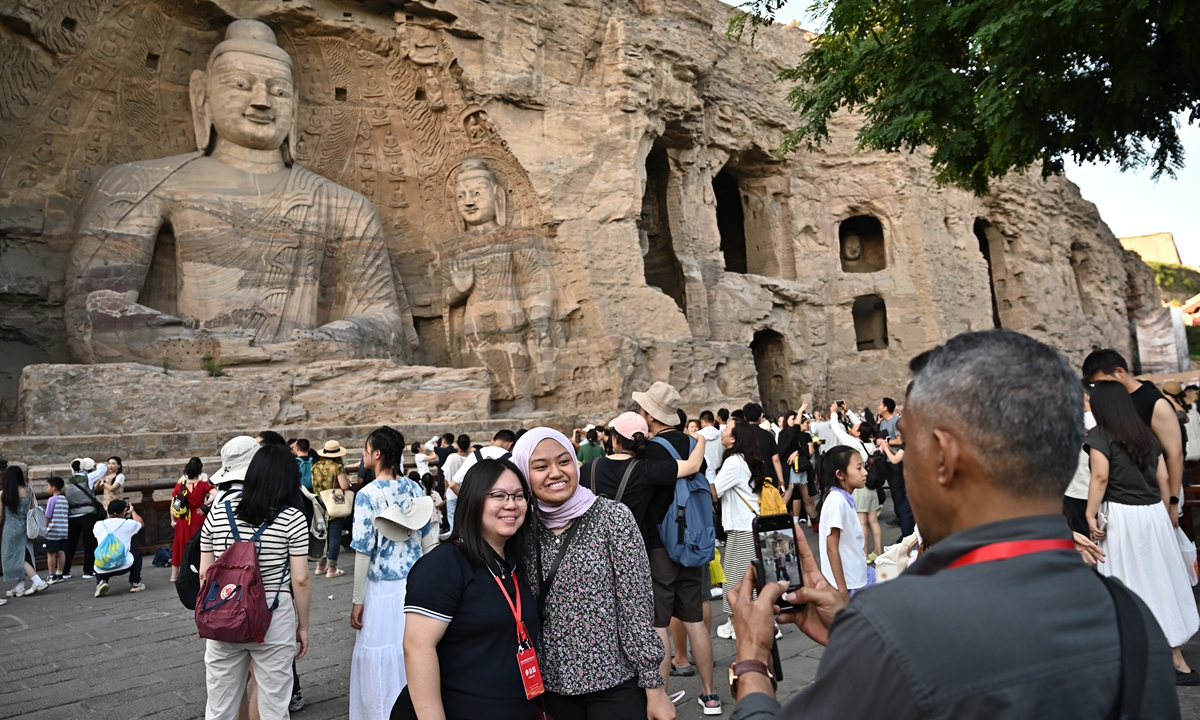
Another travel vlog documenting Lisa's itinerary in Datong traces the foreign guest's footsteps around the city and shows her visiting the Yungang Grottoes, trying local delicacies, and even taking a close-up shot of the "Black Myth: Wukong'' poster, as many scenes in the game are created based on cultural and historical sites in Shanxi, the Global Times reporter noticed.
Like Lisa, Chrissi from Germany also traveled to Datong this year and visited attractions such as the Yungang Grottoes and the Hanging Temple. "In Datong, the first thing I felt was relaxation. Unlike Beijing, where travelling anywhere takes a long time, this smaller city boasts a stronger everyday lifestyle vibe," said Chrissi, media outlet Economic View reported on Tuesday.
Endowed with profound cultural heritage, Datong is gaining rising popularity among foreign visitors. According to Datong Daily, platform data showed that as of February 17, Datong saw 735 percent growth in inbound tourism popularity, marking the top nationwide and making it into the country's top 10 cities with the fastest growth in inbound tourism popularity.
Beyond Datong, charming destinations including Wuxi in East China's Jiangsu Province, Huzhou in East China's Zhejiang Province, Luoyang in Central China's Henan Province, and Dalian in Northeast China's Liaoning Province have also become favored travel picks among foreign visitors. The Global Times reporter noticed that during the May Day holidays, many overseas netizens shared travel videos and photos on social media, posting comments that praise these small cities for their stunning scenery, with captions such as "small cities, stunning scenery" and "crowded with people, yet every spot is incredibly beautiful."
Not only individual travelers, but also tour groups, are opting for China's non-first-tier cities. According to CCTV News, a Spanish group took a 6-day tour of rural counties in East China's Zhejiang Province in April, visiting Qingtian, Yunhe, Songyang counties in Lishui city.
According to the report, foreign visitors immersed themselves in exquisite stone carving art, marveled at the fine craftsmanship of porcelain, savored the layered scenery of terraced fields, and delighted in a tranquil night tour of the wetland with fireflies flickering all around. An Austrian tourist praised the trip, saying: "The itinerary is wonderfully diverse and absolutely fantastic."
"A growing number of international travelers opting to explore China's non-first-tier cities is driven by the diversified development of the country's tourism offerings and travel routes, as well as distinctive local cultural exploration and immersive experience programs," Jiang Yiyi, a tourism and sports expert at Beijing Sport University, told the Global Times on Wednesday.
Jiang also attributed this rising popularity to the benefits of China's increasingly open visa exemption policies. According to the Xinhua News Agency on Wednesday, China saw a surge in cross-border travel during the May Day holidays, with nearly 11.3 million trips recorded, as an uptick in international visitors, including those entering visa-free, added to the increase.
Trips by foreign nationals to and from China rose to 1.26 million during the holidays, a 12.5 percent increase from a year earlier. Among those entering China, 436,000 came visa-free, up 14.7 percent, Xinhua said, citing statistics released by the National Immigration Administration.
Stepping into these mid-sized and small cities, international visitors can not only admire natural landscapes and cultural relics, but also immerse themselves in local folk customs and everyday life of residents, Jiang told the Global Times, noting that in this way, they could get a firsthand taste of regional development and sense the growing well-being in the flesh.
"Such immersive on-the-ground experience enables foreign tourists to truly perceive, observe and understand China in a comprehensive and authentic way that no other approach can replace," Jiang said.
RELATED ARTICLES