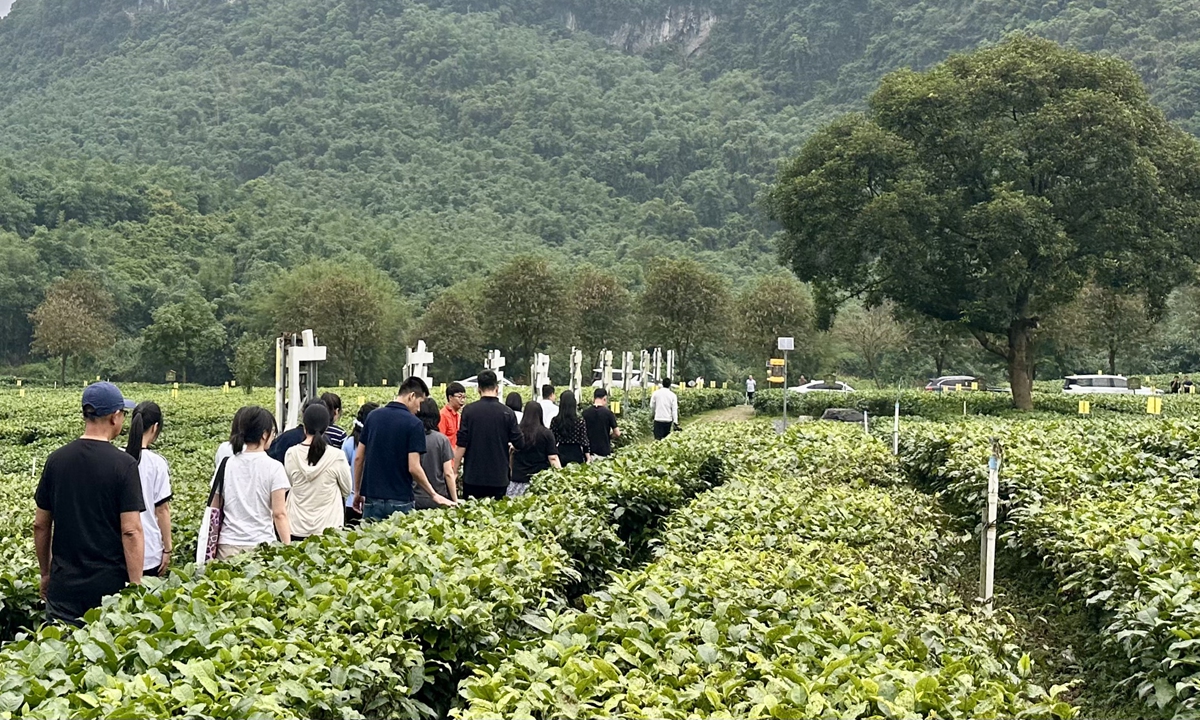
The "Friends of Global Civilization" research team inspects a tea garden in Longhua village in Yingde, South China's Guangdong Province on May 6, 2026. Photo: Lin Xiaoyi/GT
Nestled within the lush tea fields of karst landscape, a two-day "Friends of Global Civilization" on-site research program concluded on Thursday in the small village of Meizizhai, Yingde, South China's Guangdong Province. Hosted by the Global Times and co-organized by Beijing Culture Review magazine and Tencent's Sustainable Social Value Organization (SSV), the program brought together experts and international students, combining field visits and roundtable discussions to explore how a once-hollow village of just 29 households has grown into a popular common-prosperity showcase, and how its replicable approach offers insights for Global South countries.
During the visit, the research team toured Meizizhai and inspected local agri-tourism operations, newly revitalized tea gardens, tea factories and vineyards. The research revealed that once a sparsely populated hollow village, Meizizhai has been revitalized under Guangdong's high-quality development initiative for counties, towns and villages, with coordinated support from government guidance, enterprise partnerships and academic expertise.
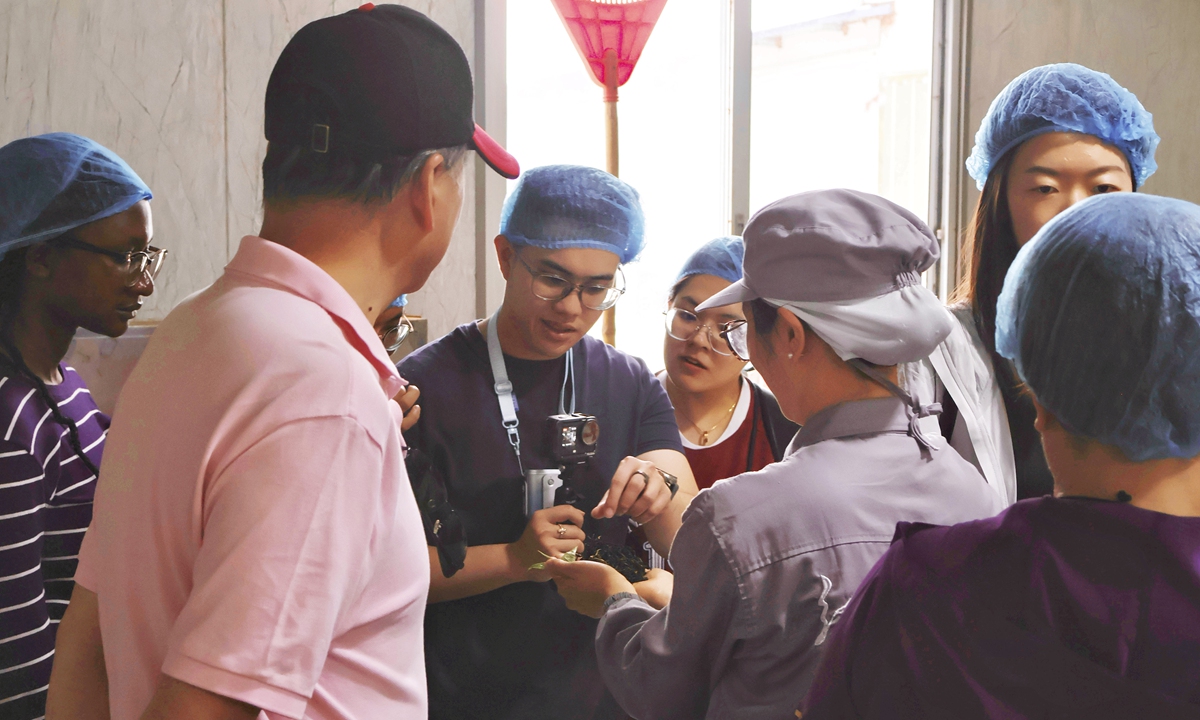
The "Friends of Global Civilization" research team visits a tea factory in Longhua village in Yingde, South China's Guangdong Province, on May 6, 2026. Photo: Lin Xiaoyi/GT
The village's development centers on training local rural CEOs - young professional leaders driving rural revitalization. Empowered by training and technology, rural CEOs have redirected idle rural homes into vibrant new spaces - including agri-tourism sites and cafes, creating new village businesses. Since launching operations in May 2025, Meizizhai has generated 1.31 million yuan ($192,500) in collective operating income, bringing tangible benefits to local residents.
During the roundtable dialogue, local village officials and rural CEOs shared their experiences of professional training and on-the-ground practice. A consensus emerged that cultivating rural management talent and integrating it with local industries can effectively catalyze rural development and common prosperity.
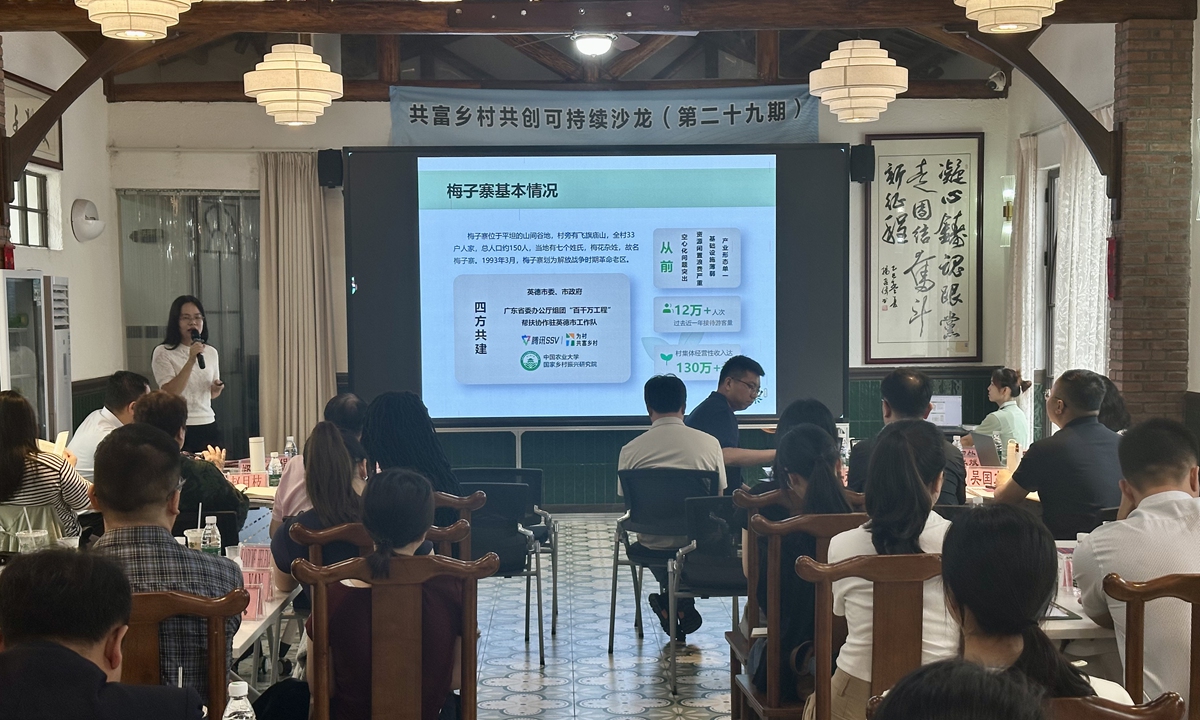
The "Friends of Global Civilization" research team attends a roundtable discussion in Meizizhai, Longhua village in Yingde, South China's Guangdong Province on May 7, 2026. Photo: Lin Xiaoyi/GT
Luo Jiaqi, a rural CEO of Meizizhai, has been at the heart of the village's transformation. "I started with basic administrative work and gradually took charge of cafe and workshop operations," she said. "What touches me the most is that villagers now fully trust and support us, working together to run our hometown well." She noted that the rural CEO model is gaining traction across China, with more practitioners from various regions visiting Meizizhai to exchange experiences.Scholars at the forum analyzed the broader implications. Yang Ping, director of the Beijing Longway Economic and Social Research Foundation, shared at the roundtable that China's rural development is exploring a balance between professional management and people-centered principles, as embodied in the rural CEO model.
"This model serves as a window into China's rural revitalization. It nurtures new market-oriented entities for rural development, while aligning the interest chain to ensure farmers' autonomy, participation and sense of benefit throughout the process," he said.
Zhao Yuezhi, professor at the School of Journalism and Communication at Tsinghua University, told the Global Times that China's rural development breaks the linear narrative that equates rural areas with backwardness, demonstrating that innovative models can create prosperous, attractive and modern villages. It also provides a practical methodology: adapting measures to local conditions by designing development paths based on each country's unique resources and realities.
The research discussions actively incorporated insights from international students studying in China, whose perspectives highlighted how China's rural revitalization practices could fit their home countries.
Kandume Helena Fudheni from Namibia focused on youth empowerment and rural job creation. She pointed out that many developing nations face low youth participation in rural areas and a lack of supportive policies. "Empowering local rural leaders to manage village resources commercially can turn basic farming into high-value industries, which could strengthen community resource management and help reduce youth unemployment, one of Namibia's biggest challenges," she told the Global Times, noting that the unity and shared vision behind China's rural CEO model deeply inspired her.
For Lim Taycheavtong from Cambodia, the trip centered on practical skills training and digital leapfrogging. He noted that China's common-prosperity model ensures benefits for every household through profit sharing, while connecting farmers to wider markets using digital tools such as e-commerce platforms and social media operations training. "With practical skills and accessible digital tools, even small villages can overcome traditional development barriers and achieve stable, inclusive growth."
Lee Hoyan from Malaysia was most impressed by China's systematic, multi-stakeholder and long-term development model. "What I admire most is the spirit of cooperation, from the government down to ordinary villagers." She noted that China's structured, sustainable and collaborative governance offers valuable lessons for Malaysia's rural development.
The "Friends of Global Civilization" program is part of a sustained effort. In 2025, it organized two major seminars. This series of initiatives seeks to outline a vibrant new portrait of rural China: young people are infusing traditional agricultural civilization with fresh vitality through technology and business acumen. At the same time, China's youth-driven rural revitalization practice has emerged as a new paradigm for agricultural civilization - one that values ecology and equity - for the Global South to draw from.
RELATED ARTICLES