Illustration: Chen Xia/GT
In recent days, an increase of international buyers at Huaqiangbei, Shenzhen's well-known electronics area, has attracted media attention. On Wednesday, Shenzhen Fabu republished a media report describing the area as the part of the city most frequented by foreign buyers. While the description carries a local perspective, it points to a clear reality: International traders are drawn to China's artificial intelligence (AI) products.Compared with previous years, more overseas buyers headed straight to Huaqiangbei after they had attended the Canton Fair, which ran in three phases from April 15 to May 5 in Guangzhou, South China's Guangdong Province, according to CCTV. During the May Day holidays, Huaqiangbei received an average of 8,000 foreign business visitors everyday, while overall tourist numbers rose 25 percent year-on-year, data released by the official WeChat account of Shenzhen's Futian district showed.
The increase in foreign buyers reflects a range of factors, among which AI has become particularly notable. Huaqiangbei has long served as a center for consumer electronics, drawing international traders in search of components such as graphics processing units (GPUs) and other electronic parts. Lately, AI products have emerged as an important new category, adding a fresh dimension to the district's international appeal.
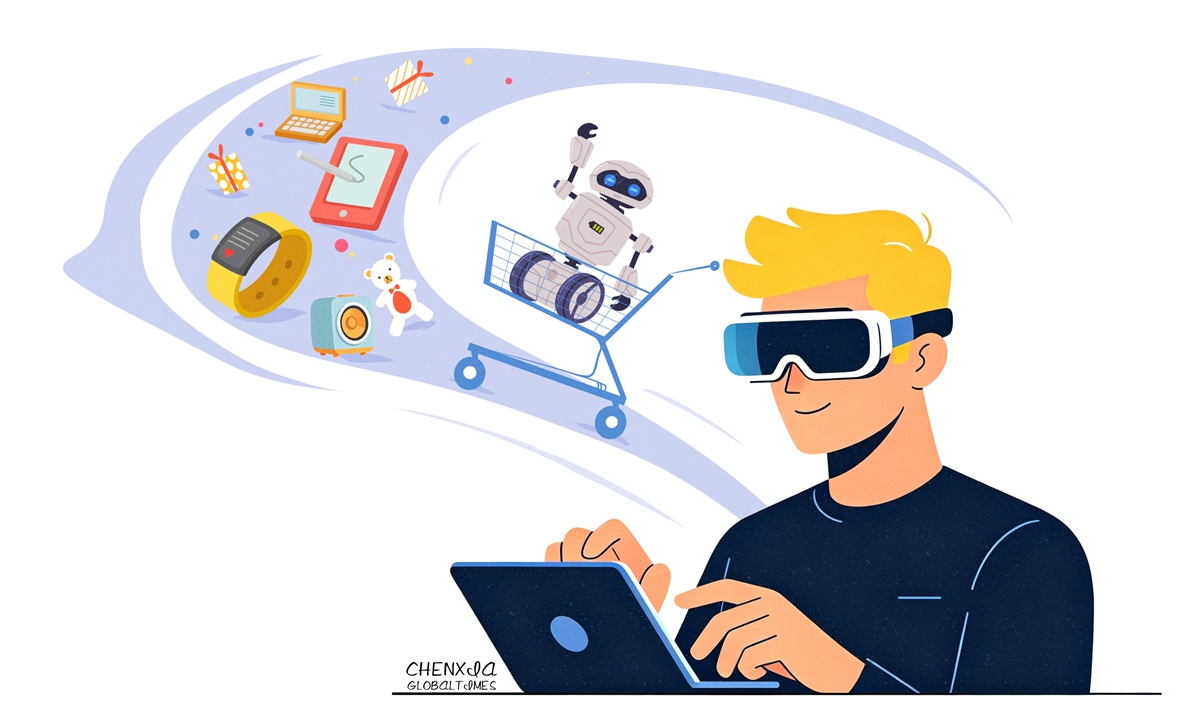
The second batch of the "AI eight rising stars" - a ranking of AI hardware products released by Huaqiangbei - made its debut on the eve of the May Day holidays. The products cover AI categories such as glasses, robots, cameras, earphones, and musical instruments. Data from the official WeChat account of Futian district showed that during the May Day holidays, sales of categories related to the second "AI eight rising stars" list surged by more than 50 percent year-on-year.
In recent years, with the rise of emerging sectors such as AI, many merchants in Huaqiangbei have seized the opportunity by offering AI-customized toys. The market is gradually moving from primarily selling conventional products such as mobile phones toward providing AI-oriented customization services. This evolution reflects how Huaqiangbei is developing its industrial chain through open-source design and intelligent manufacturing, creating new areas of competitiveness.
Huaqiangbei is by no means the only example. Yiwu, East China's Zhejiang Province, is seeing steady growth in AI toys and other AI-related products. Last month, Yiwu Shangbao newspaper reported that the number of foreign merchants in Yiwu has exceeded 30,000 per day on average this year, while daily foot traffic at the International Trade City in Yiwu has surpassed 230,000 visits.
Foreign buyers' presence reflects a genuine, market-driven engagement with Chinese AI goods. It underscores the commercial opportunities arising from China's technological development and demonstrates how international traders engage with the country's emerging AI capabilities.
China's AI development is creating tangible commercial benefits that attract international traders. These technological advances are increasingly complemented by other strengths, including a well-established industrial chain and the broader advantages of Chinese manufacturing. While some Western policymakers continue to view China through a framework focusing on alleged overcapacity, Chinese products have advanced through sustained innovation and the integration of industrial expertise. The practical value generated by China's technology and manufacturing helps explain why international traders are willing to travel long distances to source Chinese AI products.
These developments occur within the broader context of China's efforts to expand high-level opening-up and foster mutually beneficial cooperation, providing a solid foundation for sustained international engagement. Such cooperation takes many forms, from international traders sourcing Chinese products to foreign companies investing in China. China's continued commitment to high-level opening-up creates considerable space for these interactions to grow, supporting more diverse forms of collaboration.
AI is advancing rapidly across the globe and, in many ways, signals the direction of industrial development. It is generating a wide range of opportunities. The activity at Huaqiangbei reflects the emergence of new opportunities and the engagement of international traders. It provides an example of how advances in cutting-edge AI technologies can support mutually beneficial cooperation. Recognizing the reciprocal nature of AI development and the opportunities it creates can allow a broader range of participants to share in its benefits.
The author is a reporter with the Global Times. bizopinion@globaltimes.com.cn
RELATED ARTICLES