Illustration: Liu Rui/GT
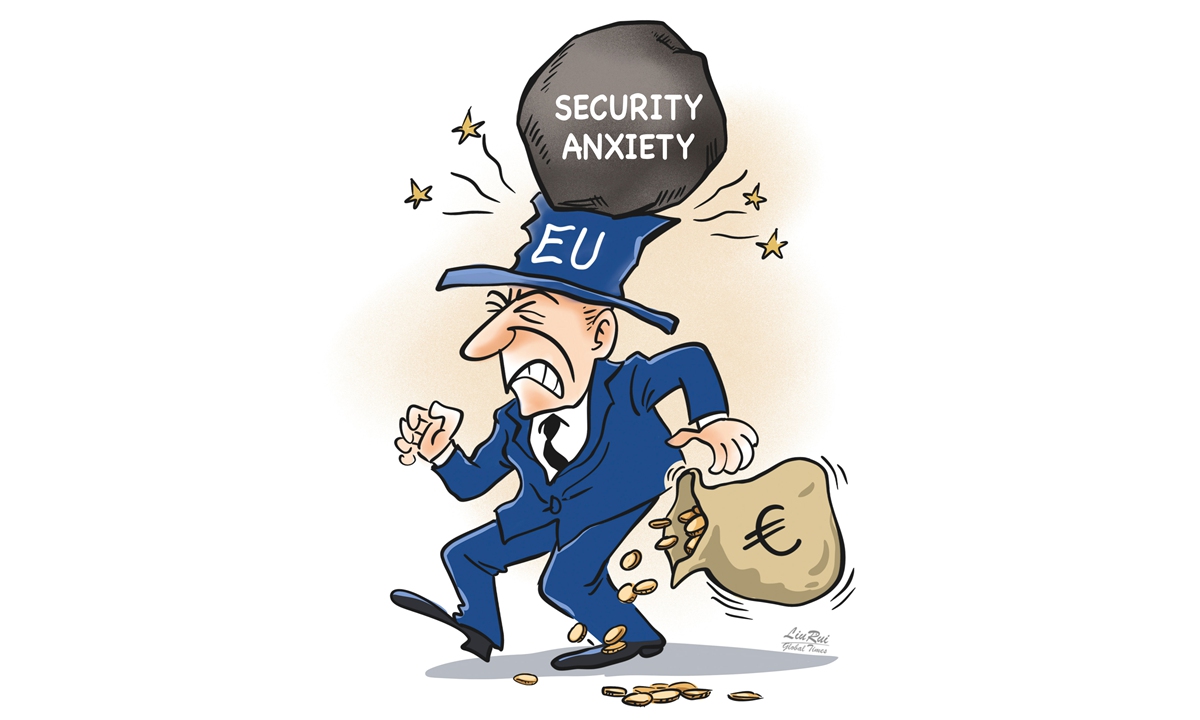
The EU has been rapidly pushing for a revision of its Cybersecurity Act (CSA), claiming that it aims to reduce "risks" in the EU's ICT supply chain from "third-country suppliers with cybersecurity concerns." Although Brussels has not explicitly singled out China, foreign media reports suggest that the primary targets are Chinese suppliers. Some observers note that the move stems more from politically charged "security anxiety" than from legitimate concerns.
Crucially, such "security anxiety" could translate into substantial economic costs for the EU. According to a new report, forced replacement of Chinese suppliers across 18 critical sectors could cost the EU as much as 367.8 billion euros ($431.5 billion) over the next five years. Of that amount, the direct losses of dismantling and replacing large volumes of Chinese hardware alone could reach 146.2 billion euros ($171 billion).
The report, jointly released Wednesday by the China Chamber of Commerce to the EU (CCCEU) and KPMG, not only revealed the hefty cost of the EU's move, but also demonstrated how difficult it would be to artificially sever deeply intertwined digital infrastructure and supply chains built over decades.
"The EU is essentially trying, for so-called political and security reasons, to artificially alter a relationship of interdependence formed through decades of economic cooperation. This is a typical practice of politicizing trade issues and overstretching the concept of security," Zhao Junjie, a senior research fellow at the Institute of European Studies at the Chinese Academy of Social Sciences, told the Global Times.
The costs will not remain confined to policy papers - they will be transmitted directly into various aspects of the EU economy and society. The report notes that the impact of mandatory supplier replacement would not be confined to telecommunications equipment, but would spread through network systems, supply-chain coordination, public services, financial infrastructure and research and innovation systems, creating cross-sector and cross-departmental costs. Key industries including energy, telecommunications, financial infrastructure, logistics and manufacturing are likely to face mounting pressure, according to
The EU economy is already grappling with sluggish growth, the lingering effects of an energy crisis and declining industrial competitiveness. Against this backdrop, further increasing operating costs for businesses and broader social costs will force EU consumers, companies and public services alike to pay the price for politicized policymaking, further narrowing the room for economic recovery.
In many ways, the significance of this report lies in the fact that it "does the math" for the EU. Cui Hongjian, director of the Department of European Studies, China Institute of International Studies, told the Global Times, said that such cost assessments could help the public and EU member states better understand the real costs of the EU's protectionist policies.
The revision of the CSA is neither rational nor entirely realistic. According to the report, such restrictions would be difficult to implement and largely detached from industrial realities. When concrete industrial interests are involved, EU member states may not fully accept Brussels' requirements. Meanwhile, companies and markets that would ultimately bear the costs of these policies are also likely to seek ways to reduce expenses and mitigate risks.
Cybersecurity is a legitimate global concern, and the EU's desire to safeguard its network security is understandable. However, facts and prudence are key to addressing such concerns. There is no substantiated evidence to date of a "technical backdoor" or violation of EU cybersecurity rules by Chinese companies operating in the EU, according to the report.
The cooperation between China and Europe in telecommunications and digital infrastructure is not the result of one-sided dependence, but rather the outcome of long-term market choices and industrial collaboration. Chinese companies have become deeply involved in Europe's telecom network construction primarily because their technology, cost-efficiency and service capabilities have been recognized by the market - not because of any so-called "security infiltration."
Yet, the cost of the EU's protectionist move could be even greater when considering its broader impact on China-EU relations.
In April, China's Ministry of Commerce formally submitted comments to the European Commission regarding the proposal for revision of the CSA, warning that if the EU side insists on adopting this proposal and discriminates against Chinese companies, China would have to take corresponding countermeasures.
This latest report is once again a reminder to the EU that excessively politicizing and securitizing economic and trade issues will not automatically bring genuine security. On the contrary, if "security anxiety" continues to override economic rationality, the ultimate victim will most likely be the EU's own development prospect and global competitiveness.
RELATED ARTICLES